This article was part of FORUM+ vol. 33 no. 2, pp. 56-63
Elsewhere. A cross-contextual conversation
Clementine Butler-Gallie, Kwasi Darko, Luamba Muinga, Nisha Merit, LiLi 丽丽 Nacht, Sofía Steinvorth
“Take a walk in your local landscape. Capture an image. Write a reflection.” – A prompt is shared among the curatorial, digital network Continued Conversations…: a dispersed group of curators based in different geographies who have been meeting online over the past four years to converse on curatorial matters and experiment with collective writing formats. In response to the prompt, they initiate dialogue through individual reflections, playfully exploring how their experiences connect across borders and “continue the conversation.” These texts then merge into a co-written endnote – a gesture towards finding a collective voice.
Framed by the question “how do we learn from, and share across, different contexts?”, Elsewhere: A cross-contextual conversation weaves together situated texts and images gathered during each contributor’s individual walk, proposing an intertwined reading of time and place across the following pages. The resulting translocal topography operates as both performance and record, with an aim to trace the often-ephemeral intersections of conversation across geographical, political, and conceptual terrains.
“Maak een wandeling door je eigen omgeving. Maak een foto. Schrijf een reflectie.” – Deze opdracht wordt gedeeld binnen het curatoriale, digitale netwerk Continued Conversations…: een gespreide groep curatoren uit verschillende regio’s die elkaar de afgelopen vier jaar online hebben ontmoet om te praten over curatoriale kwesties en te experimenteren met collectieve schrijfvormen. In reactie op de opdracht gaan ze een dialoog aan via individuele reflecties, waarbij ze op speelse wijze onderzoeken hoe hun ervaringen over grenzen heen met elkaar verbonden zijn en “het gesprek voortzetten”. Deze teksten vloeien vervolgens samen tot een gezamenlijk geschreven slotnoot – een gebaar in de richting van het vinden van een collectieve stem.
Met als uitgangspunt de vraag “hoe leren we van verschillende contexten en delen we deze met elkaar?”, verweeft Elsewhere: A cross-contextual conversation gesitueerde teksten en beelden die tijdens de individuele wandeling van elke bijdragende auteur zijn verzameld, en stelt zo in wat volgt een verweven lezing van tijd en plaats voor. De resulterende translokale topografie fungeert zowel als performance als verslag, met als doel de vaak vluchtige raakvlakken van gesprekken over geografische, politieke en conceptuele terreinen heen in kaart te brengen.

a body of water. Photo by LiLi 丽丽 Nacht
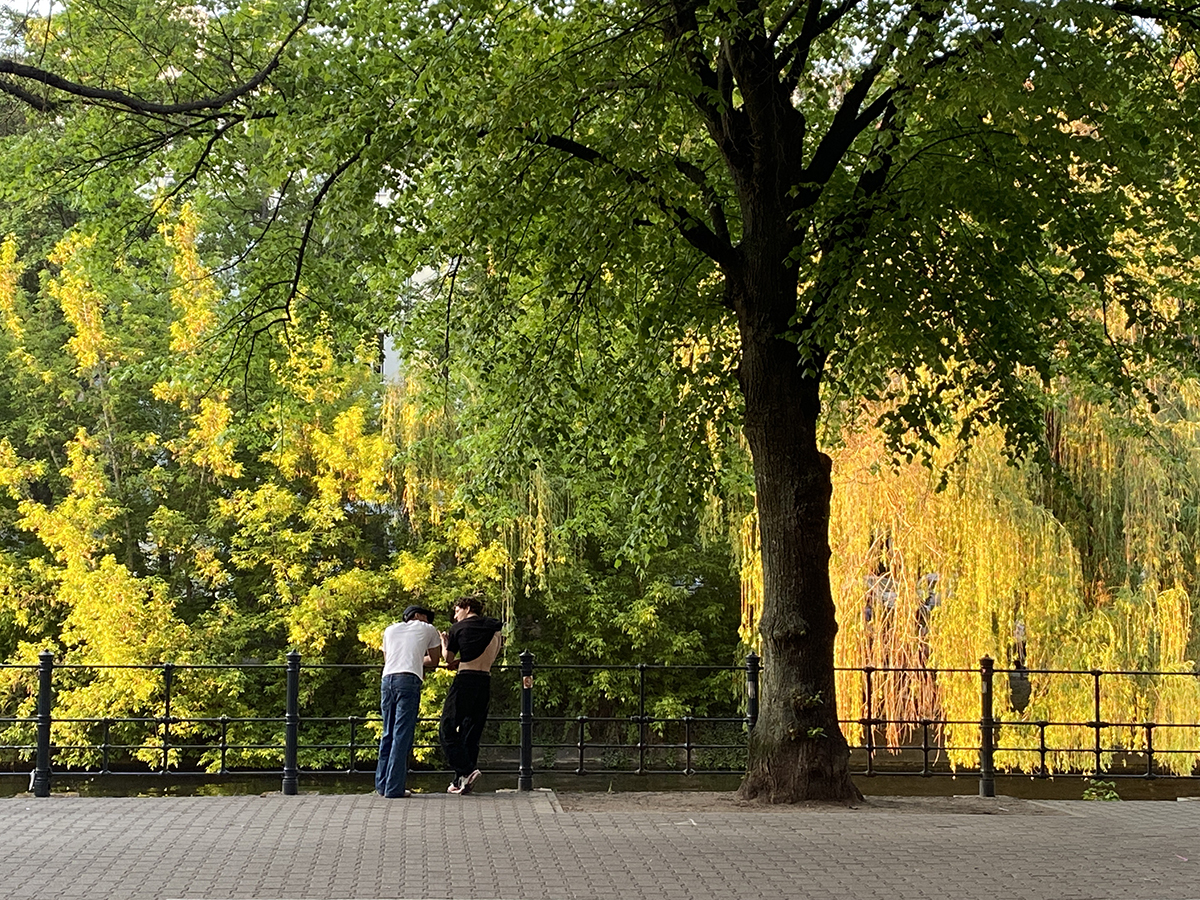
between us, 2025, photograph. Photo by LiLi 丽丽 Nacht.
In 2012, two members of the Harvard Generalists set the world record for the longest conversation by phone: 46 hours, 12 minutes, and 52 seconds.1 They did so under strict rules – no more than ten seconds of silence, only a five-minute break each hour. This staged conversation was framed as an art performance.
Conversation is an art form, with its own architecture. Even the most staged conversations hold space for potential dead-ends, detours, and continuation. How does this architecture shift depending on setting? Conversing across a table can create a barrier for some, for others a comfortable divide. Video-call is at once creating contact whilst maintaining distance. And what about a conversation in-motion, walking side by side? Silences may feel softer, ideas meander, and tangents emerge more freely.
Whilst walking and thinking about conversations, a desire path emerged ahead of me – an unofficial trail formed by people choosing their own rather than prescribed routes. They aren’t pre-planned reroutes, rather in-the-moment responses to curiosity or necessity. In this collective work, the desire path could be taken as both metaphor and method, using walking-writing to explore how curatorial routes emerge through shared conversation rather than pre-defined frameworks. When two desire paths cross do they form a node of exchange or a collision? Perhaps this text is an example of six desire paths crossing, with moments of collision necessary for a fulfilment of the intended exchange.
Text by Clementine Butler-Gallie
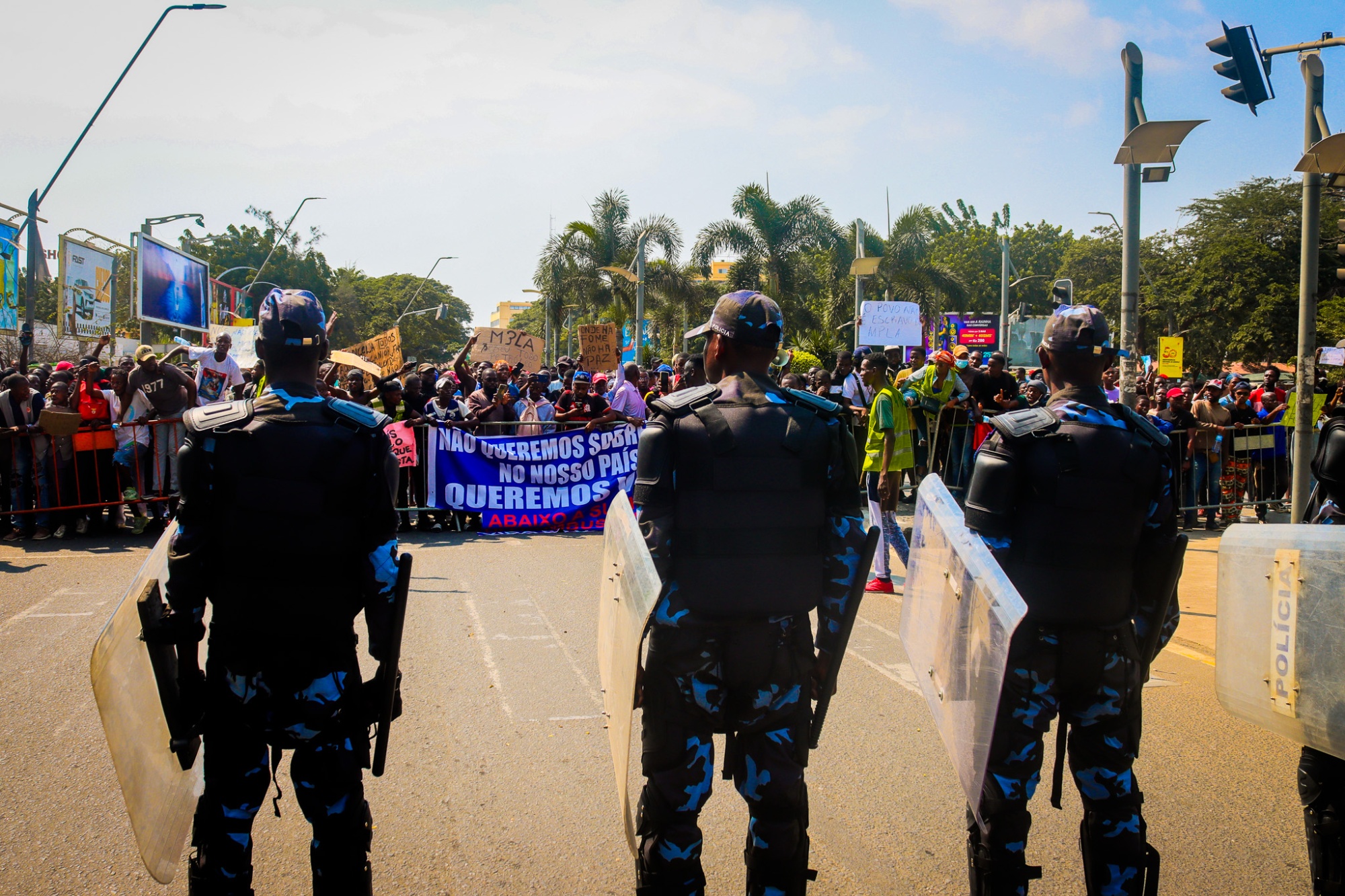
Walking Confrontations, 2025, photograph. Photo by Luamba Muinga.
Let’s have an imbizo this morning, Khensani says.
A gathering of all to solve communal issues.
Zulu.
Ubuntu.
Not the same in schematics but it carries the same spirit.
Or Kple.2 Word.
Fon. People
Benin Grand Popo.
Together with.
Or just together
To-gether
To-gather
Side by side.
In fellowship.
In conversation.
Text by Kwasi Darko

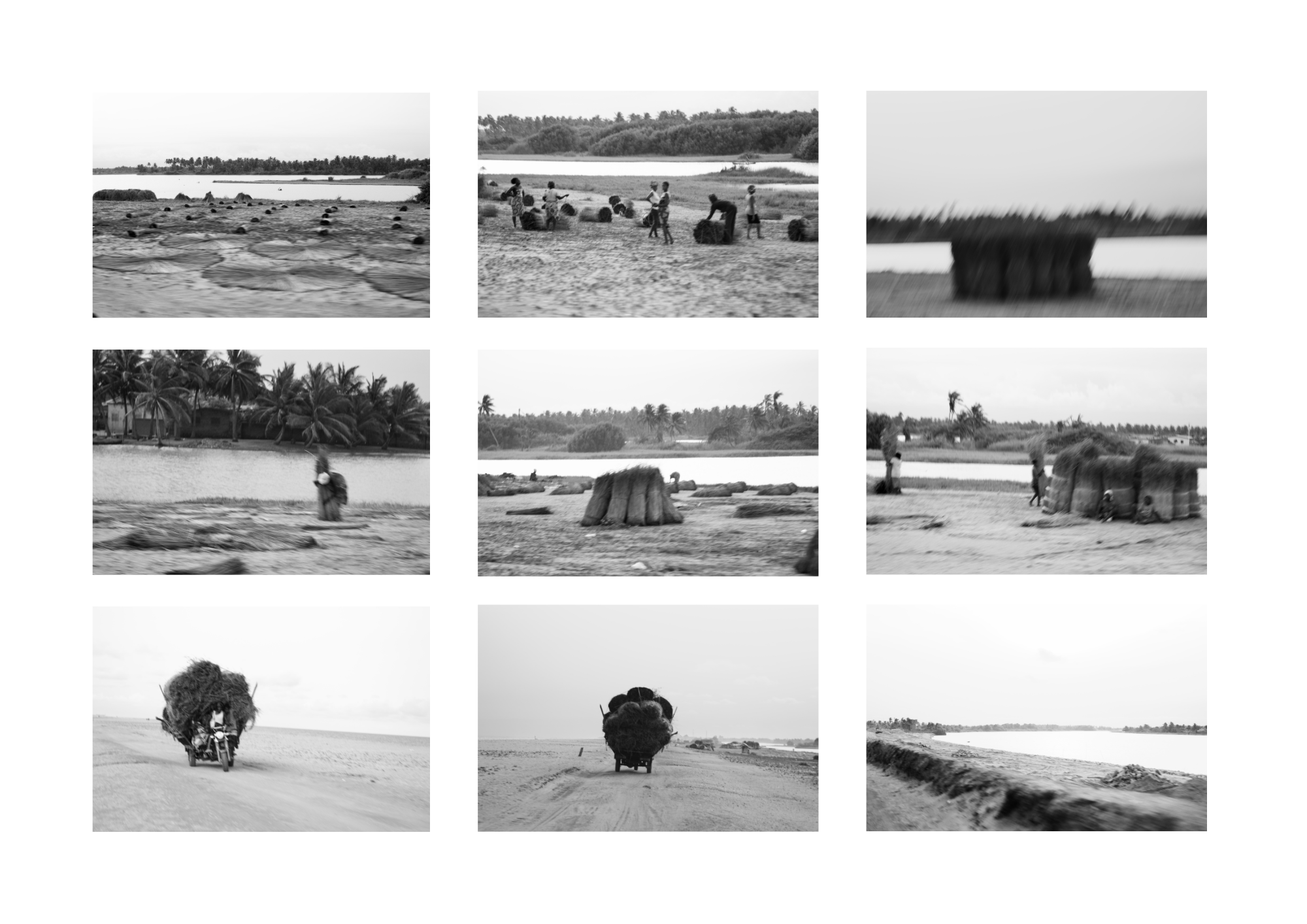
Tɔgbɔ // Together, 2025, Canon DSLR photograph. Photo by Kwasi Darko.
Bodies of water are sites for connection
Shore to shore
Water is a magnet, a gathering place
Friend to friend
A body of water, a continuous invitation for connection, a conversation.
The Maybachufer Canal holds the pulse of the city of Berlin. Since April, I’ve watched the city shed its winter skin tentatively, like an animal learning to trust warmth again. In German, the term “Frühlingsmüdigkeit” describes the tiredness one feels during the spring months – not the exhaustion of labour, but the deep fatigue that comes from transformation, from cells remembering how to reach toward light. As I take my daily walk along the water, I too ebb and flow. Sometimes wishing to remain dormant in the safety of winters numbness, and at other times, feeling particularly alive. Sometimes angry at the state of the world, and at other times, simply grateful to exist here, now.
It is a necessity to create in these times.
On an unusually warm spring evening, the kind of day where the air molecules churn faster, thick with the promise of summer, I took a walk along the canal. When I think of an ongoing conversation, I think of the slow, gradual flowing of time, an amorphous communion that exists somewhat like a body of water. Moving through the seasons. A continuous invitation for connection. A series of thoughts spanning years.
Water doesn’t think about when was the last time it followed up.
It simply exists, and flows in between
City to city
Text by LiLi 丽丽 Nacht

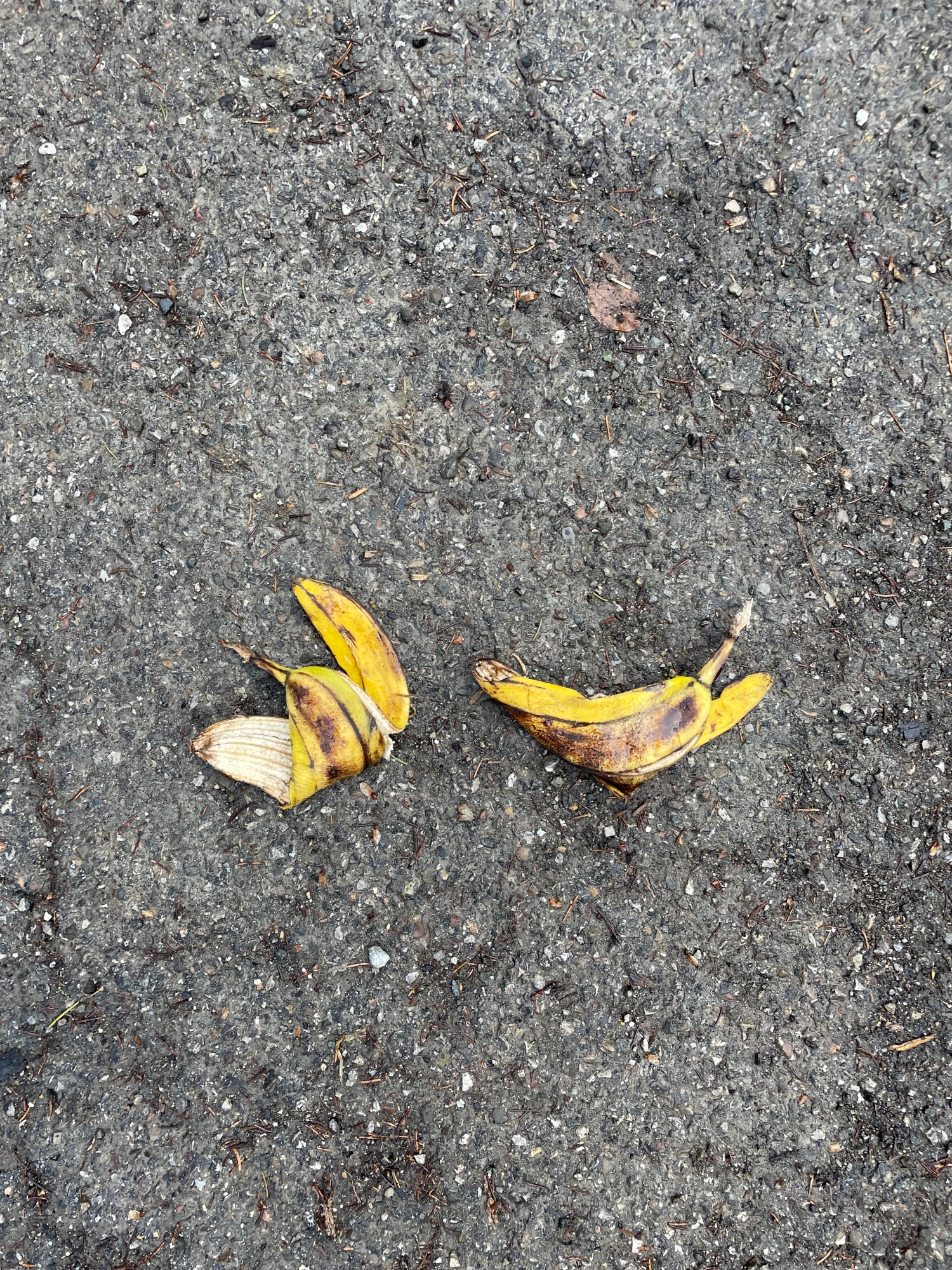
bananas on an unnamed junction, pointing north-south, 2025, photograph. Photo by Nisha Merit.
Two years ago in Lisbon, I joined Os Passos em Volta – Alcântara [The Steps Around – Alcântara], a performative walk conceptualized by Joana Braga and Diogo Alvim to interrogate and reconfigure our relationship with the city’s rhythms and spatial uses.3 At the time, I was particularly struck by the archival photographs of the now-buried Alkantara river – an experience I carried with me to where I walk today. São Paulo is a city known for its colossality and for a horizon made up of high-rise concrete buildings. Yet not too long ago, it was a place of valleys, hills, and floodplains irrigated by hundreds of rivers, springs, and streams4 – a characteristic, I would later find out, shared with many other large cities.
As I took my first walks, I started noticing recurring stencil inscriptions that, like X-rays, pointed to the presence of these waters beneath the concrete that now buries them. Looking at images of the city, never would I have imagined that water has such a strong presence in this territory, nor that one of the most visceral experiences of being here would be the foul smell of its dead rivers. If “Tietê” means “crystal clear waters”, today the river’s name is no more than a reminder of what used to be and has become nearly unimaginable.
I learned about this meaning with Carlos Papá during a series of encounters organized by Selvagem5 at Casa do Povo, an independent cultural centre in central São Paulo, where walking and listening have been employed not only as relational practices, but as critical curatorial methodologies for engaging with the immediate surroundings of the Bom Retiro neighbourhood, its inhabitants and other, more-than-human presences. As antidotes to the silence and odourlessness of images, to engage all the senses. As a way of connecting by placing the body – and our presence, at disposal.
Do you want to go for a walk?
Text by Sofía Steinvorth

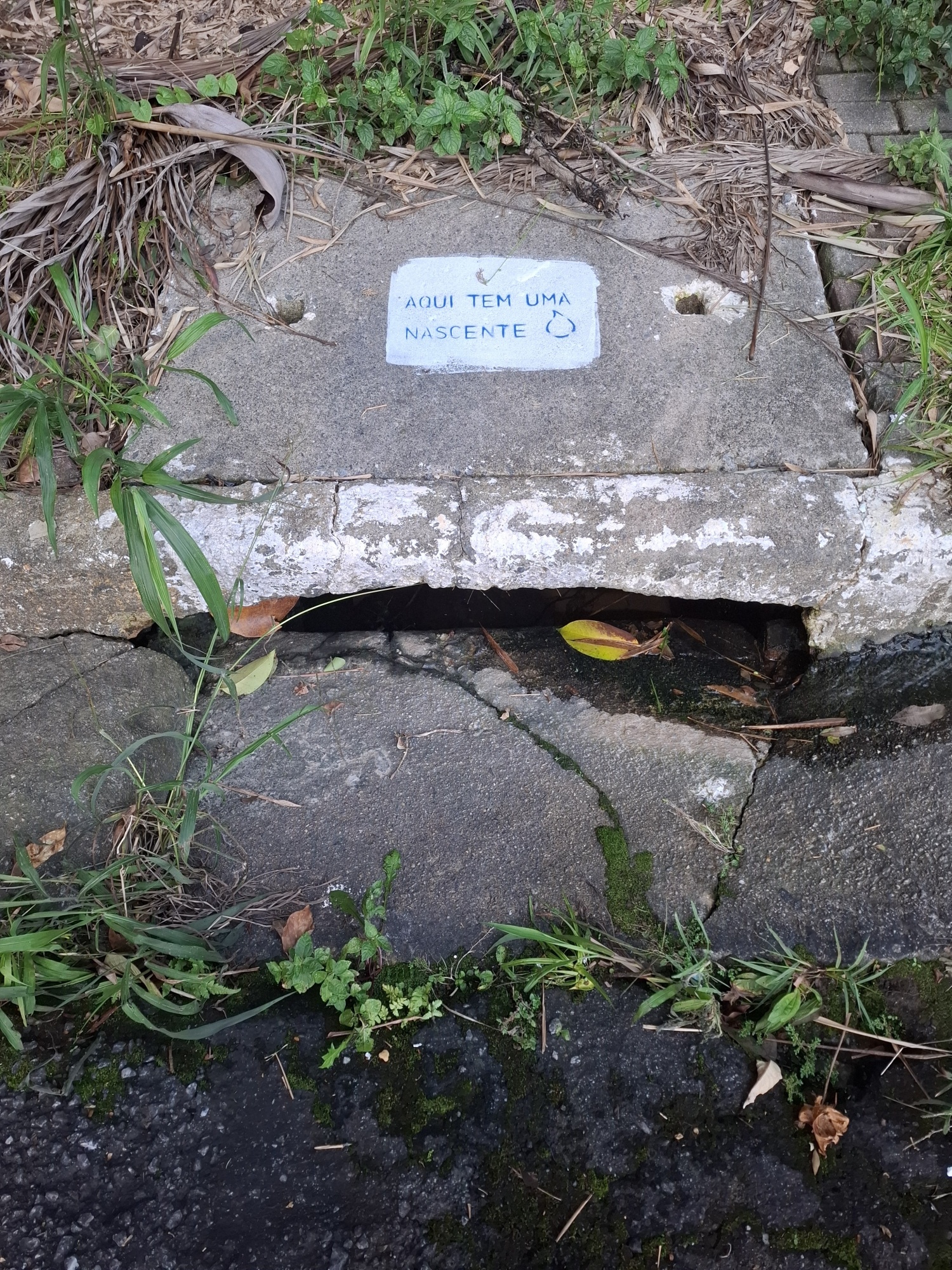
Aqui tem uma nascente I [There’s a spring here I], 2025, Samsung Galaxy photograph. Photo by Sofía Steinvorth.
![<p><em>Aqui tem uma nascente II</em> [There’s a spring here II], 2025, Samsung Galaxy photograph. Photo by Sofía Steinvorth.</p>](https://forum-online.be/media/pages/nummers/oktober-2026/elsewhere/3ef167fb53-1789484546/fig6_-1.jpg)
Aqui tem uma nascente II [There’s a spring here II], 2025, Samsung Galaxy photograph. Photo by Sofía Steinvorth.
![<p><em>Aqui tem uma nascente III </em>[There’s a spring here III], 2025, Samsung Galaxy photograph. Photo by Sofía Steinvorth.</p>](https://forum-online.be/media/pages/nummers/oktober-2026/elsewhere/f008ea11ca-1789484546/fig7_-1.jpg)
Aqui tem uma nascente III [There’s a spring here III], 2025, Samsung Galaxy photograph. Photo by Sofía Steinvorth.
I recently learned a new word – ventriloquism. An auditory illusion, performed by the nightjar during its mating chanson. To deceive predators it makes sounds that seem to come from a different direction than where the bird is actually located. It made me wonder about the origin of things. About the obsession to locate, attribute, and specify. Not what has been experienced, but who, what, and where from.
Is it possible to generate from a multitude? From a place of ventriloquism? Also recently, I find myself walking through the countryside. None of the paths leading through fields, forests, and hills have names, numbers, or any signifiers of historical or contemporary markers – other than being transitional. Of course, nothing I see is “wild”, it all has been created, cultivated for a purpose. Yet no measures of place or ownership we have invented are used here.
No map has taken notice, the path exists only when you are there – like a not-no-place. The digital spaces we use to exchange and gather have this transitional quality too – though dispersed physically, our IP addresses all point towards the same digital point whenever we meet – we extend ourselves, perform a collective space we create, share, and landscape. A not-no-place that only exists when we are there. When we meet – ventriloquist.
The relational situatedness of being in the world is something we cannot escape. However many devices we have, the body remains the terrain, but sometimes we can perform a ventriloquist dance somewhere on an unnamed path – being neither here nor there.
Text by Nisha Merit

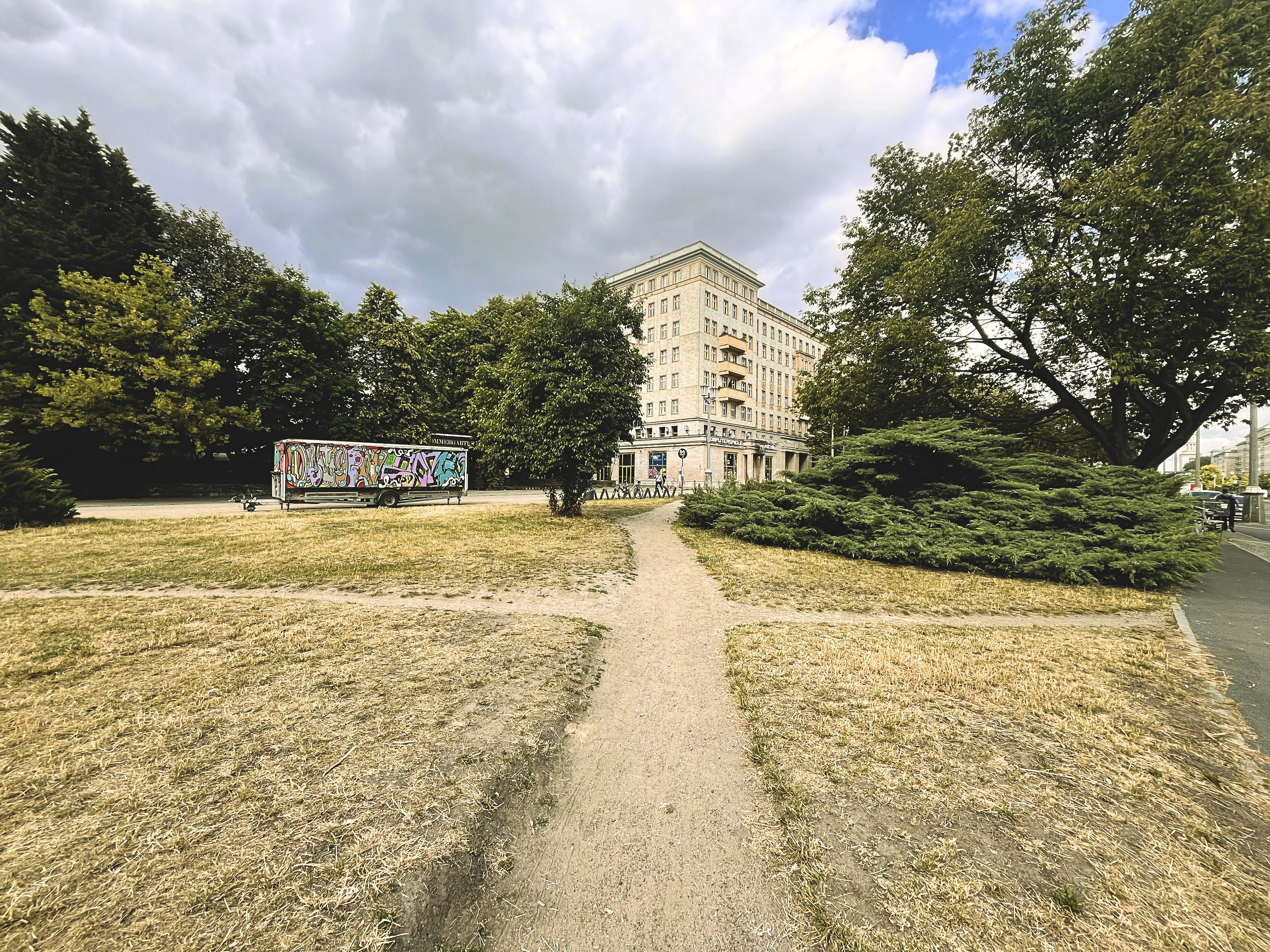
Desires Crossing, 2025, photograph. Photo by Clementine Butler-Gallie.
On a recent Saturday afternoon, I walked through Luanda. It wasn’t a solitary walk, nor perhaps one designed to be conceptualized, but rather one that unfolded naturally.
Marching is a choreography of desire.
After all, I was in the middle of a protest, and people were walking together so as not to walk. The Angolan government had increased public transportation fares, and the population’s greatest fear was that no one would be able to use public transportation again, and perhaps that would mean long, solitary, and unconceptualized walks for their daily needs.
I used to use the word “serendipitous” quite often, some time ago. That day I might use it again; after all, it’s still sometimes said that you see people walking to protest in Luanda, and as informed as I was, I hadn’t known that I’d find myself in that company.
In the midst of this, something caught my attention: a man with the Angolan flag in the middle of the crowd. I photographed him. Then I photographed the entire crowd, and the desire to photograph everything led me to walk along on this serendipitous walk.
“Marching is a choreography of desire,” I read somewhere, I can’t remember where. And this time it made perfect sense. And I’d add that marching is always a conceptualized act. In the case of a demonstration, the desire and the concept are in the posters, the chants of revolt, and the speeches. And there’s a lot of performance in all of this too: the steps are controlled, the route is defined with purpose, and the words follow a form.
I’ll summarize quickly: That march was interrupted by brutality. The police controlled the walkers’ steps, cut off the route, and were bothered by the form of the words. The crowd dispersed, the right to the city was nullified, and the desire to walk was suppressed.
On that day, words weren’t enough.
But walking, even interrupted, is also a way of speaking.
Text by Luamba Muinga
Collective endnote:
Continued Conversations was initiated as an online curatorial platform where curators across different geographies could regularly meet to informally exchange around their profession, after the project’s co-founders, Luamba Muinga and Clementine Butler-Gallie were paired up for a three-month German residency programme.6 After the official residency period came to an end, both curators felt that they still had a great deal still to discuss and the wish to continue the conversation emerged. The foundation of the self-organized, online, curatorial exchange platform Continued Conversations… followed to give form to this shared desire, inviting others to join in.
Butler-Gallie is based in Berlin and Muinga is based in Luanda, so their networks stretch across the globe, and the initiative keeps on growing organically, disseminated mainly via word of mouth. The contributors to this article have been active participants since the early stages of the project, which started out as an experiment among virtual strangers and now looks back on four years of sustained exchanges.
After a first collective writing exercise entitled Unfolding Notes on Curatorial Solidarity for textur magazine,7 in which Continued Conversations… hosted an anonymized, spontaneous writing exercise through a shared Google Doc as a method to express a collective thought, this was the second occasion that the group wrote together. Previously, varying font colours and styles marked different temporalities and interventions in the text, letting participants contribute asynchronously across time zones. This time, each contributor’s text remains an individual, situated reflection. Yet, from each text, we extracted a few keywords to compose a thread of words that flow through the content of the different pages, connecting and thus defying what seem to be distant lived experiences.
In addition to this, the images each author took on their walks are not presented alongside the respective texts, but dislocated from their original context, contributing to a translocal topography through which images and texts from different places are juxtaposed and together create an elsewhere or what Homi Bhabha has called a “third space”.8 The idea of the “third space” or elsewhere emerges whenever different histories, languages, or identities come into contact. It is not a stable environment, nor a synthesis that resolves into a conclusion. Rather, it is a generative interval, a space of ambiguity where new forms of understanding become possible precisely because certainty breaks down. Here, meaning does not belong fully to one voice or another; it arises in the act of each encounter. In other words, knowledge is not “here”, nor “there”, but elsewhere; somewhere in between texts, images, and conversations, where we meet the other, in a space we can never fully grasp but constantly search for.
Starting from different places and contexts, we set out to do the same thing: take a walk as a means to begin a conversation. This simple action evolved into a dialogue between ourselves and our environments, leading to close observations, which produced insights on larger, overlapping topics such as what lies beneath surfaces, serendipity, communication beyond language, the role of water in geographies, liminal and transitional spaces, and gathering as a form of resistance. These themes were not set out in advance, as can often be the case with research practices, but rather emerged through the collective motion and the piecing together of individual insights. As each text and image was shared within the group, these separate thoughts and places started overlapping and entering into a dialogue with each other. Together, they form a meandering reply to the question of what emerges when we allow ourselves space and time for observation, and in turn, how this helps inform the process of unconstrained conversation-making in relation to curatorial practice – an ongoing exploration that lies at the heart of the Continued Conversations… network.
Returning to the initial question of “how do we learn from, and share across, different contexts?”, the outcome of this exercise does not perhaps provide any direct response, but rather opens up new paths of desire that lead us on further in a collective reflection of the question. In conclusion, by knowing that individual experiences will be shared amongst the group, the intention of close looking at something one might be familiar with, yet others might not, created a larger spectrum of observation, language and newness. New nodes of knowledge can then be made in the collective sharing and conscious rearranging between text and visual materials.
+++
The text is co-authored by a constellation of curators/artists within the framework of Continued Conversations…, a collective conversation group on curatorial matters, that began in 2022 and is ongoing. Contributors include:
Clementine Butler-Gallie (Berlin)
is a curator whose work is interested in nonmaterial, dialogue-based, and socially engaged artistic practices. Her ongoing research into walking as a curatorial space is practiced through The ReRouting Project, which she founded in 2023.
Kwasi Darko (Accra)
is a Ghanaian multidisciplinary artist and curator. His own lived experiences and community form the basis of his practice in themes and approach. His work centres communal and personal local stories told using various media including image making, digital tools, and site-specific installations.
Luamba Muinga (Luanda)
is a curator, researcher, and writer. His practice is centred on re-examining history and the permanence of memory, exploring how we appropriate the past and extract its context to locate it in the present. He coordinates LabCC – Laboratório de Crítica e Curadoria, an art platform in Luanda that facilitates the practice of young curators and art educators.
Nisha Merit (Johannesburg/Berlin)
is a curator and writer of the in-betweens. Focused on process, granularity, and systems, she works on creating moments to share in situ or distributed through print – it is all about the nodes and encounters.
LiLi 丽丽 Nacht (Tennessee/Berlin)
is an artist, curator and educator. Her work engages with social practice, creating opportunities for people to gather and explore the tensions between chosen versus inherited identities, reimagine historical narratives, and foster collective unlearning.
Sofía Steinvorth (Lisbon/São Paulo)
is a curator and researcher interested in experimental approaches to curating and mediating that bring the city and its inhabitants into closer contact with art and its infrastructures in everyday life. Her research focuses on independent art institutions, collective practices, and translocal networks.
Footnotes
- Haber, Matt. “The Generalist.” The Harvard Crimson, 31 Jan. 2012. thecrimson.com/article/2012/1/31/generalist-art-group. Accessed 26 Aug. 2025. ↩
- “Kple”. Fon Language, Benin, meaning “Spirit”. ↩
- “Temps d’images.” Duplacena, duplacena.com/tdi-2023-momento-i/os-passos-em-volta. Accessed 16 Aug. 2025. ↩
- Rolnik, Raquel. São Paulo: o planejamento da desigualdade. São Paulo, Fósforo, 2022. ↩
- Selvagem is a non-governmental organization that involves a cycle of studies on life, the Indigenous movement of Escolas Vivas (Living Schools) and a collaborative network focused on learning and translations between worlds. Since 2018, Selvagem has been dedicated to studying, sharing, recording and supporting Indigenous knowledge, composing dialogues between science and the arts. ↩
- The now defunct TURN2 curatorial residency programme organized by the German Federal Cultural Foundation in collaboration with ZK/U Berlin and the Triangle Network was implemented to foster research exchanges between practitioners in Germany and African countries, aiming to lay the groundwork for future international collaborative projects. ↩
- Butler-Gallie, Clementine et al. “Continued Conversations…”. Unfolding Notes on Curatorial Solidarity, textur magazine, issue 5, 2023, edited by Julianne Cordray and Sarie Nijboer, Berlin, textur. ↩
- Bhabha, Homi K. The Location of Culture. London and New York, Routledge, 1994. ↩
More from this theme
Once around the theatre. Walking as choreographic practice
Martin Nachbar
Between the written word and the stage
Kristof Van Baarle
More from this dossier
Rethinking biases. A polyphonic conversation about postcolonial blind spots in film
Liesje Baltussen, Steff Nellis
Photograve. A search for memory
Inne Eysermans, Ingrid Leonard, Katharina Smets
More from this edition
Conceptual, performative, personal: A curriculum
Yuki Okumura
AI in Motion. Embodied practices meet craft AI
Frederik De Bleser, Cèlia Tort Pujol, Myrthe Bokelmann, Lieven Menschaert
Mapping the Local. A collaborative pedagogical paradigm
Özgür Ilter, Allan Siegel