This article was part of FORUM+ vol. 33 no. 2, pp. 24-35
Making space for trust. Scores as scaffolds for shared risk
Simona Kicurovska
This article centres Synchronized Swimming, a situated experiment in which an artistic score – a set of open-ended prompts – served as a scaffold for embodied, sensory attunement, collective responsiveness, and shared risk. In the context of the increasing, often hidden use of AI in design education, scoring engages uncertainty as a space of possibility, countering dominant models of extraction and automation while sustaining conditions for trust and “response-ability”.
Dit artikel stelt Synchronized Swimming centraal, een gesitueerd experiment waarin een artistieke score – een reeks open instructies – diende als kader voor belichaamde, zintuiglijke en collectieve afstemming en gedeeld risico. In de context van het toenemende, vaak onzichtbare gebruik van AI in het ontwerponderwijs wordt het inzetten van de score voorgesteld als alternatief voor gangbare benaderingen die gericht zijn op extractie en automatisering. Zo wordt er ruimte gecreëerd voor het collectief vertrouwen en ethische reflectie.
Background
The growing presence of AI in design education introduces automated processes that not only accelerate the creation of artistic work but increasingly participate in selection, evaluation and refinement of references used in the process. These systems formalize patterns derived from large datasets and externalize forms of decision-making that were previously internal, intuitive, and cultivated slowly through iterative practice. As a result, it becomes harder to trace how students make decisions and who is accountable for these, making it more difficult to sustain the trust that learning environments depend on. In the classroom, students often use AI tools covertly, with the risk of little or no reflection or discussion, raising pedagogical and ethical concerns around authorship, transparency, and the conditions under which judgement is or can be formed.
As a designer and lecturer, my practice-led research in graphic design, where insights emerge through iterative, situated doing, begins with a provocation: if AI can now replicate much of what designers are trained to do, what else calls for our attention and our teaching? As AI masters much of what graphic design students have traditionally been trained to do, new questions emerge around what resists algorithmic execution. This requires identifying the irreplaceable and hard-to-control dimensions of design work: relationships between designers, their judgment and its relation to agency, ethical reasoning about ostensibly small decisions with profound impact, and the capacity to navigate ambiguity, which, even though intrinsically entangled with their automated tools, still makes designers accountable, or evokes entirely new questions about accountability.
Research such as Melani de Luca’s PhD project Steve: A Framework for Identity Design (2024) demonstrates how machine learning tools are already integrated into professional identity design workflows, often augmenting designers’ decision-making capacities. Yet this augmentation is asymmetrical: experienced designers benefit differently from such systems than novices do. Designers who have already internalized criteria through years of practice can judge outputs, sensing when something is “off”. Students who are still forming these criteria risk relying on systems that simulate competence without cultivating the slow development of judgement.
In design education this distinction matters. Judgement is not treated as an individual cognitive skill but emerges in situated, often collective processes of making, testing, discussing, and revising. If students can generate competent visual solutions without developing deep technical or material knowledge, what becomes of the iterative struggle through which designers traditionally develop judgment? How do we train them to cultivate a critical eye without the experience of failed attempts, material constraints, and the slow refinement of craft? More profoundly, AI challenges the cultivation of agency within design practice and education. Agency emerges from the capacity to make informed decisions, born in understanding constraints, recognizing implications, and accepting responsibility for outcomes. Currently, this decision-making process becomes narrowed, resulting in a shift of the locus of agency. This puts designers at risk of becoming evaluators and refiners of output, rather than originators of ideas formed through embodied and relational engagement.
At the time of writing, art academies in the Netherlands are actively negotiating how to articulate boundaries surrounding AI use: permitting it as creative tool when its use is made explicit and critically reflected upon, while classifying unacknowledged or uncritical use as plagiarism. This closely relates to the urgency of renewed imaginaries of trust. In general, trust is earned through demonstrated competence – the visible evidence of skill, judgment, and reliability accumulated over time. Trust is commonly framed as a predictable outcome of feedback loops or as a function of reliability guarantees. But when technical competence can be artificially augmented or entirely simulated, the signals that establish trust become unreliable. This requires us to rethink trust as the outcome of a generative, relational process that unfolds between design students, educators, automated systems, institutional frameworks, and the material conditions of practice.
Thus, the growing presence of AI in design education raises urgent questions about accountability. This article highlights that design education carries ethical weight – decisions about representation, accessibility, persuasion, and resource allocation have real consequences for real people. Yet accountability depends on transparent causation: understanding why a decision was made, who made it, and what values informed it. When AI generates solutions through processes that remain opaque even to their designers, accountability becomes diffuse. Who bears responsibility in a context where tracing and assigning responsibilities has become nearly impossible?
That question prompted me to carry out a critical re-examination of the assumptions underpinning design education. This connected my enquiry to a broader discourse across design research and HCI (Human-computer interaction) communities, as AI and machine learning began fundamentally challenging the conceptual space designers had created to cope with complexity.1 As a researcher positioned at the intersection of design practice, education and practice-led research, I approach this research from these vantage points simultaneously. The questions: “What kind of changes for design practices does AI bring? What are the effects and consequences of these changes for the design profession? for the design classroom? for design discourse?” continuously pull at each other, with insights oscillating between contexts. More recently, this discourse has extended into design schools and dedicated pedagogical research.2 It foregrounds what intelligence itself might mean beyond human-centric and output-driven definitions and what that means for how agency, accountability, and trust are cultivated within design education.
The answers probably lie in redirecting attention toward what remains irreducibly human: the capacity for contextual interpretation, ethical reasoning in ambiguous situations, sensitivity that transcends pattern recognition, the ability to build genuine relationships with stakeholders and negotiate values, and the critical judgment to question both human and machine-generated solutions. Design education needs new ways to move from teaching students what to do toward teaching them how to think, how to question, how to navigate complexity, and how to remain accountable actors in interaction with the non-human, increasingly automated creative landscape. Thus, the question central to this article is: Which pedagogical-ethical strategies might support critical, situated forms of design, where values – what matters to whom, to what, why, and where – are co-produced by human and non-human participants in relational, generative spaces of continuously shifting design practices?
What follows arises directly from engaging with these questions in (pedagogical) practice. This article traces an unfolding enquiry, rooted in co-creative encounters in which trust is generated slowly and relationally, through bodies and materials that share time and space. These situations are marked by ambiguity and indeterminacy and require trust to be felt and called forth rather than prescribed. I turn to posthuman theory and care ethics in search of alternatives to transactional models of trust and in doing so, situate trust as a generative practice of care within entangled relations that include students, teachers, and tools.
Positionality and framing
The article centres around one situated experiment – Synchronized Swimming – in which a score functioned as a scaffold for collective attunement and shared risk. The experiment took place during a hands-on symposium on not-knowing, organized by a temporary collective of artists and held in a rented space in the north of the Netherlands in 2022. The experiment was part of a day-long carefully shaped sequence of scored activities, each inviting participants to engage with the unknown as a condition to be inhabited collectively. Participants were self-selecting attendees of the event, drawn through the organizers’ artistic research networks as well as local outreach in the surrounding area. The session described here was facilitated by me in the dual role of early-stage PhD researcher and member of the organizing team. While embedded within a collaboratively structured programme, the segment was shaped by a specific research interest in the role of uncertainty, specifically in relation to algorithmic processes. At the same time, this experiment remained part of a broader co-created framework developed with others. The experiment thus operated both as a contribution to a collective event and as enquiry within an ongoing doctoral trajectory. Participation in the session was voluntary and non-evaluative; no assessment criteria or predetermined outcomes were attached to the activity. Engagement with the score was the only shared commitment. The conditions of the session were framed by me as facilitator, even as its unfolding depended on the responses and interpretations of participants. What follows, therefore, offers one situated perspective within a collectively generated event – an account that recognizes both the shared production of the experience and the uneven distribution of framing, responsibility, and authorship that structured it.
Drawing from traditions of experimental notation, the score is understood as a set of open-ended instructions that guide action.3 Crucially, the score does not determine its outcome in advance. In the project, it structured action while leaving space for interpretation, attunement, and variation in its enactment. It served as a framework for collaborative navigation to enquire how trust in the unknown is generated, grounded in a relational accountability that did not emerge from individual authorship or technical control, but from mutual commitment to remain present and responsive within shared constraints. The experiment taught me that trust emerges through a shared orientation to vulnerability – the willingness to make moves without predetermined outcomes, to depend on others’ interpretation, to accept that coherence will emerge collectively. The score became a mechanism for distributing agency across participants while renegotiating responsibility, creating conditions where attunement to others became a practice of care.
The insights from this experimental approach point towards possible ways to cultivate designers capable of working meaningfully in algorithmically shaped contexts. Treating the experiment as a simulation of such conditions, I sketch a pedagogy of relational and ethical sensitivity. This pedagogy makes interdependence visible by attending to distributed agency and entangled structures, holds uncertainty as productive, and constructs accountability collectively rather than attributing it individually (as virtue or competence). I develop scoring as a method that enables collective sense-making and shared risk in design education. These capacities, I argue, are increasingly necessary in pedagogical contexts shaped by algorithmic logics. Scoring, I propose, offers an alternative to dominant models of extraction in service of automation.
Introduction
An empty swimming pool has been repurposed as the site of a collective experiment titled “Synchronized Swimming”. A group of participants engage with a series of open-ended instructions designed to guide shared exploration through physical movement, sensory awareness, and mutual attention. Prompts such as “scan the horizon,” “float,” and “point your toes like a ballerina” elicit tentative movements. Gradually, the participants move with greater ease, attuning to sensory cues and adjusting their gestures in response. Smiles flicker. Bodies swirl and improvise. People hold hands. Smaller groups begin to drift together. One group are making “waves” with their arms.
Then, a prompt “Thread lightly” is given. The participants pause and look around. (The thread referenced in the prompt has not yet been provided.) The collective movement halts. People glance at each other, then at me, the prompter. The previously attuned rhythm (temporarily) collapses. I switch to Dutch: “Er is draad” (“there is thread”), attempting to re-establish clarity and preserve the continuity of the collective engagement.4
This moment is significant because, although it involved a breakdown, it brought something unexpected to the surface. A fragile rhythm had formed and then faltered. A few things slipped simultaneously: the instruction that was deliberately opaque – the idiom “T(h)read lightly”, inviting a change of tempo towards slowness and care, was perhaps unfamiliar to participants navigating a language that is not their own, while the actual thread was not in place. Although the confusion was not entirely planned for, the moment marked a turning point, a shared suspension. The group wavered, paused, yet persisted. In retrospect, this gap, between instruction and interpretation, between intent and enactment, between “answered” and “lived”, is precisely the space that efficient, problem-solving systems are designed to foreclose. The moment revealed something about what becomes possible when that closure is resisted: a collective capacity to remain present, to read each other’s cues, to act without certainty. This is the threshold I am working towards as a design proposition. It raised questions I would carry forward: What made this moment and what followed possible? What kind of preparation had allowed the group of strangers to risk confusion together? What conditions needed to be in place and how might they be deliberately designed? The questions emerged from a specific practice and disciplinary formation. In what follows, I take that practice as my point of departure.
My academic and professional background is in graphic design, and I teach within a graphic design department, where image, typography, and media function as what Johanna Drucker calls “visual forms of knowledge production,”5 enabling critical engagement with how meaning is constructed and communicated across diverse (technical/media) formats and contexts. At the outset of my practice-led PhD research, this perspective offered an important entry point for engaging with emerging AI technologies in design, particularly through visual and media-theoretical analysis. However, the turning point described in the opening vignette exposed dynamics that exceeded this analytical frame. The fragile rhythm, permeability and subtle readjustment that unfolded in that moment were not primarily matters of representation, but of relation: of how participants oriented themselves toward uncertainty, toward one another and toward the conditions that made shared risk possible. As my research progressed, it became clear that analysing visual outputs alone was insufficient in addressing the questions that increasingly preoccupied my pedagogical practice. In both the collective experiment described in this article and in my teaching, what proved decisive was how judgement was formed. Judgement did not reside in an individual cognitive act but through situated and often collective processes of making, testing, discussing, hesitating and revising.
This understanding of judgement, as situated and collective rather than individual, redirected my attention toward processes of relational engagement as central to my practice. How can (teaching) design be viewed as a process of relational engagement? Donna Haraway’s notion of situated knowledge offers a productive framework for doing so, grounding relational engagement in an epistemological commitment to partiality, location and accountability; to materials, situations, and relations rather than through abstraction or “disembodied vision”.6 Designing became a practice-led enquiry in which judgement is formed through interaction with a situation, or what describes as “conversation with the materials of a situation.”7 Rather than positioning design solely as a site for analysing images and media systems, I began to approach my practice as the design of situations in which relations, responsibilities and forms of knowing emerge through collective engagement. This reorientation provides the methodological ground for engaging posthuman concepts in pedagogical practice.
Posthuman theory offers powerful concepts that prove generative for this enquiry, such as entanglement – the recognition that beings and technologies are constituted through their relations, and response-ability – the capacity to remain present and responsive within those relations. Rosi Braidotti’s articulation of the posthuman subject extends these commitments within an affirmative ethics grounded in relational becoming. In design research, scholars such as Ron Wakkary have begun to articulate how posthuman commitments reshape our understanding of design as a field of situated, plural and relational practices, drawing on epistemological reconceptualization of design by for example, Johan Redström.8 These contributions challenge humanist assumptions of disciplinary foundations and universal design principles, foregrounding multiplicity, situated knowing and nomadism. Building on these pathways, this research extends posthuman design theory into the concrete methodological terrain of the design classroom. Rather than remaining at the level of epistemological reframing it explores how such ideas can be practised in collective, pedagogical settings. In the design classroom, where AI tools have quietly embedded themselves in students’ workflows, existing ethical frameworks often fall short of addressing the relational complexities they introduce. Instead of resolving these tensions or managing the destabilizing effects of AI tools on existing practices, my research attends to making the dynamics of trust, vulnerability, and ambiguity visible and opening new forms of collective learning. How can students, teachers, and the tools they work with enact response-ability in the design classroom? How can teachers, students, and institutions co-create conditions that make shared risk possible and allow trust to emerge through ongoing negotiation, attentiveness, and care?
This article takes the last of these questions as its immediate concern while keeping the broader pedagogical-ethical question in view throughout: how values and trust might be co-produced in relational, generative spaces of design practice and education. It analyses a collective experiment in which a group of relative strangers navigated shared ambiguity through open-ended instructions and cues. It proposes a method – the use of scores as scaffolds for shared risk – and through tracing what emerged, develops a posthuman understanding of trust, an understanding elaborated in a dedicated section below. Rather than treating theory as a lens to be applied to practice, I approach practice as a site where theory is enacted and transformed through embodied, material, and co-creative processes. By tracing moments where trust became perceptible, I show how this relational concept can remain generative and open, and how the score as artistic method supports the conditions that co-produce such openness. What is at stake is how I practise design, how I teach it, and how I remain with its uncertainties. In design, open-ended instructions set the stage for exploration rather than prescribing outcomes. Designers are “in transaction with a design situation [...] they respond to the demands and possibilities of a design situation, which, in turn, they help to create”.9 Prompting has become the primary language through which humans address AI systems: it structures human-machine interaction as a set of instructions that elicit outputs. In this context, prompts are typically optimized for clarity, speed, and essentially, extraction – producing immediate outputs by pulling from vast datasets, often through processes that also extract significant computational and environmental resources.
Yet this logic of efficiency is not inherent to the act of giving an instruction. In performance, a cue or condition invites an embodied or improvised response. In both design and performance, such initiating acts function as invitations to engage in open-ended ways, allowing for unexpected developments rather than prescribing specific outcomes. In my practice I had already been working with constraints before explicitly turning to the artistic score as method. A score works through cues and instructions, establishing conditions for response while leaving interpretation open. From this perspective, the experiment asks what happens when such cues are taken up by human bodies, individually and collectively, who interpret, misinterpret, and respond in ways that are contextual, sensory, and unpredictable. Instead of setting these responses against the prompted, literal outputs of generative AI, I am interested in understanding them in relation to it, marking what becomes visible when initiating acts move from precision to ambiguity, from efficiency to emergence. What unfolds when language-based cues are taken up in situated, improvisational ways, where meaning is unstable, relational, and shaped through movement?
Within the framework of the one-day event, my segment introduced a series of open-ended instructions that participants enacted collectively. These were voiced verbally and invited the participants to position themselves in space, move in relation to one another, or respond through gesture. Each was a minimal cue, specific enough to activate action yet indeterminate enough to require interpretation. No correct or shared outcome was prescribed; meaning emerged through hesitation, adjustment and response to one another and the surroundings. AI systems were not used directly; instead, AI prompting provided a conceptual backdrop for examining how prompts might operate beyond efficiency and extraction, as ambiguous and relational invitations. The experiment thus brought to the surface what becomes visible when a structure designed for generative output is redirected toward ambiguity, relational interpretation and shared uncertainty.
Trust – a posthuman perspective
Informed by posthuman theory, I approach trust as a situated, material, and relational phenomenon emerging from embodied practices.10 Karen Barad’s notion of intra-action provides a way to describe the entangled relational dynamics through which trust arises between human and more-than-human actors, within temporally unfolding, material-discursive conditions of a given practice.11 Rather than something to be built or increased through predefined structures, trust is co-constituted through embodied, embedded, and relational processes that unfold in specific contexts. While Braidotti does not explicitly theorize trust, her account of the posthuman subject as relational, affective and accountable within networks of interdependence, offers the ground to understanding trust as an emergent condition of affirmative ethics.12 From this perspective, trust arises within a broader ecology of entanglements – where humans, technologies, and other entities configure and reconfigure their relations.
Approaching trust from a posthuman perspective has important consequences for how trust is understood in relation to design and technology. If trust emerges through situated relations rather than residing in individuals or systems, then it cannot be fully specified or stabilized through design alone. Trust is shaped by the contexts, materials, and interdependencies that define a given situation. Design can influence the conditions under which trust becomes possible, by enabling, constraining, or redistributing agency, but it cannot stabilize trust as a singular design outcome.13 This limitation of the capacities of design has been increasingly recognized in human-automation research, where trust is no longer understood as a variable to be calibrated through feedback or transparency alone, but as an iterative process that unfolds over time.14 From a socio-technical perspective, trust can be understood as a distributed concern,15 shifting across actors and situations rather than being resolvable once and for all through system design. Trust is/in motion.
The Synchronized Swimming scene offers an entry point into trust that foregrounds its improvisational, affective, and situated dimensions. Trust here arises in the absence of familiarity, clarity, or even shared language. Trust does not precede the action; it is enacted in motion, through subtle feedback loops of bodily responsiveness. Trust emerges from the relational field itself – from how bodies, time, voice, and space co-constitute each other in the unfolding moment. The score itself participates agentially as part of the material-discursive apparatus, shaping how participants relate to each other and to uncertainty.16 The material conditions – the reverberations of sound against the tiles of the pool, and the pool itself as a vessel for movement – become co-actors in the process. These contribute to the making of an event in which trust is neither guaranteed nor enforced but emerges through mutual exposure and responsive action. This is my interpretive reading, developed reflecting on the video documentation and in conversation with co-organizers of the event. In this setting, the prompts, actions, and material environment begin to coalesce into a way of working; one that moves from the abstract idea of trust toward its embodied dimension. Rather than treating trust as a fixed value, the question becomes how to design conditions in which trust can take shape. How might concepts from posthuman theory be approached as methodological orientations, guiding the design of situations where trust can emerge?
Through my enquiry I came to see how trust is entangled with responsibility, vulnerability, and relationality. The experiment enabled a group of strangers to form a temporary collective capable of taking a shared risk. Through open-ended verbal cues, participants entered a situation that required ongoing interpretation and mutual adjustment. As the situation unfolded, attention gradually shifted toward the group itself (instead of me, as the prompter). Meaning was enacted through watching, imitating, and taking cues from one another. When instructed to imagine their arms as butter knives and rotate, participants glanced at each other until the movement clicked – a swimming motion, in an empty swimming pool. Coordination emerged through this shared moment of recognition. The empty swimming pool functioned as a spatial container that held the group together, creating a sense of shared exposure while remaining safe and playful. Ambiguity and mild discomfort were maintained as generative conditions throughout the process, enabling participants to rely on their collective capacity to respond as the situation evolved. These became key concerns in figuring out how trust might be practised in specific contexts, and Synchronized Swimming offered a concrete site for engaging with this relational field. What began as a playful session within a symposium on not-knowing revealed the potential of the artistic method of the score – a form through which I began to recognize how conditions for emergence, and with them trust, could be deliberately facilitated.
Scoring as artistic method
Within performance-based traditions, Fluxus artists developed minimal event scores that foregrounded everyday actions as shared gestures. Their open-ended nature emphasized co-presence and collective attention over authorial control.17 In this tradition, scores operate as performative invitations – structures that unfold in and through interpretation. Dorothee Richter conceptualizes scores as political tools – poetic and instructional notations that activate reflection and collective action.18 Her framing resonates with my aim to use scores pedagogically: as structures for ethical negotiation and situated knowledge-making. I build upon her work by explicitly exploring how scoring can hold shared risk and co-constitute trust within educational or co-creative settings. Emma Cocker’s writings bring an attentional, durational dimension to scoring.19 She frames scores as temporal structures for perceptual enquiry – modes of engaging with rhythm, hesitation, and not-knowing. This directly informs my own practice, where scoring becomes a mode of holding uncertainty, and where trust emerges through processual engagement.
Beyond performance traditions, I also draw from the logic of generative constraint in literature and design. The Oulipo collective – particularly Italo Calvino’s Cybernetics and Ghosts20 – conceives of constraint as a driver of variation, where even systemic order must allow for deviation. This notion parallels how I use scoring: as a field of possible actions that invites rupture, response, and emergence. This logic extends into design systems and computational practices. In typography and generative design, modularity and parameterization define systems whose outcomes depend on context-sensitive variation. Here, scoring becomes a bridge between artistic method and computational logic, a structure that prompts action without determining it. Positioning my method within this broader lineage, I propose scoring as a speculative technique: a way to structure the possible while remaining open to the emergent. This framing also opens a methodological dialogue with AI systems, particularly in how prompts function as dynamic agents.
Synchronized Swimming: a case of shared risk
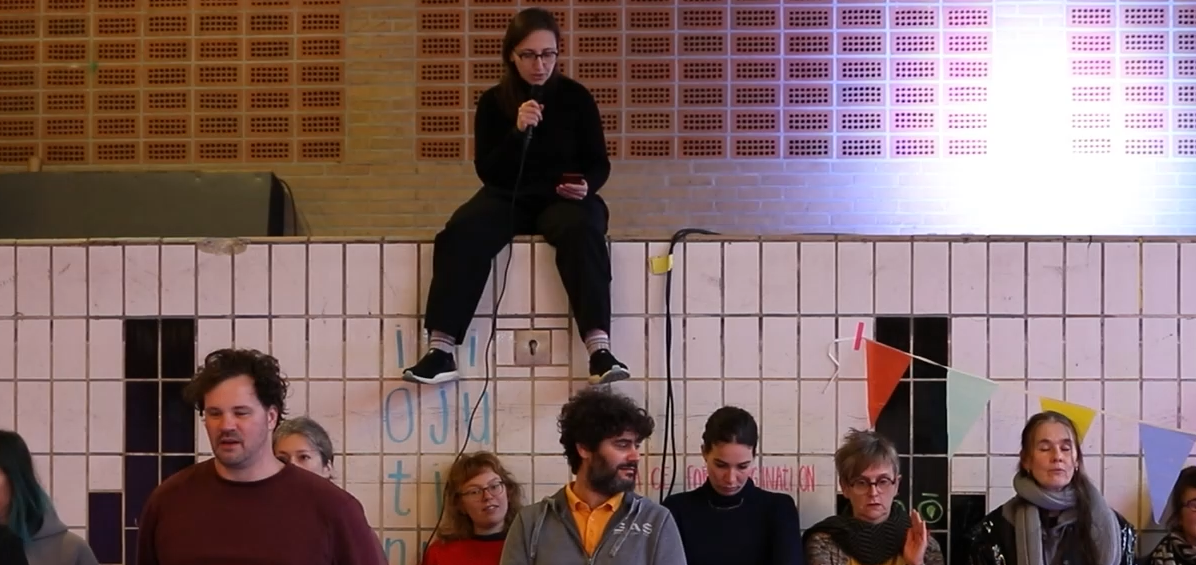
“Across from here is point B,” I say. “You’ll follow a series of instructions to get from B to A and then back again. Are we ready?” Heads nod.
“Imagine your forearms are like butter knives.” People look puzzled. Some close their eyes; others glance sideways, seeking confirmation. Arms extend in various directions – palms down, elbows raised, hands forward.
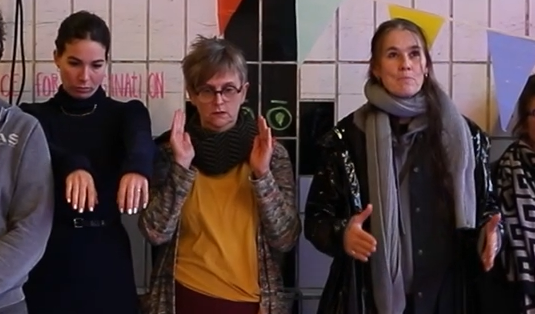
Arm movements begin – clockwise, counterclockwise.
“Scan the horizon.”; “Float.”
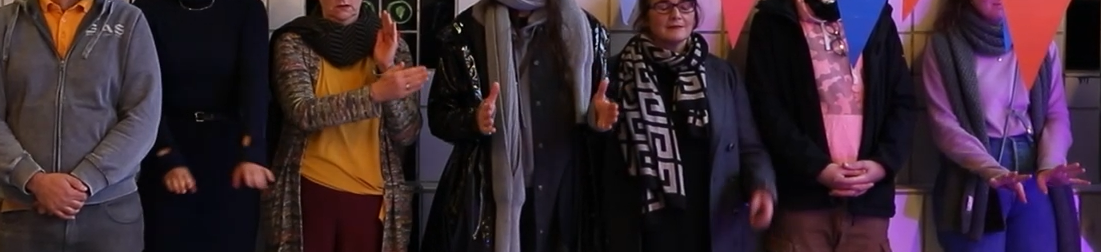
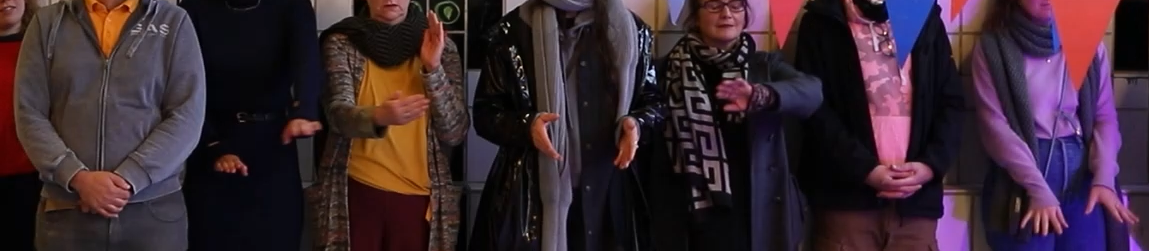



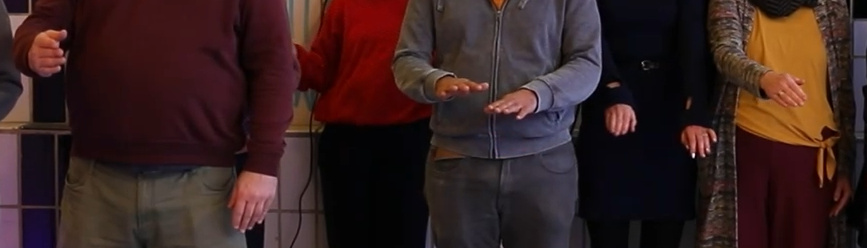
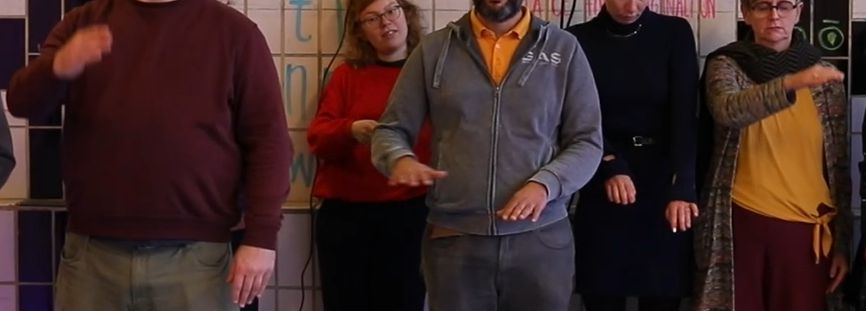
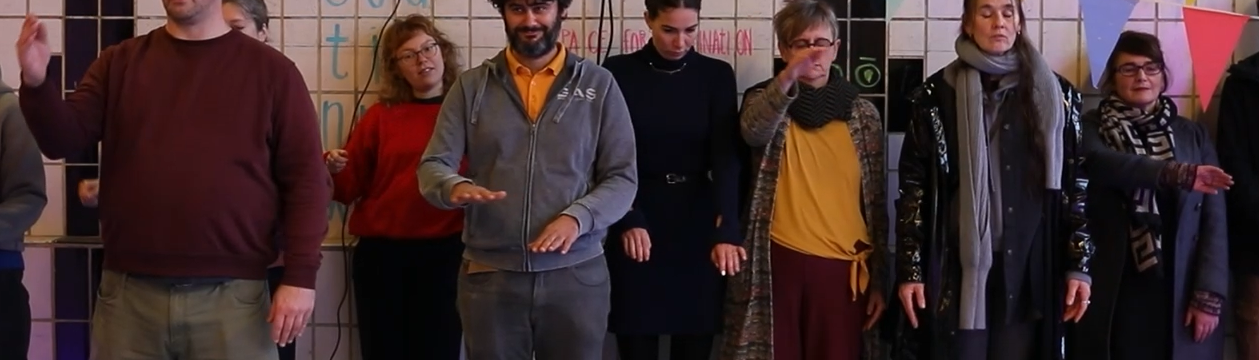
“Point your toes out like a ballerina.” Legs stretch; the group begins to move forward.
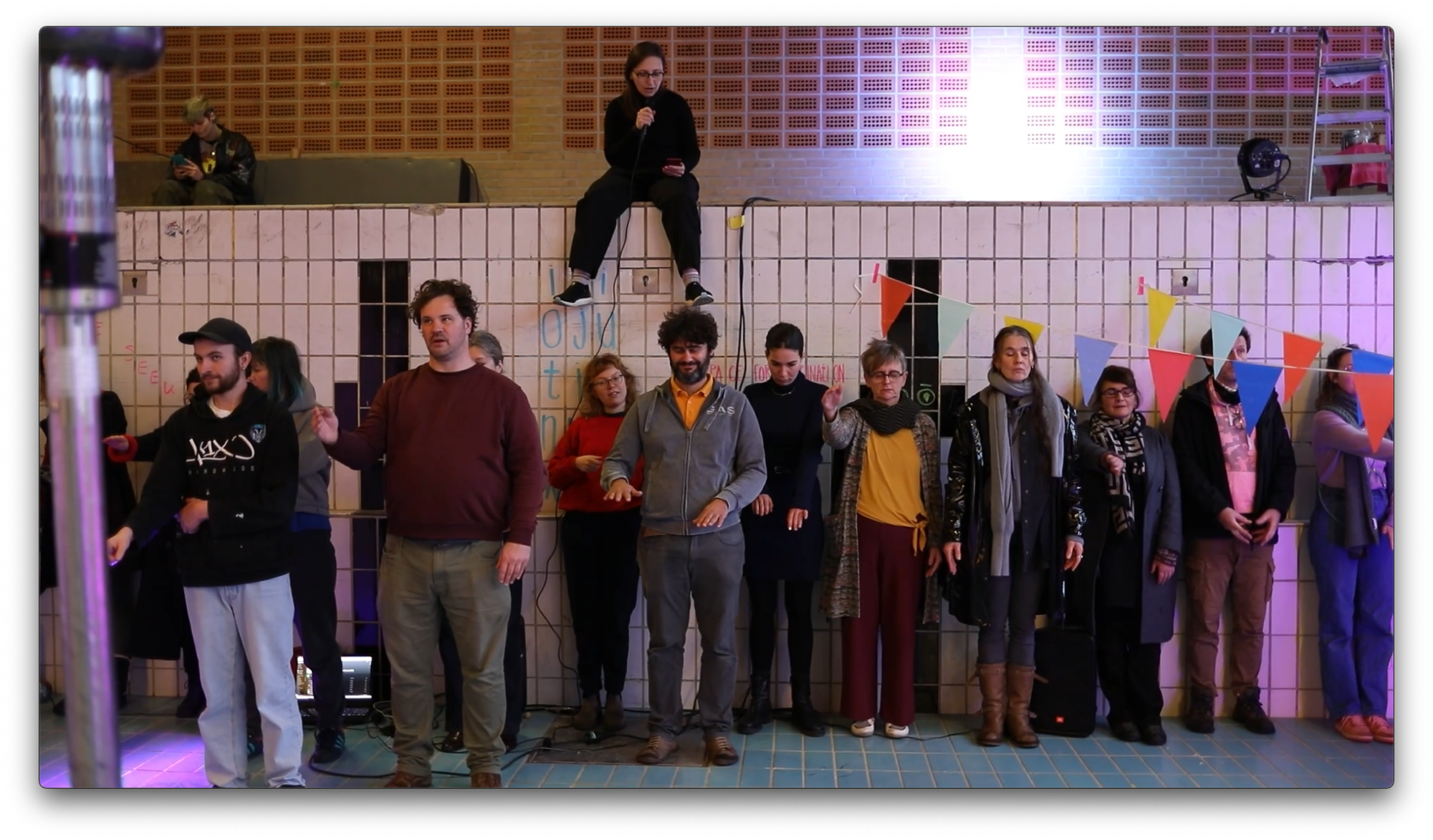
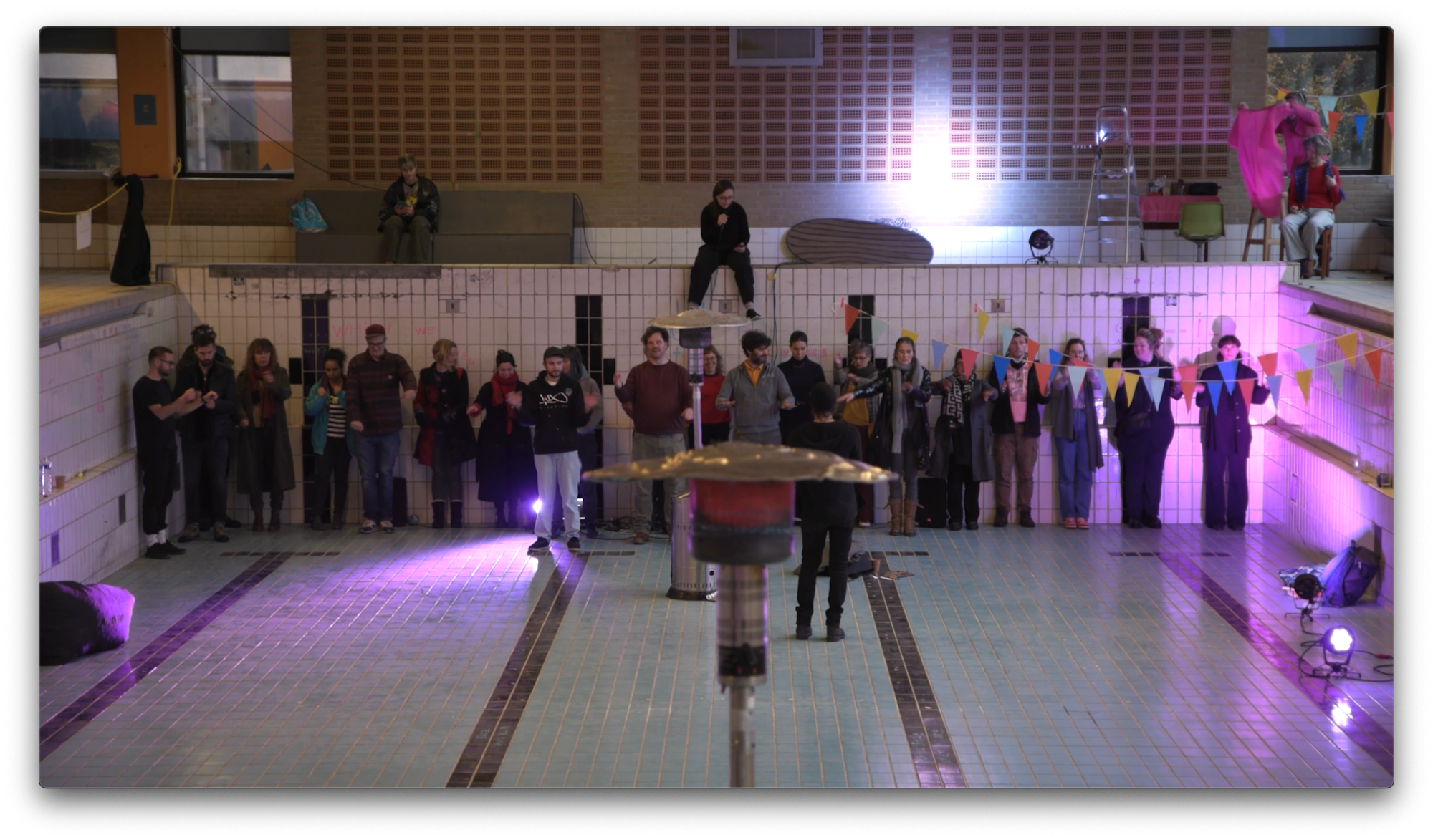
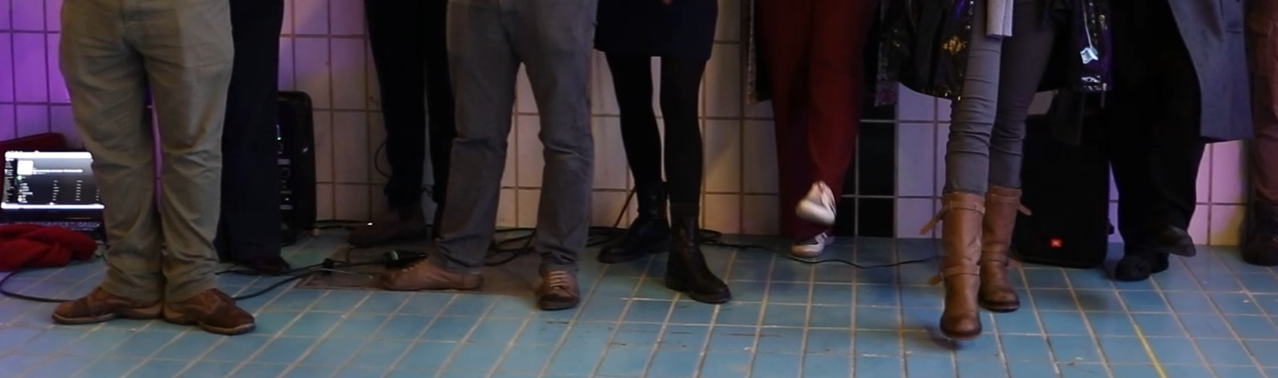
(There’s a sudden, gracious quality in their improvisation – movements I hadn’t imagined when I wrote the prompts.) Participants begin swirling, smiling.
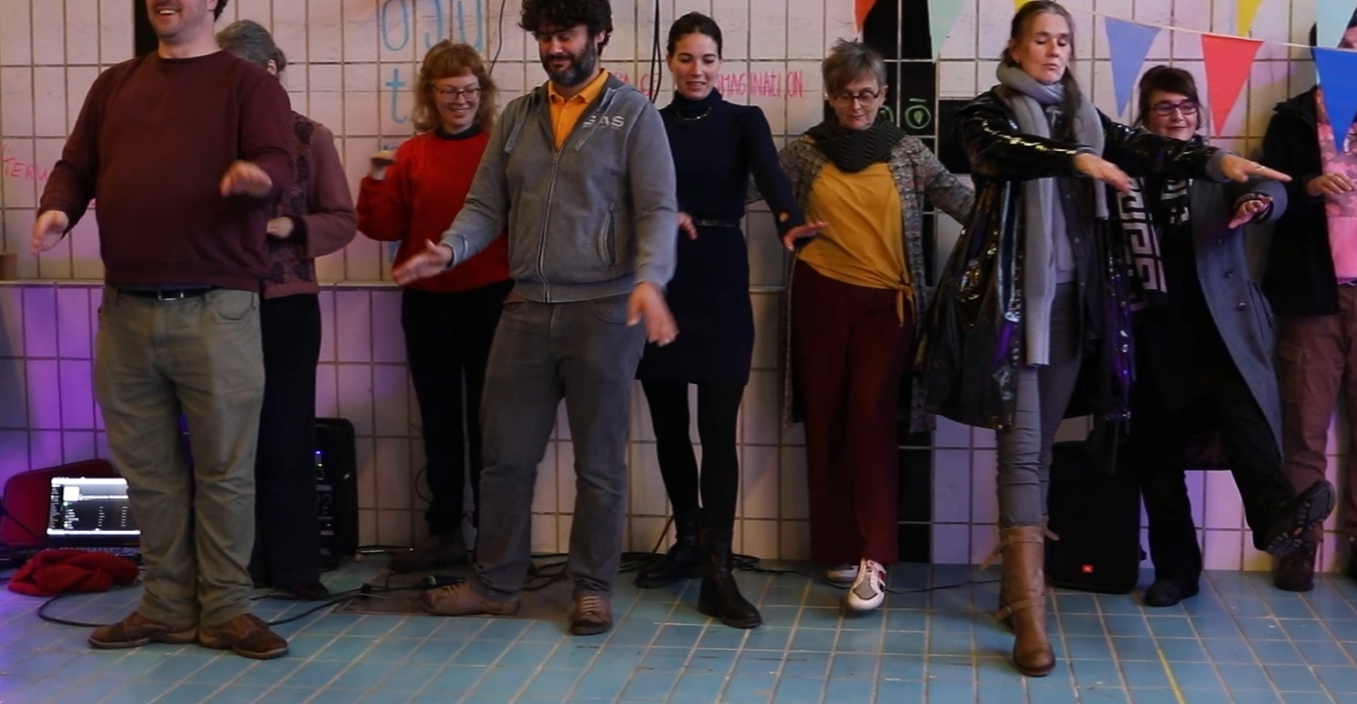
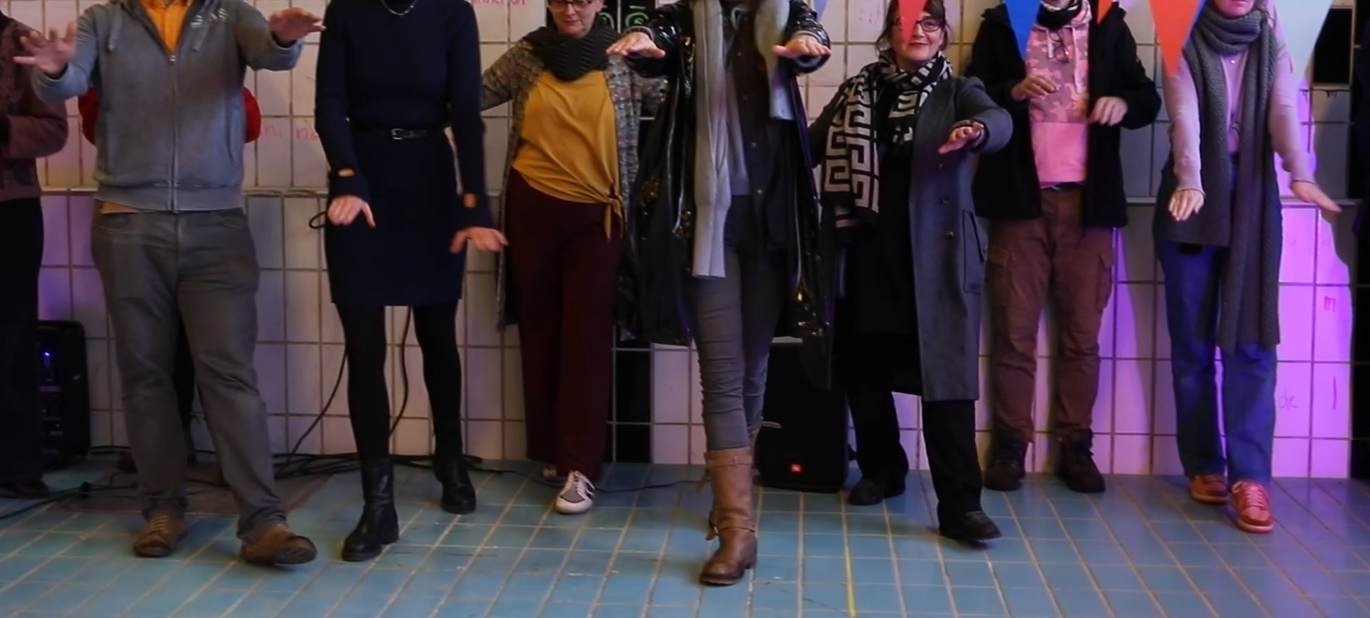
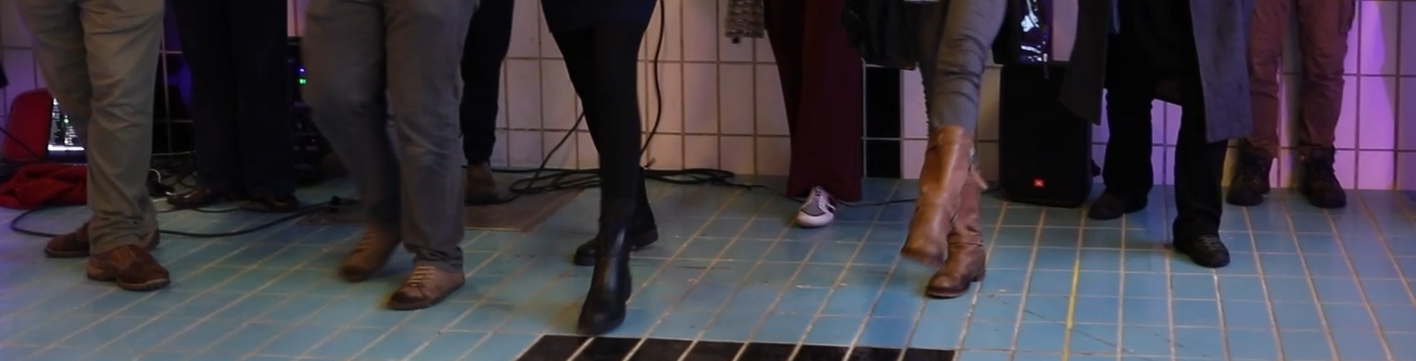
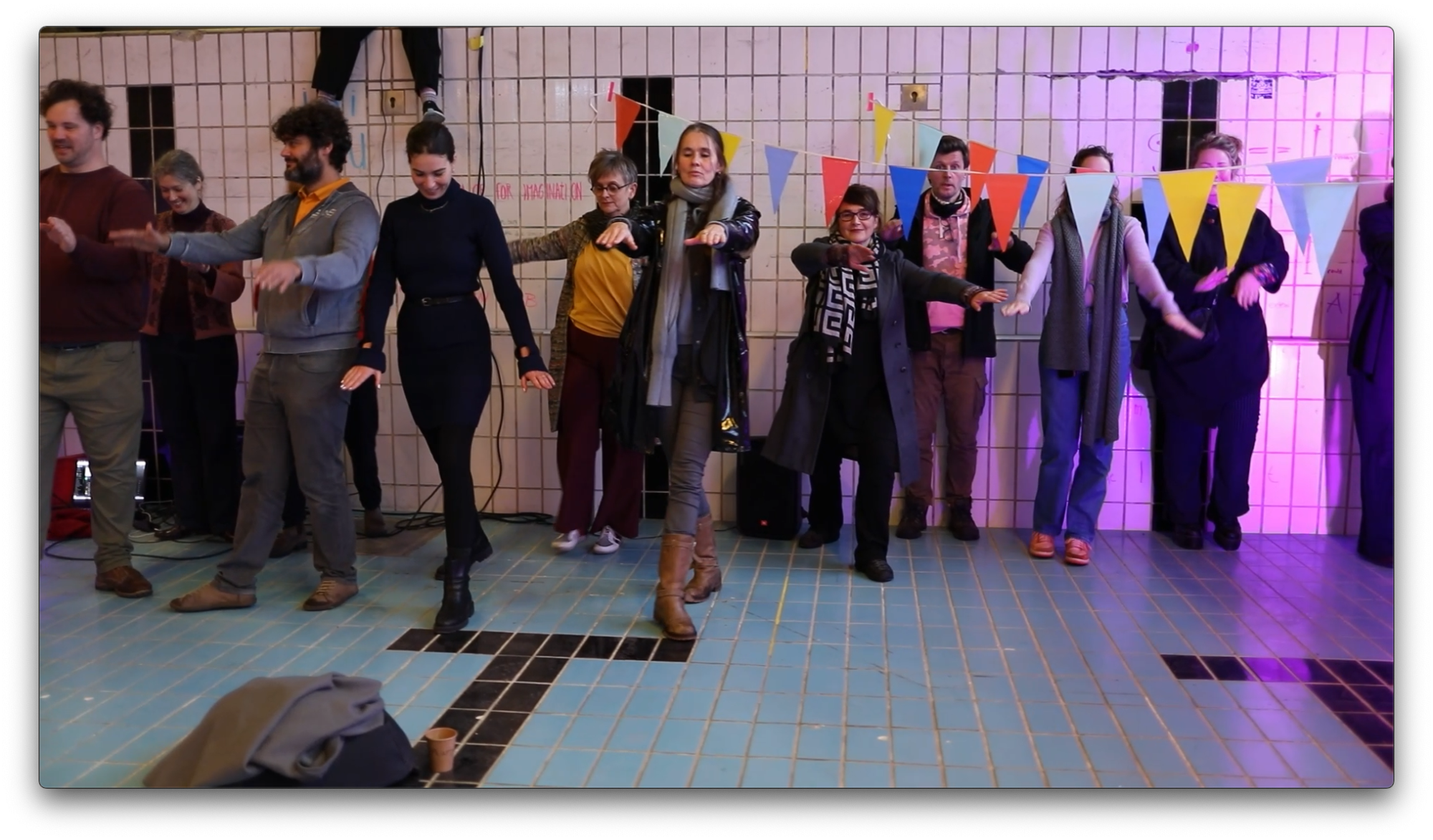
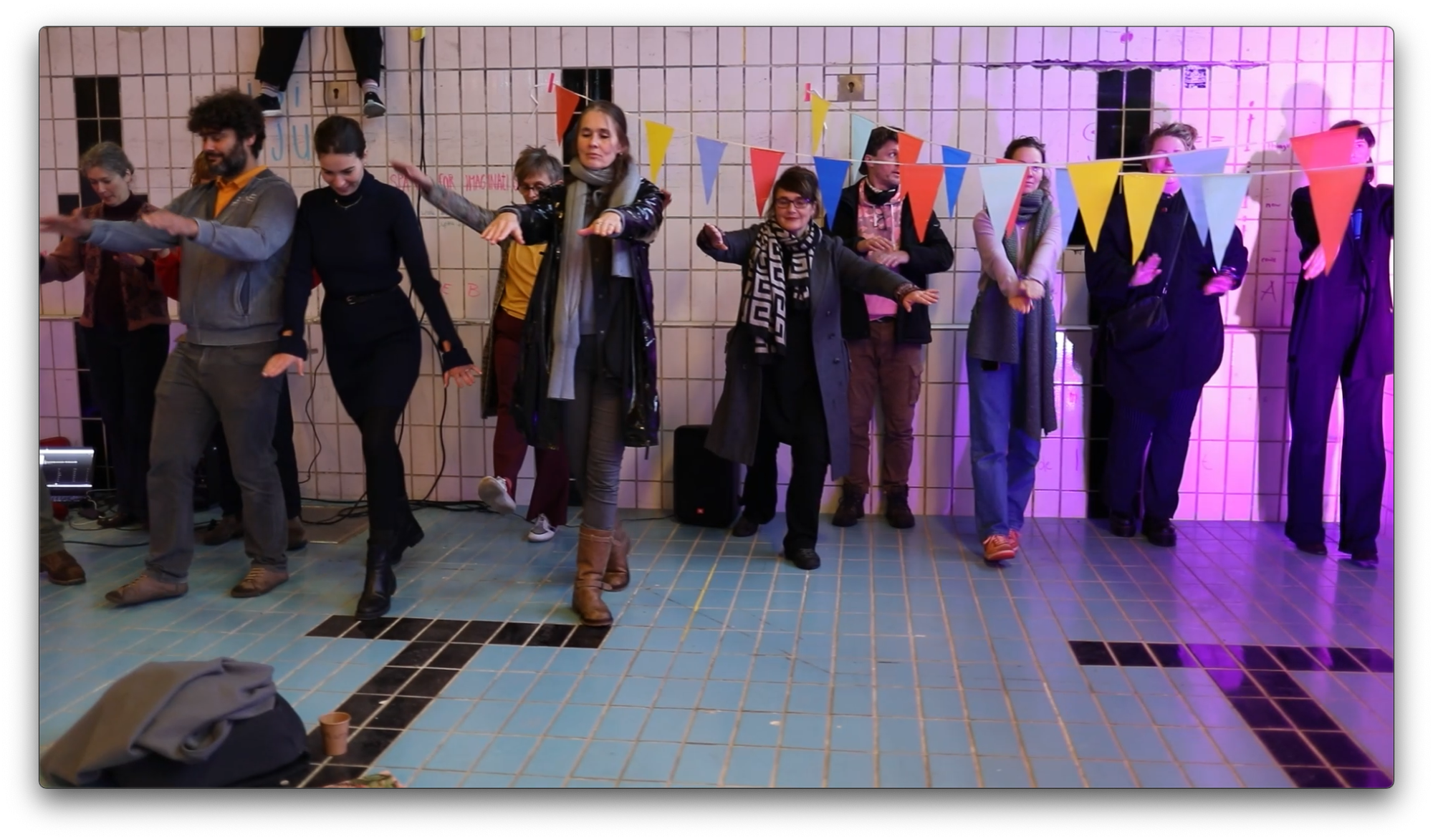
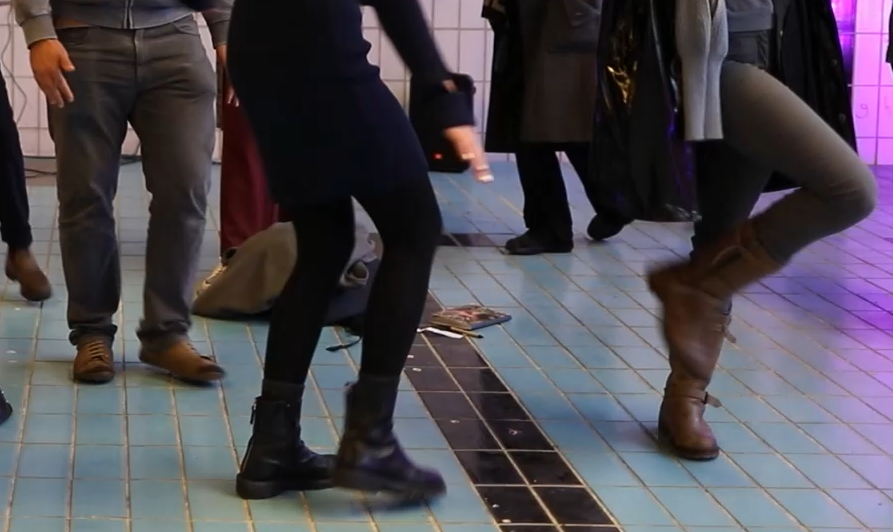
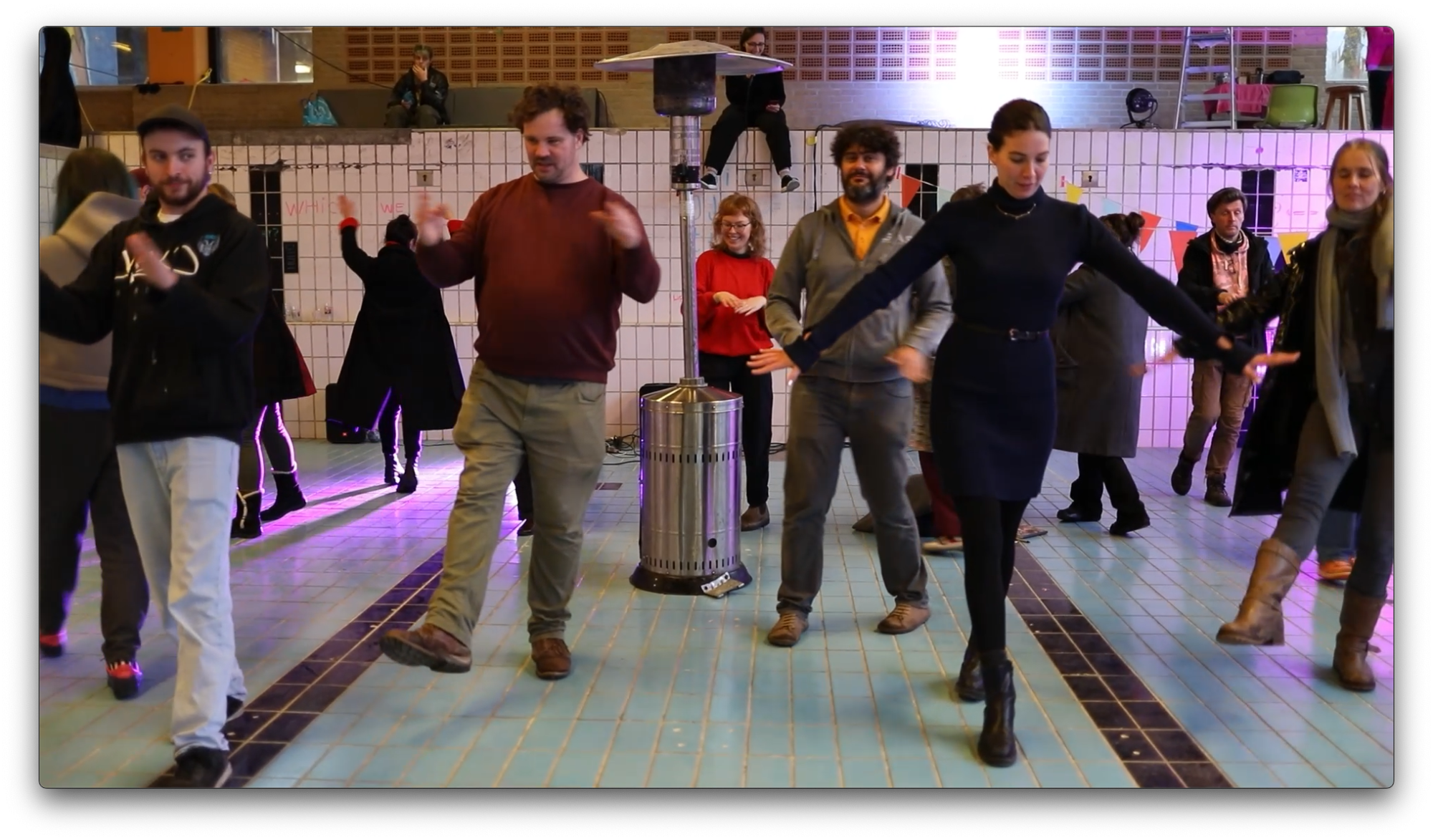
They make a T-shape with their arms and suddenly, they synchronize. Then stop moving.
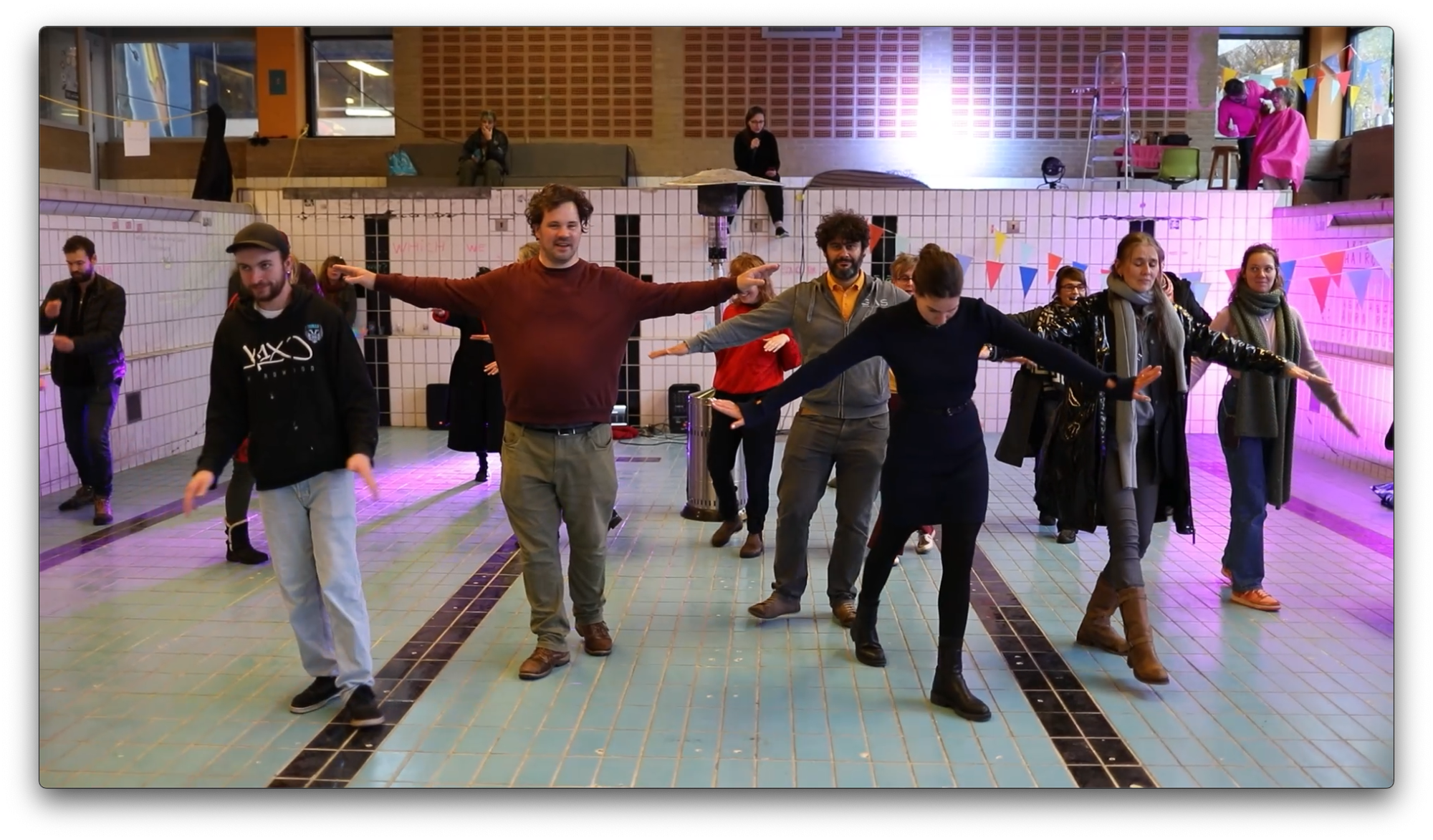
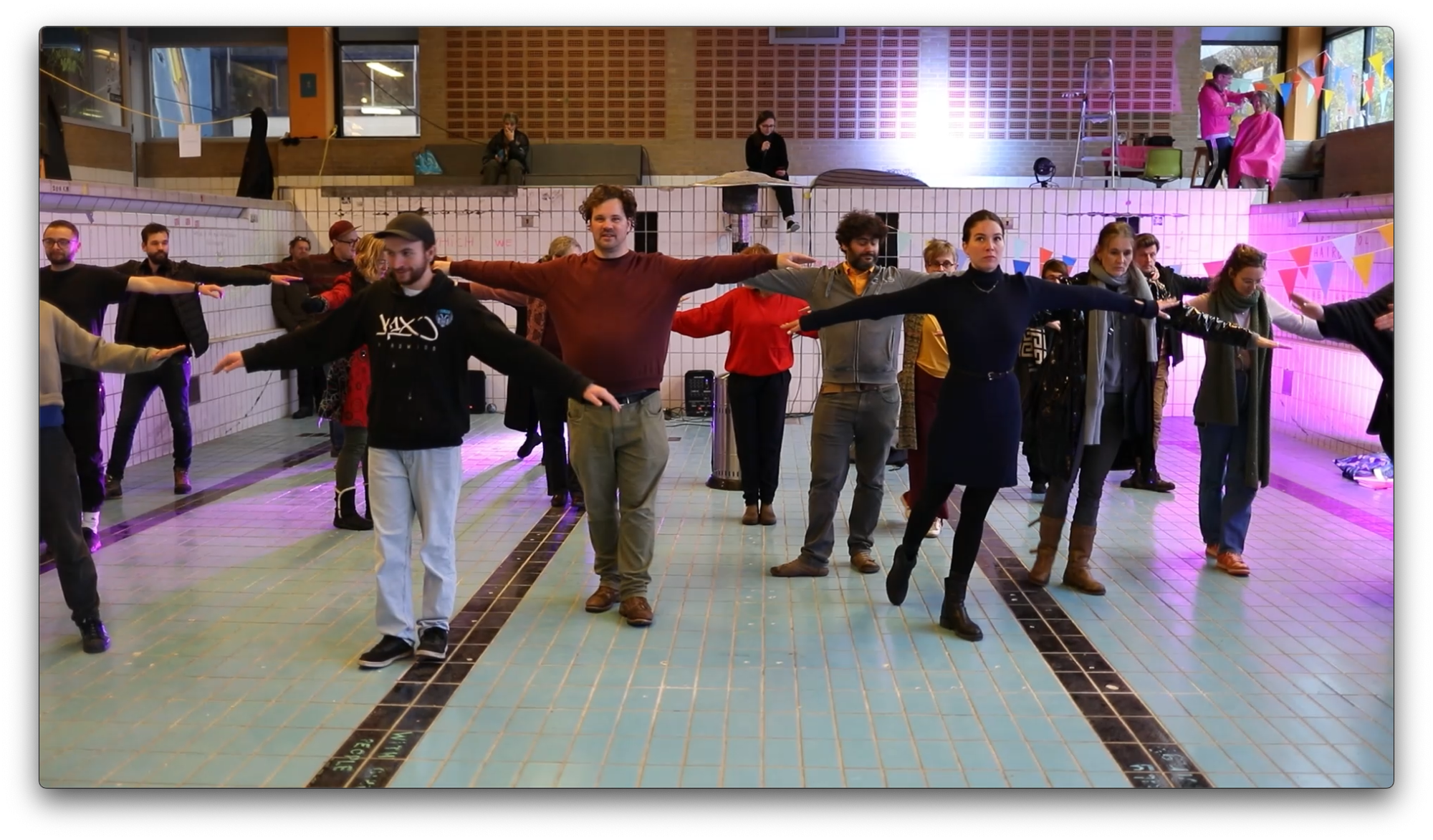
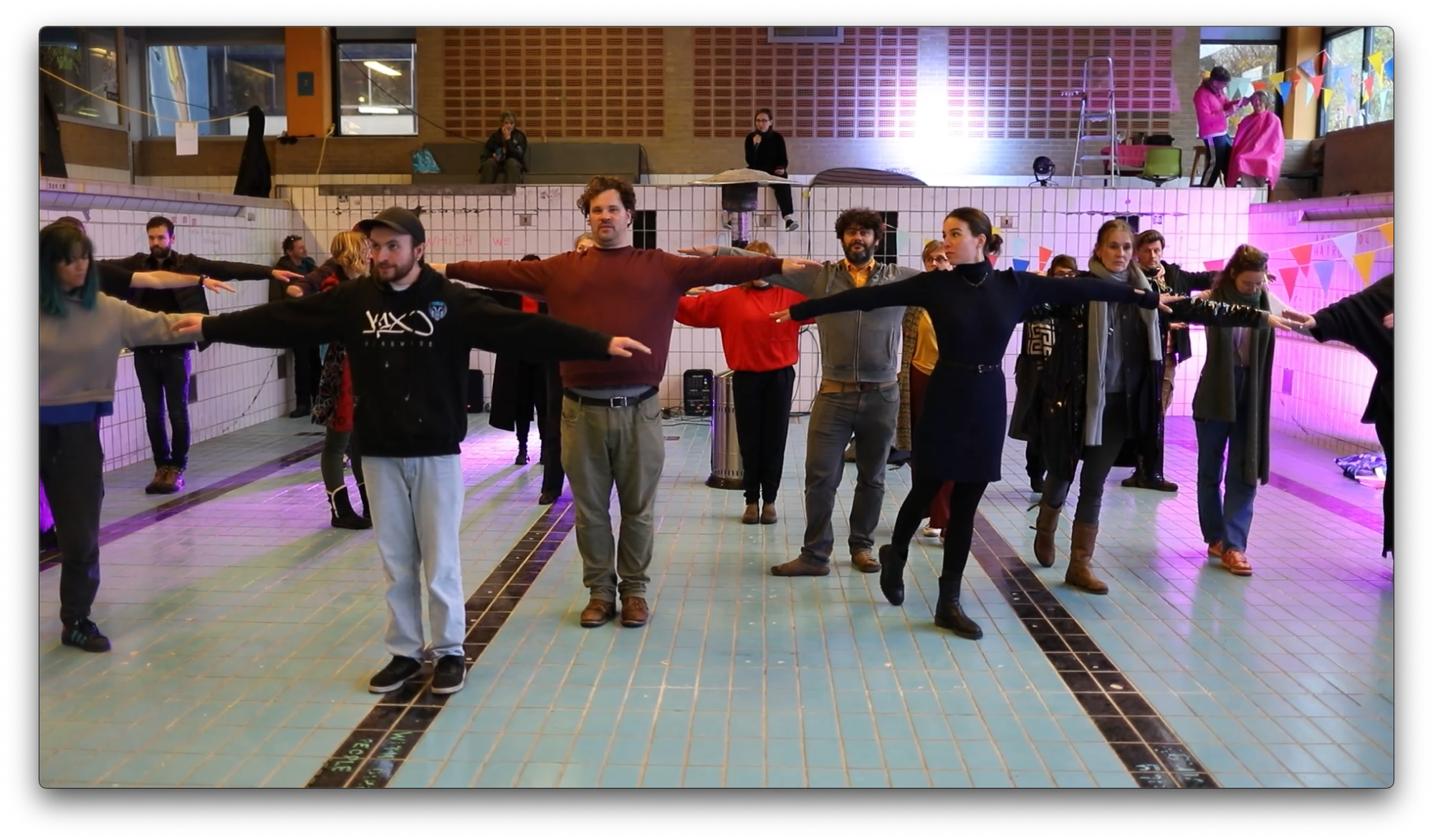
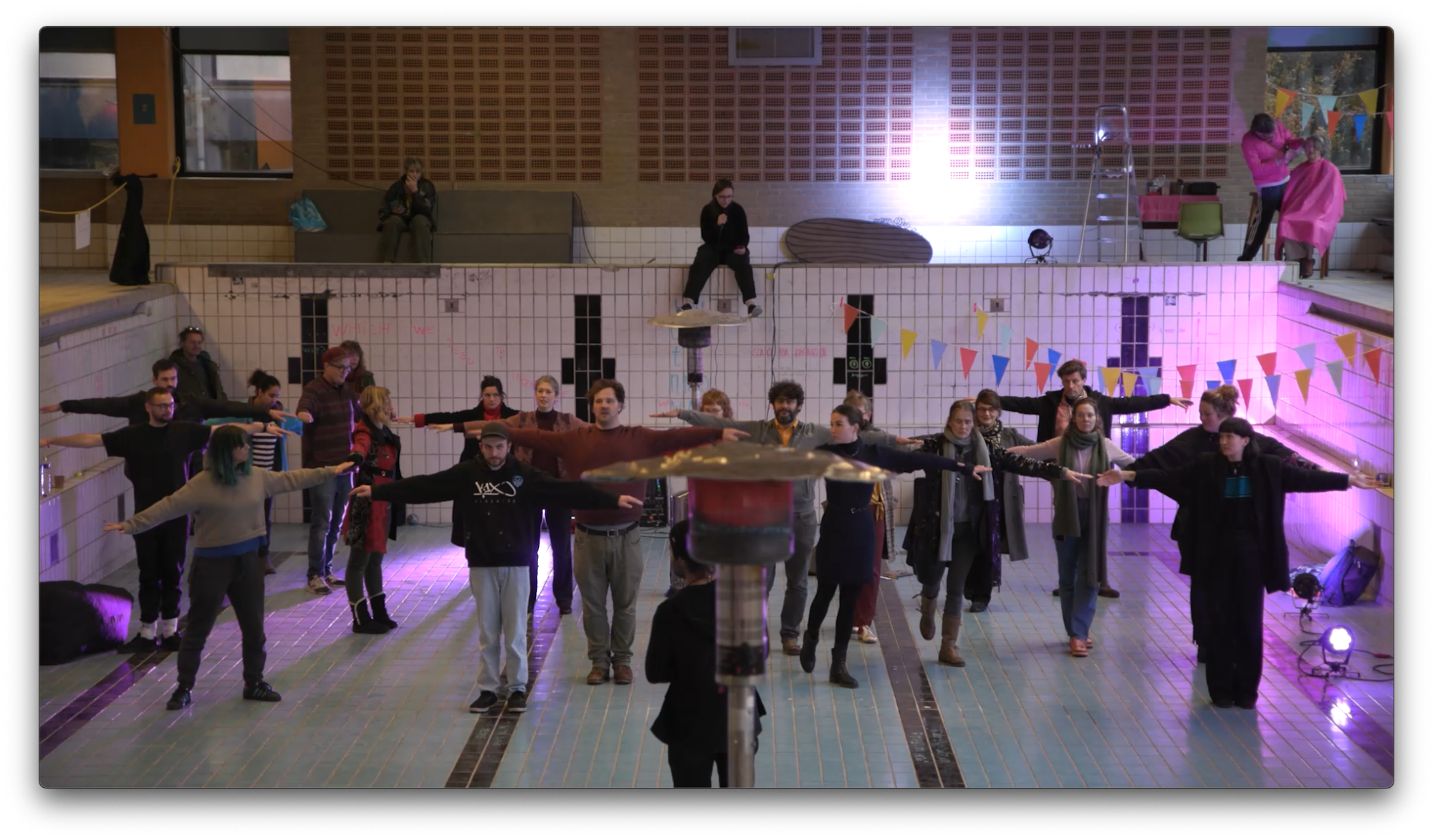
‘Collective swimming’ motions follow. Some jump, laugh, lose balance. We can hear feet tap against the dry pool floor.
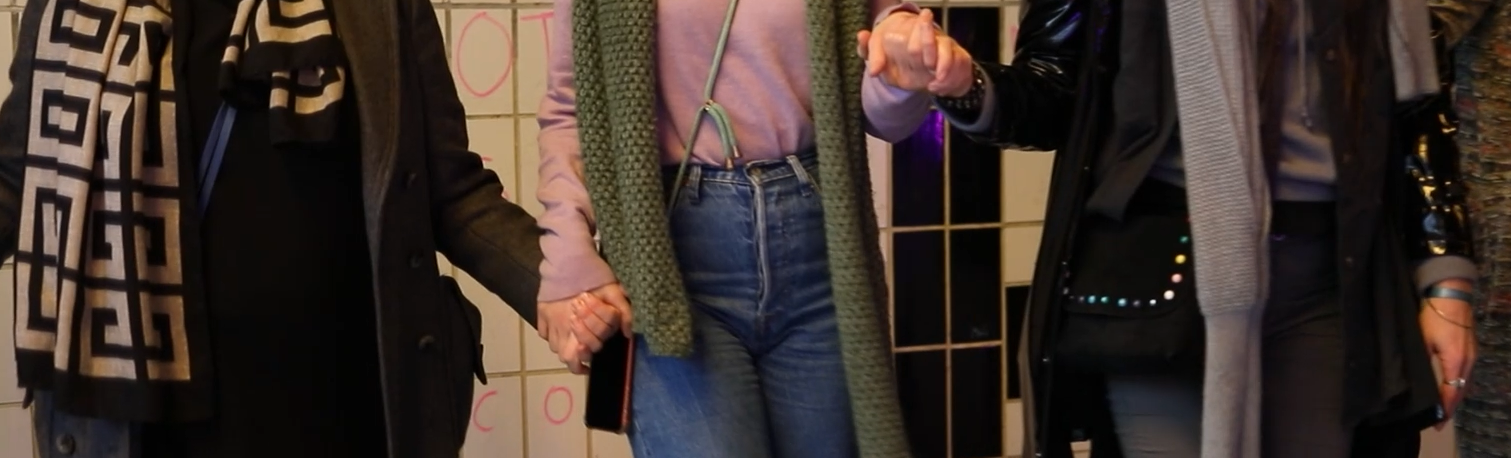
As soon as they reach the other end of the pool I prompt: “Offer a hand.”
“Hold on.”
Participants clasp hands, now moving together.
“Now freestyle.” Making wave-like gestures. Clusters form – groups of three or more.
The pool fills with spontaneous, messy motion.
“Stop.”
“Look below.”
“Pretend you’re sitting in a chair.”
“Look up.”
“Offer a hand.”
“Hold on.”
“Move forward.”
“Propel.”
“Clockwise.”
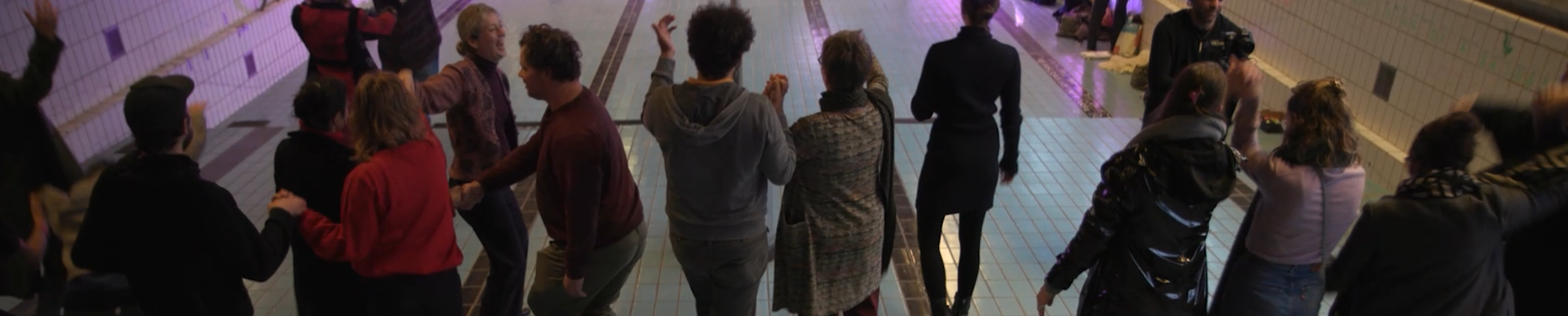
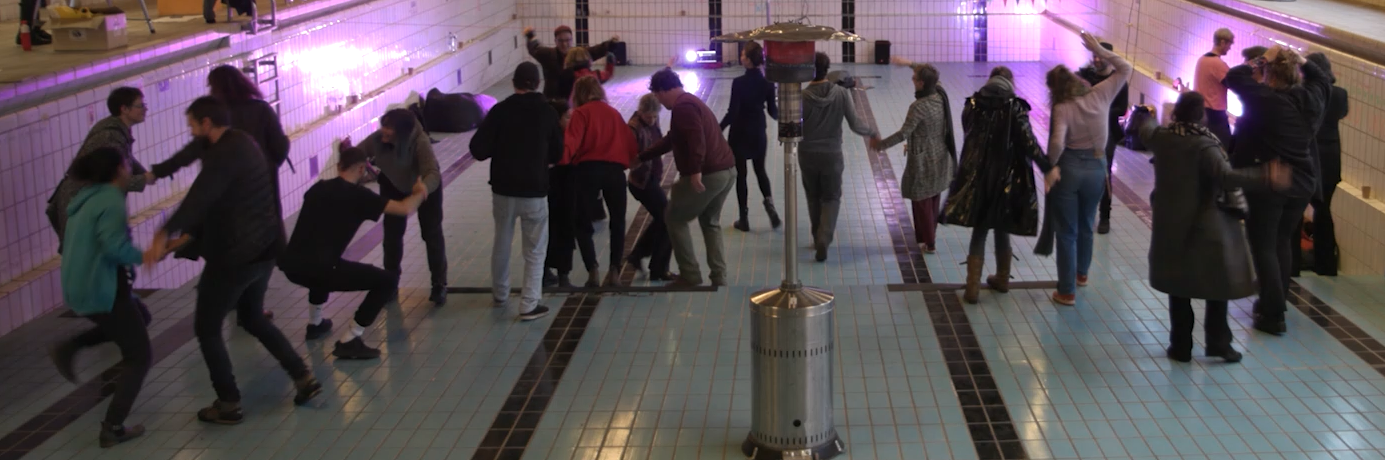
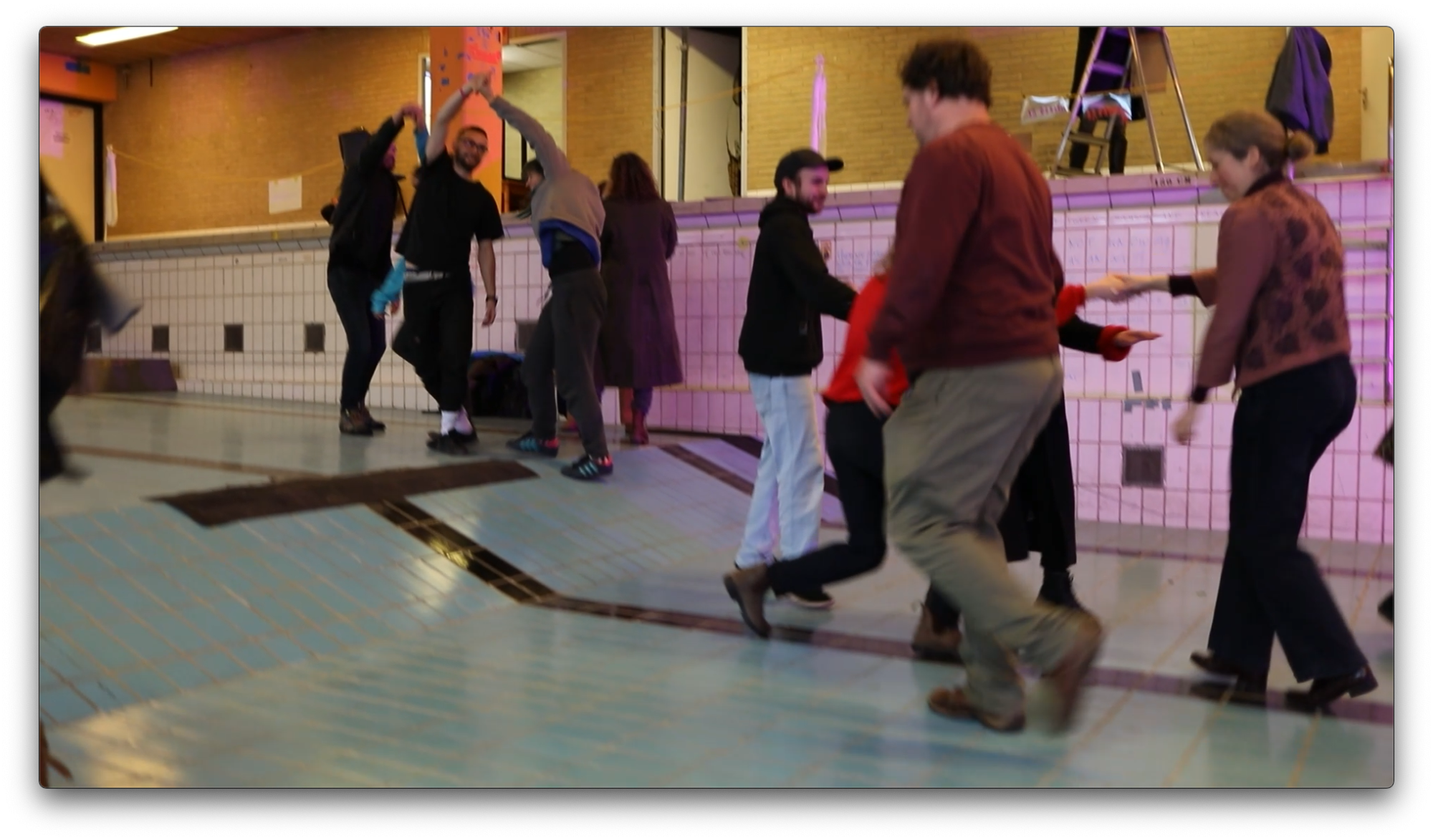
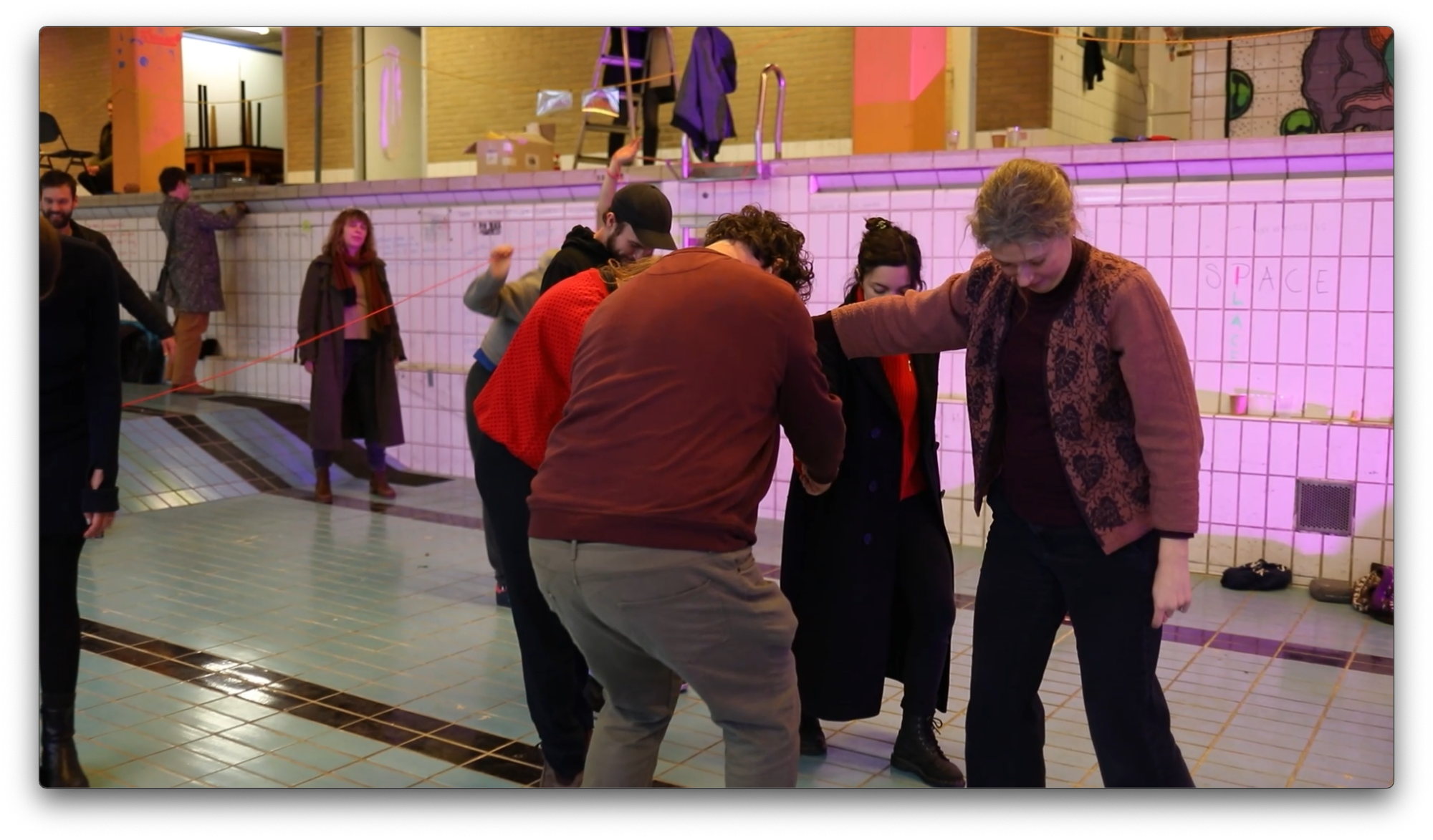
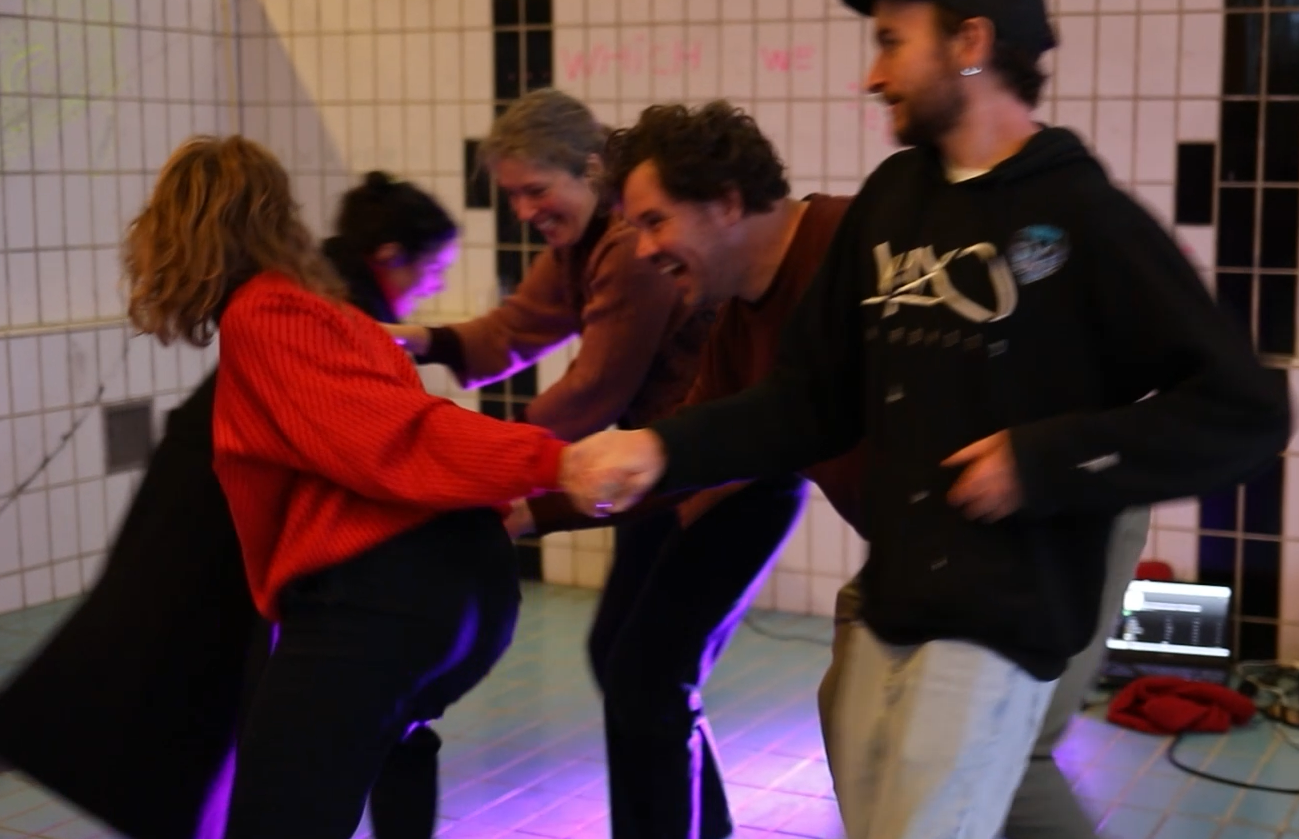
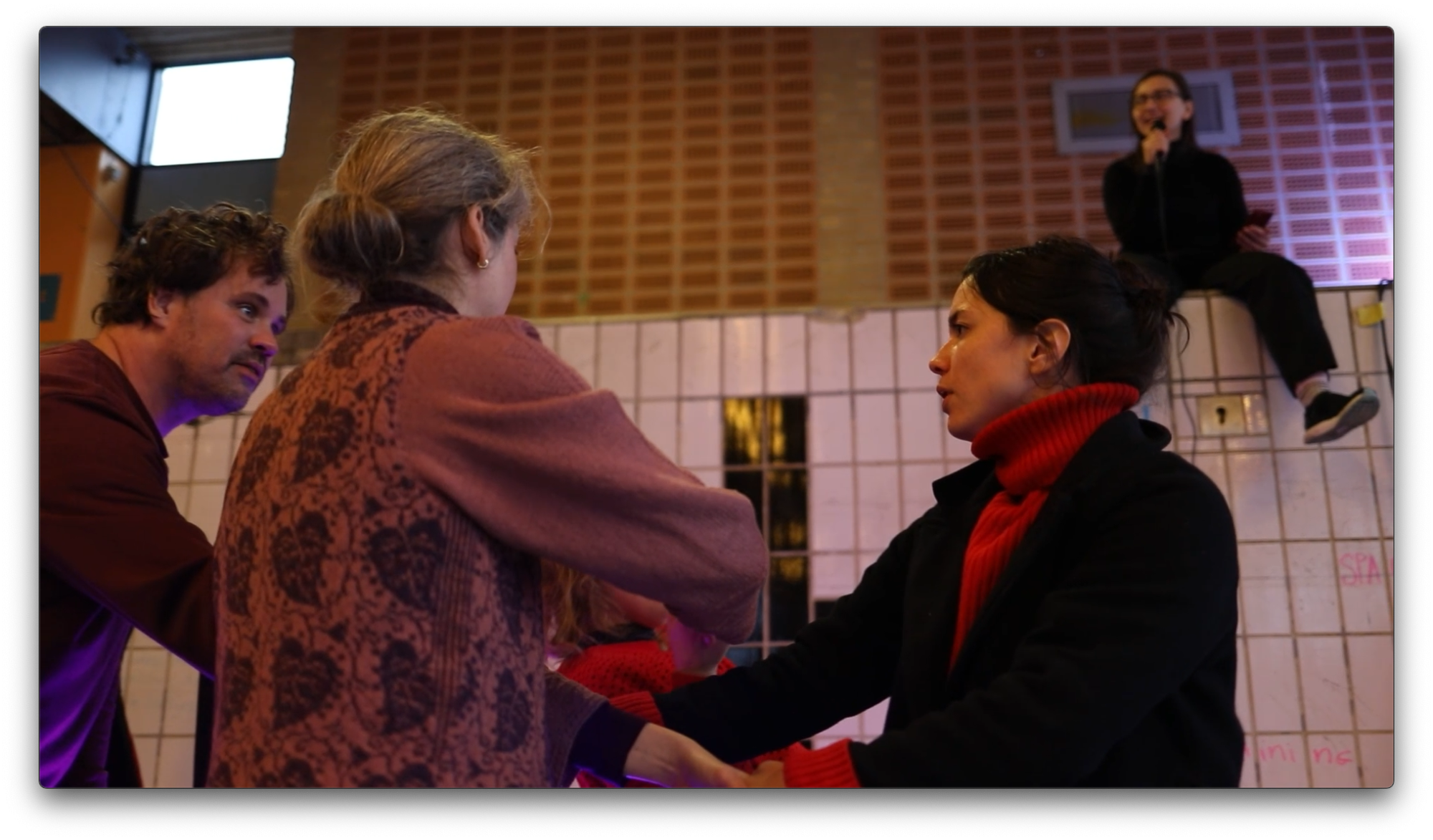
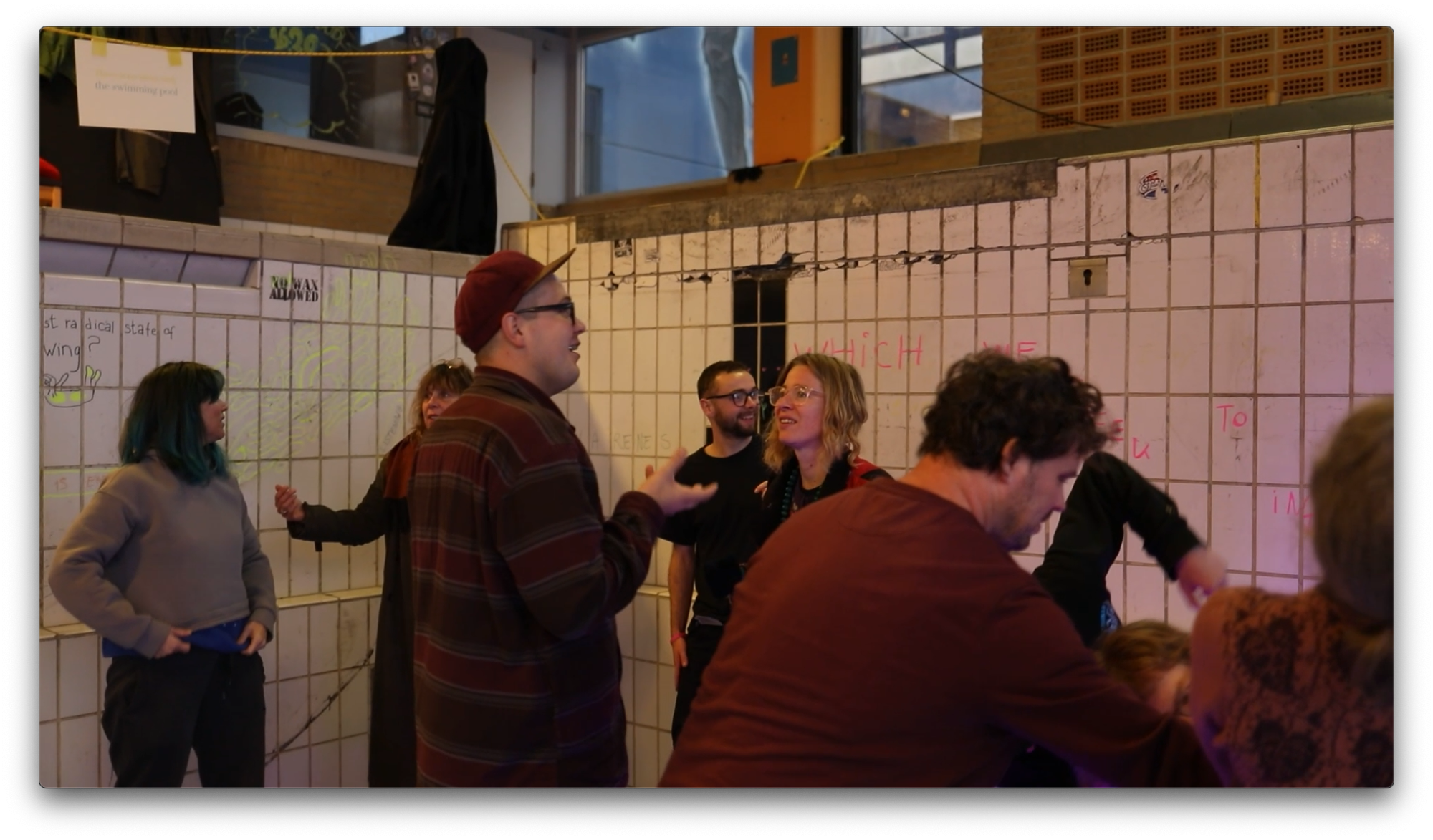
“Thread lightly” …
“Thread lightly” …
“Thread… lightly” …
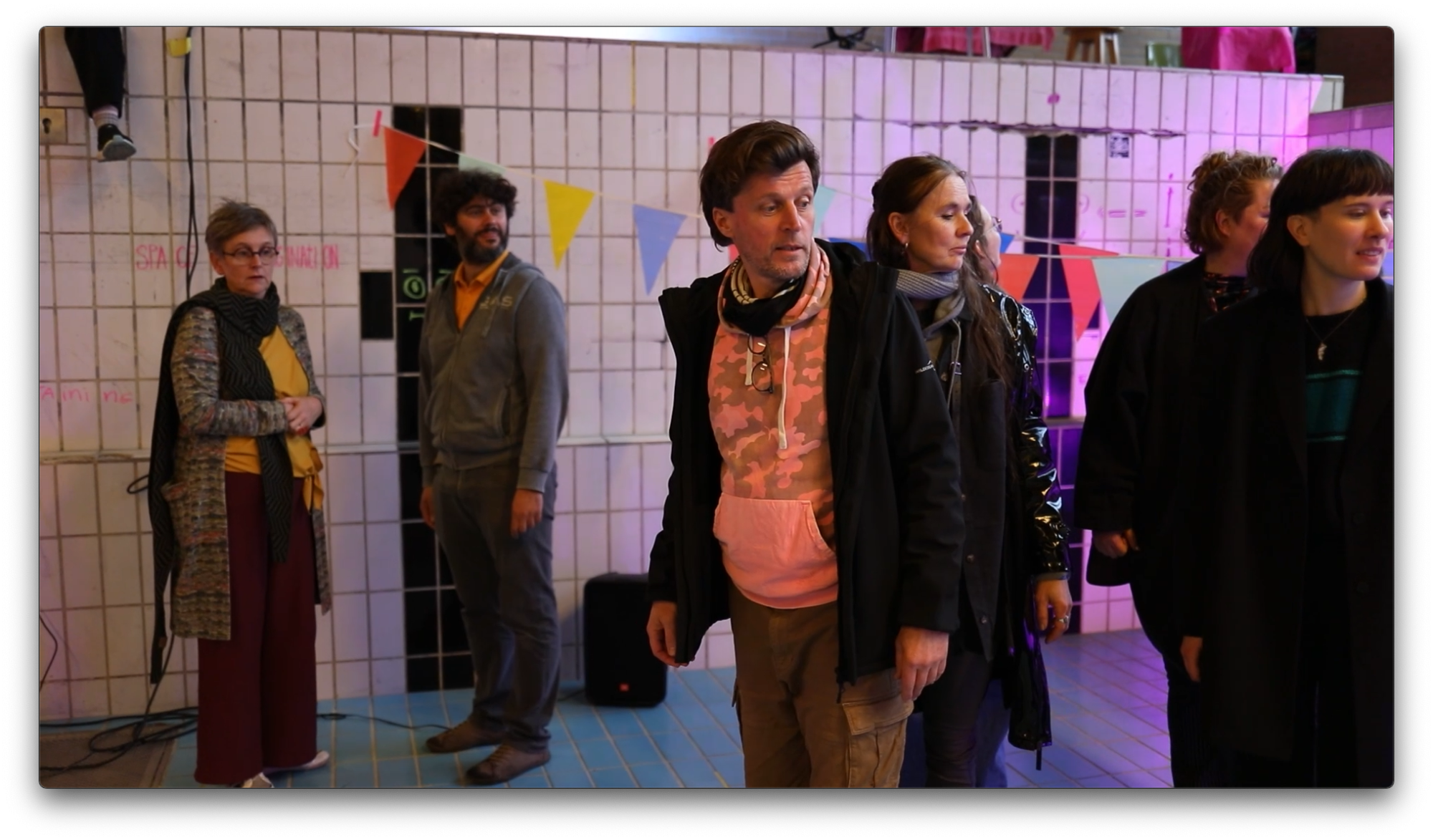
Confusion sets in.
I point toward the back of the pool. They haven’t noticed the thread.
“Er is draad,” I say.
(I intentionally withheld further instruction, aware of my fear that the momentum might collapse, yet relying on professional experience to trust the process.)
A few noticed the thread and moved toward it, and gradually the others followed.
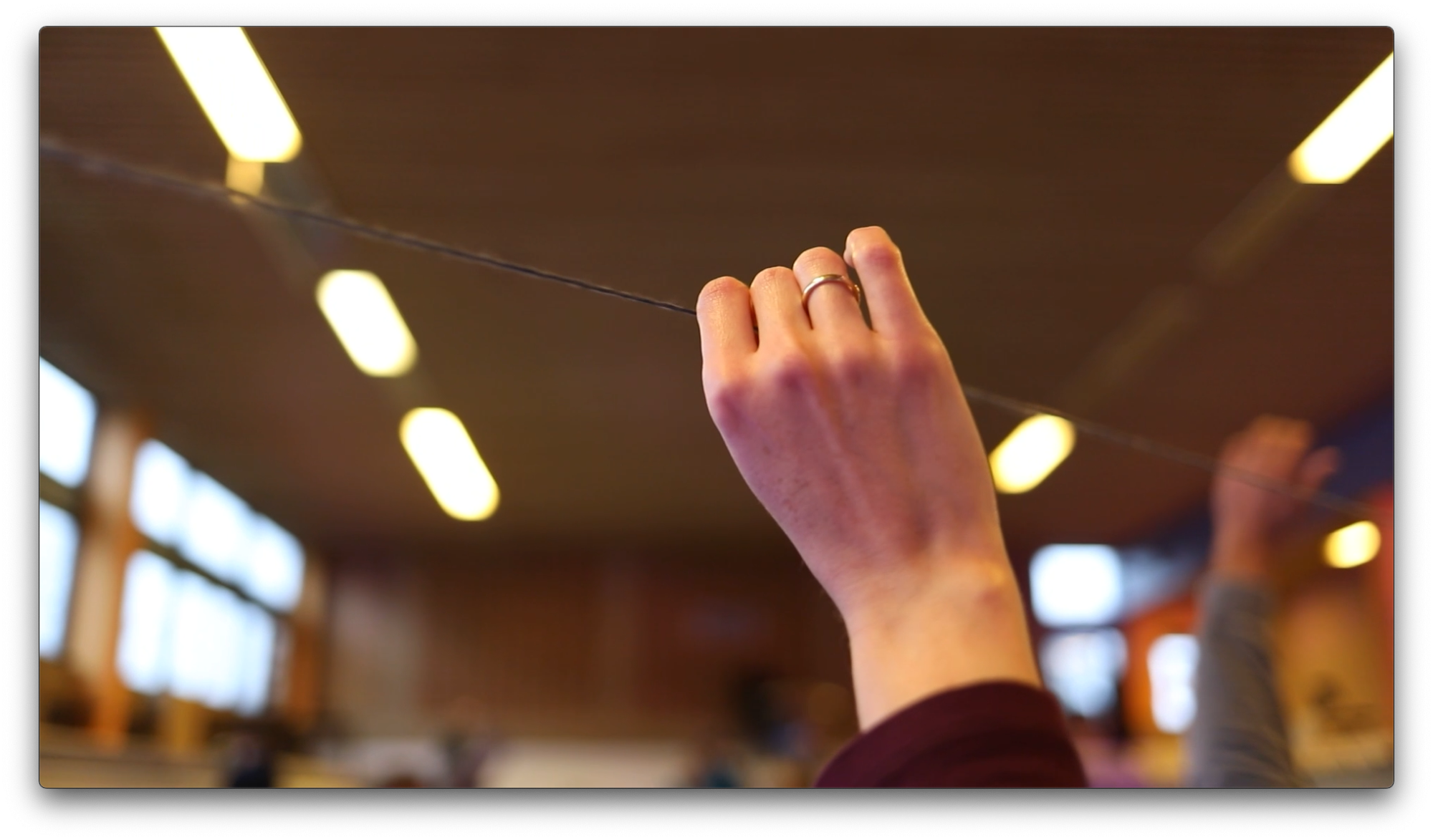
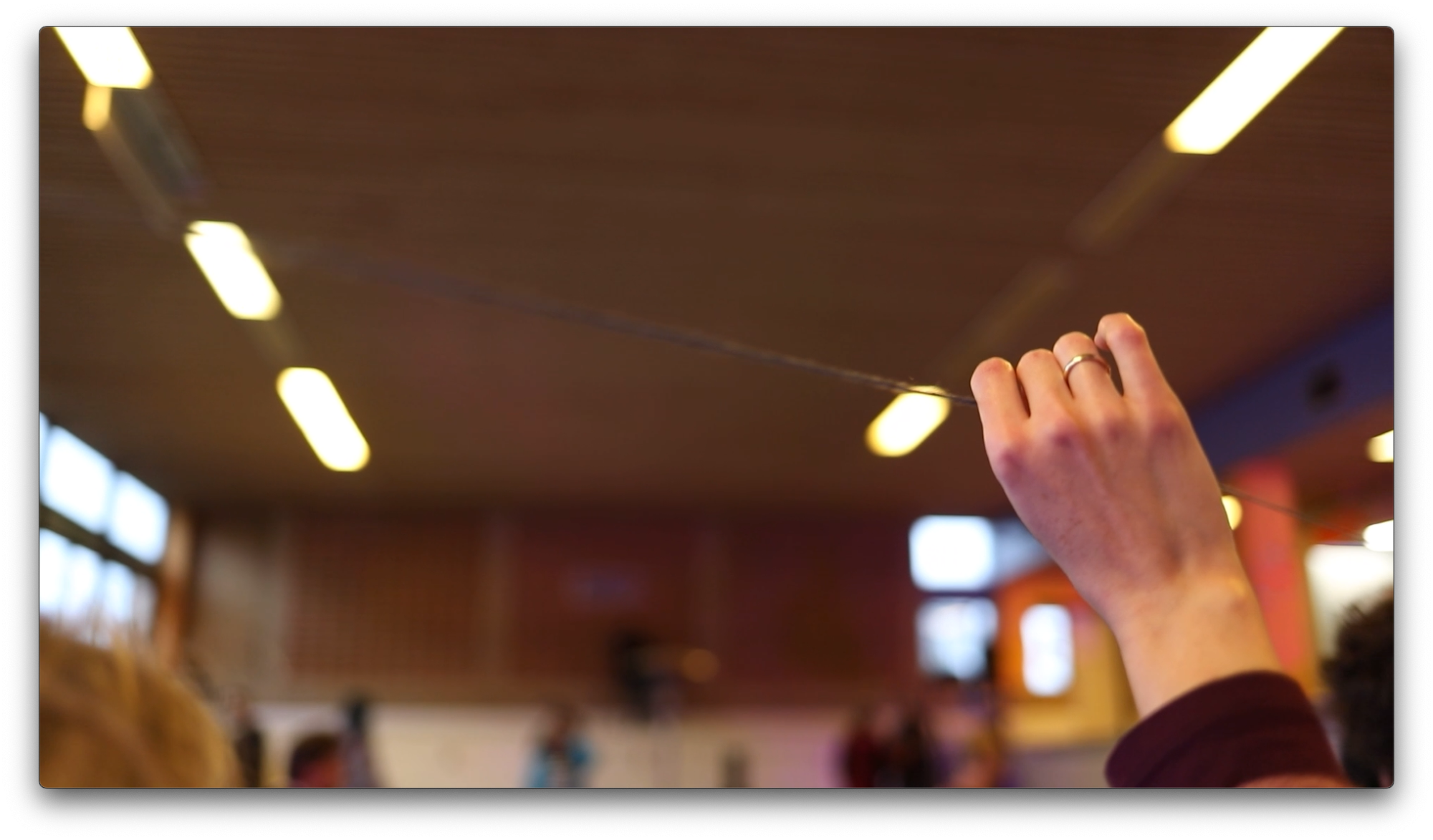
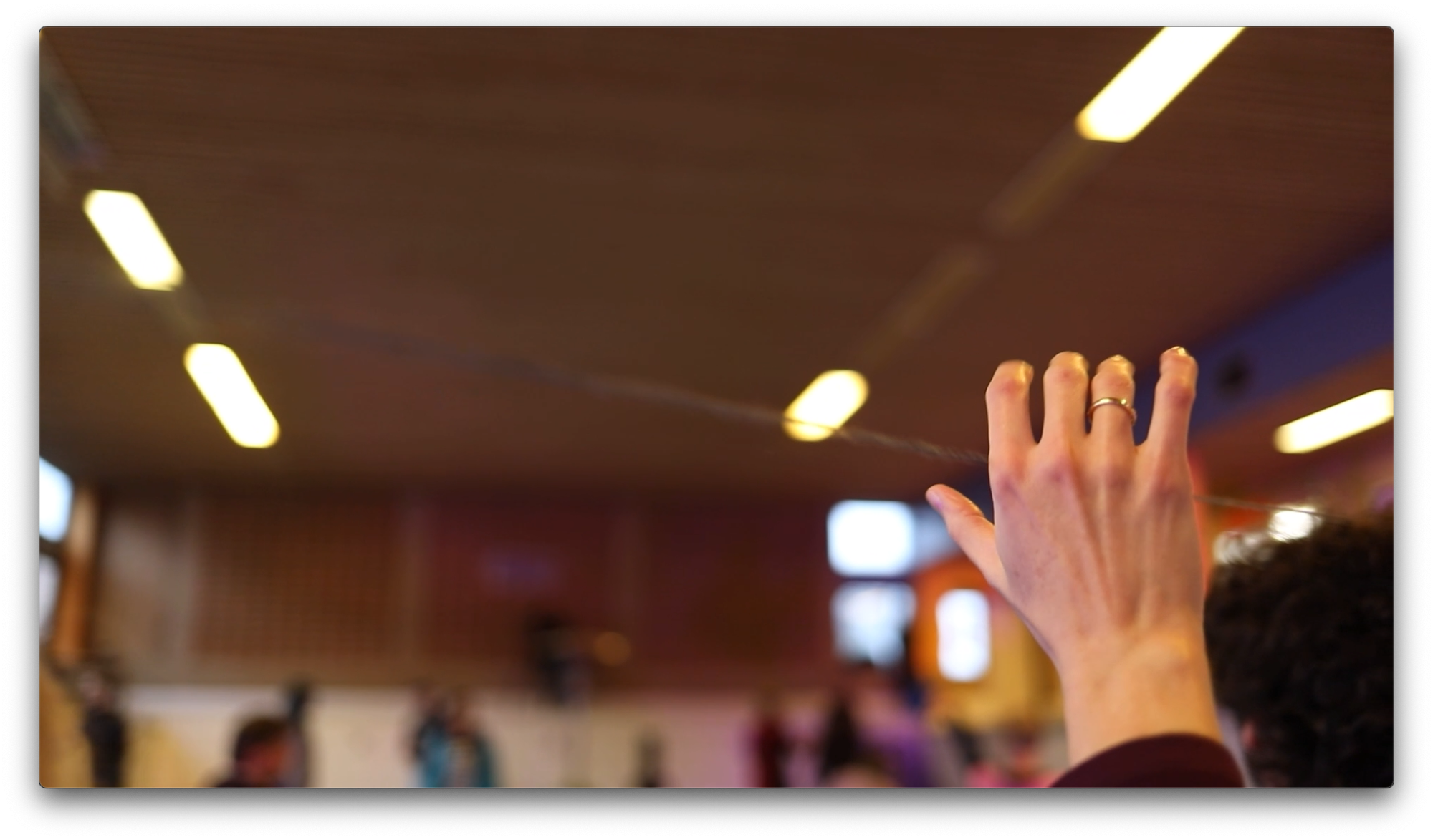
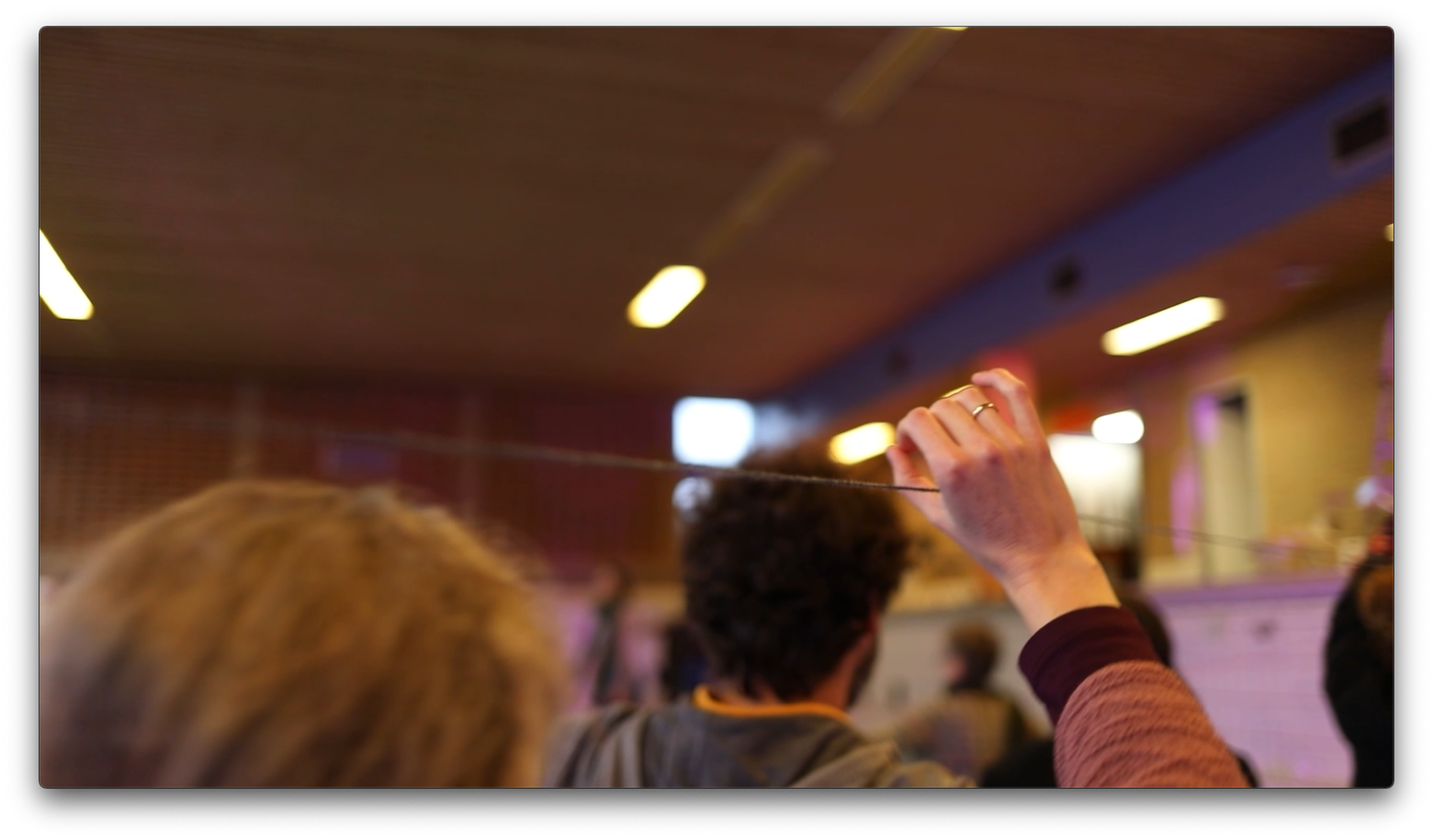
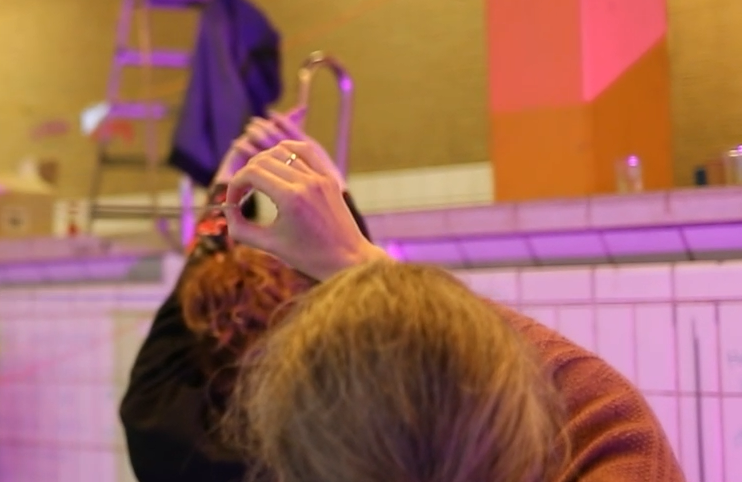
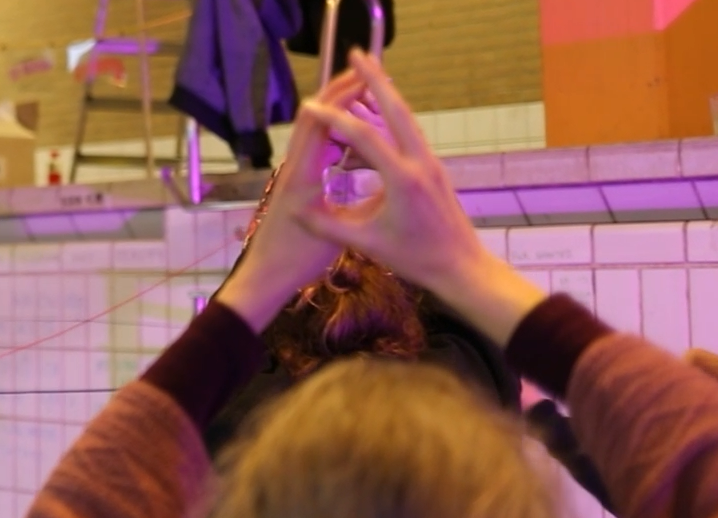
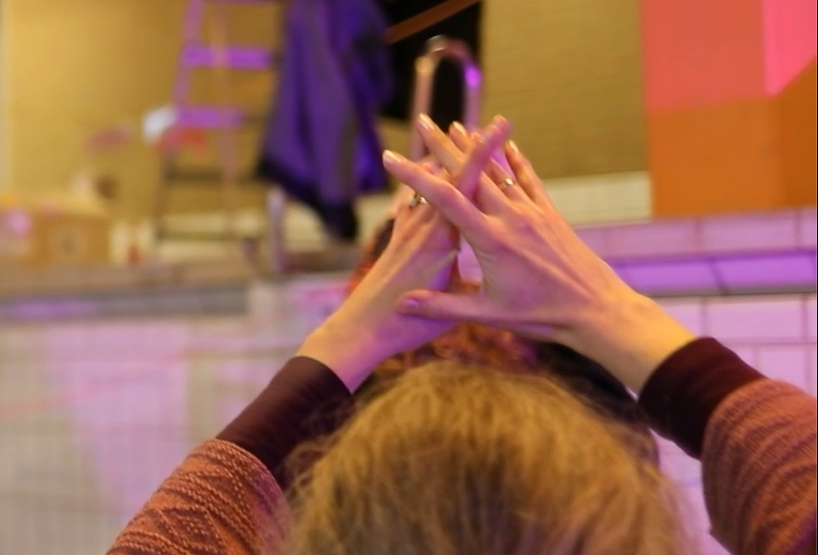
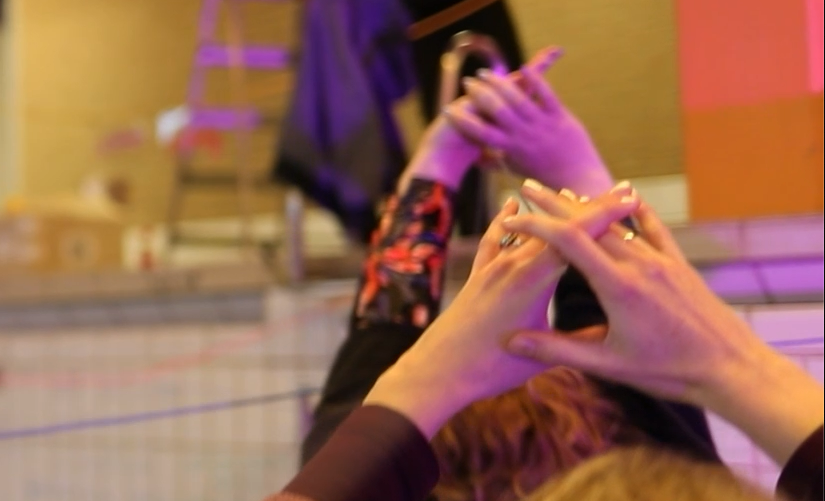
Fingertips find the yarn, stretched across the pool.
“And float.”
That’s the final instruction. They move as if weightless, holding the threads lightly. Yarn now lines the pool’s edges. Most participants are in the middle, suspended in a kind of still choreography, loosely tethered together.
Analysis of the case
What unfolded during Synchronized Swimming left a residue of what could not be fully accounted for within the frame of the session itself: subtle shifts in attention, relational tensions, and mutual vulnerabilities exposed. The group, at times unprompted, found ways to recalibrate – adjusting to each other, realigning their movements, and re-establishing a collective rhythm. This improvisational responsiveness became the ethical ground of the encounter: an emergent ethics, where responsibility was generated rather than assigned, and trust distributed through the navigation of shared risk.
Care and feminist ethicist Margaret Urban Walker’s expressive-collaborative model offers a lens to examine these dynamics. In this model of practices of responsibility, morality is understood as a “socially embodied medium of understanding and adjustment in which people account to each other for the identities, relationships, and values that define their responsibilities”.21 Here, responsibility is a practice through which people collectively allocate, take on, or resist responsibilities, while remaining attentive to what such movements imply for their shared moral lives. It is within this iterative process that trust becomes meaningful as something continuously shaped and strained through shared action and uncertainty.
The deliberate attentiveness to how shared responsibility is entangled with the materialities of the pool helps to articulate what was at stake in the session. Keeping moral space open requires ongoing effort, a vigilant reflexivity that resists closure. Without this active maintenance, even moments of apparent collaboration can become rigid or exclusionary. In Walker’s terms, closure of moral space means the breakdown of the expressive-collaborative process itself: responsibilities can no longer be negotiated, contested, or redistributed, and what remains is either rigid attribution or the evasion of accountability altogether. This ongoing effort played out in Synchronized Swimming. The use of verbal cues about ‘how to swim’ functioned more as metaphors than instructions. Swimming, like trust, requires tacit knowledge, embodied adjustment, and affective risk.
Importantly, the notion of prompting is used here deliberately against its dominant association with AI systems. Rather than aiming for precision or optimization, the instructions were intentionally ambiguous, inviting misinterpretation, delay, and improvisation. In this human, collective context, this mode of activating did not reduce uncertainty but actively and productively distributed it, forming a shared field of attention in which meaning had to be worked out together. Such invitations tested the limits of prompting as a logic: How much clarity is needed for action to begin? How do people interpret gestures differently? What happens when language fails? The unfolding of the experiment exposed a set of underlying conditions that allowed for a willingness to stay with not-knowing and to collectively discover what might emerge. These conditions were held, however loosely, by the prompts.
Trust is built through shared play and strained by ambiguity. Recognizing this moral space marked a shift in my research: from abstract considerations of responsibility toward understanding how scores can create conditions for care, shared risk and unpredictable outcomes. The various traditions – music and sound scores (from graphic notation to deep listening practices), Fluxus, curatorial practice, literary constraint, design systems, and emergent AI prompting – form the conceptual and methodological background to the use of scores. Through practice, these ideas are tested, stretched, and reconfigured. In Synchronized Swimming, scoring functioned as a scaffold for a relational, embodied form of trust.
What scores do: Attunement, Improvisation, Trust
Drawing on Emma Cocker’s writing on scores as relational tools that invite “micro-dynamics of emergence”22 and enable participants to dwell in moments of uncertainty, deviation, and openness, I frame scores as infrastructures for navigating uncertainty and cultivating trust. Cocker describes how minimal, shifting structures allow trust to develop through shared improvisation, where one is “actively moving towards rather than away from the experience of not knowing”.23 This resonates with Ingar Brinck’s account of entrainment, where collective rhythms – bodily, perceptual, and affective – build mutual responsiveness and trust through real-time coordination.24
Scores can hold space for improvisation and hesitation, offering just enough structure to support co-creation without foreclosing the openness that trust requires. Trust, in this context, is a relational practice, a becoming-with. Scores act as scaffolds: supportive infrastructures that redistribute agency and enable a collective sensing of space, rhythm, and relation. As Cocker writes, such scaffolds contain vulnerability and hesitation without collapsing into chaos.25 They allow for a form of collective risk-taking by creating conditions in which uncertainty can be encountered together. Kolb and Richter describe the enactment of a score as “a political form of thinking, one that is not related to representational power, but one of activation and reflection. It thrives to create empathy, cultural exchange, and relations.”26
During Synchronized Swimming, participants receive instructions such as “point your toes out like a ballerina” and “use your arms to propel yourself.” At first, the group moves awkwardly, out of sync. Gradually, gestures begin to align, and a collective rhythm emerges because the structure of the score creates space for mutual adjustment and improvisation. This improvised synchronization is relational (entrainment). As participants figure out the meaning of the cues together, move forward, hold hands, trust takes shape as a distributed, affective coordination. Much like the Fluxus tradition of event scores, which transformed ordinary gestures into shared performative moments,27 the instructions in Synchronized Swimming worked precisely because they were minimal, inviting open interpretation. Their simplicity enabled participants to attune to one another, and to the moment itself.
In this sense, the score becomes the structure that allows for vulnerability and hesitation, enabling trust through shared, situated movement. When the instruction shifts – “Thread lightly…” and then “Er is draad” – eventually the participants notice the yarn stretched across the pool. One by one, they reach out, gently holding the thread with their fingertips. In this moment, trust re-emerges through mutual attunement. They watch each other, adjust their gestures, and begin to move again, in synchrony. As they “float”, they collectively rediscover a rhythm. Through this moment, trust is not built once and for all, but performed again and again – through bodywork, responsiveness, and collective risk-taking.
It is precisely this, the building of a collective capable of shared risk, which I argue can translate to the design classroom. When scoring becomes a sustained pedagogical practice, it can shift the conditions under which students, teachers and tools relate to one another. Rather than managing trust as a variable or calibrating it through transparency, scoring makes space for trust to emerge through attunement, improvisation and collective risk-taking. In a classroom shaped by algorithmic logics, this changes the conversation entirely.
Cumulative conditions: scoring across the day
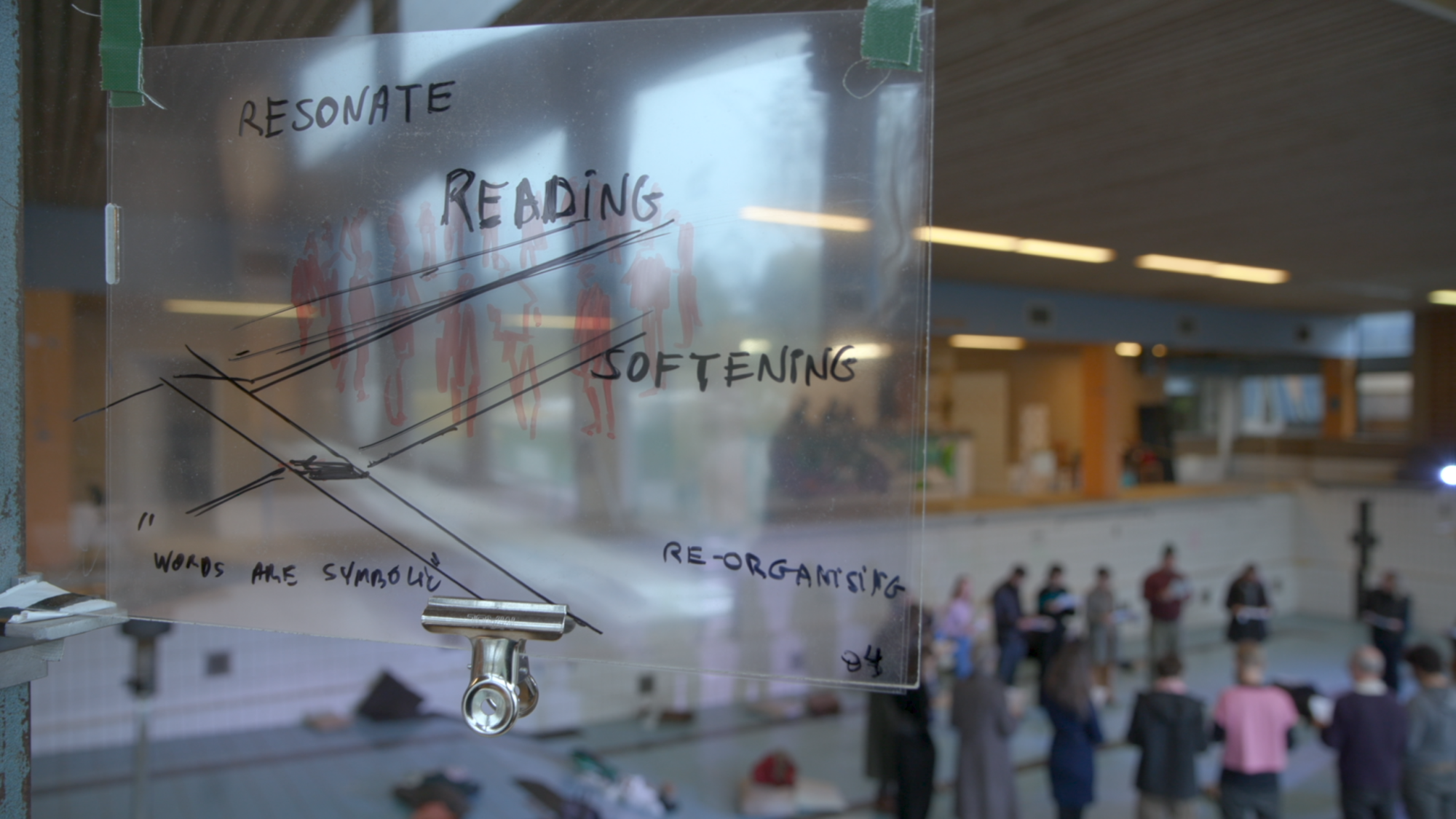
The trust that emerges in Synchronized Swimming cannot be understood in isolation. There is no knowledge, only encounters28 – the event in which the experiment took place was carefully shaped by the practices of the temporary collective that organized it. The day began with a series of structured activities – listening, noticing, walking backwards, sitting back-to-back, reading/voicing – which I recognize as establishing distinct states that collectively formed a kind of dramaturgy. These earlier scores laid the groundwork. They established a rhythm of shared attention and subtle coordination, allowing participants to approach discomfort later in the day without disorientation. In this sense, the empty pool became an action space – an ecology of entanglement in which trust could be cultivated over time through relational, material, and temporal processes.
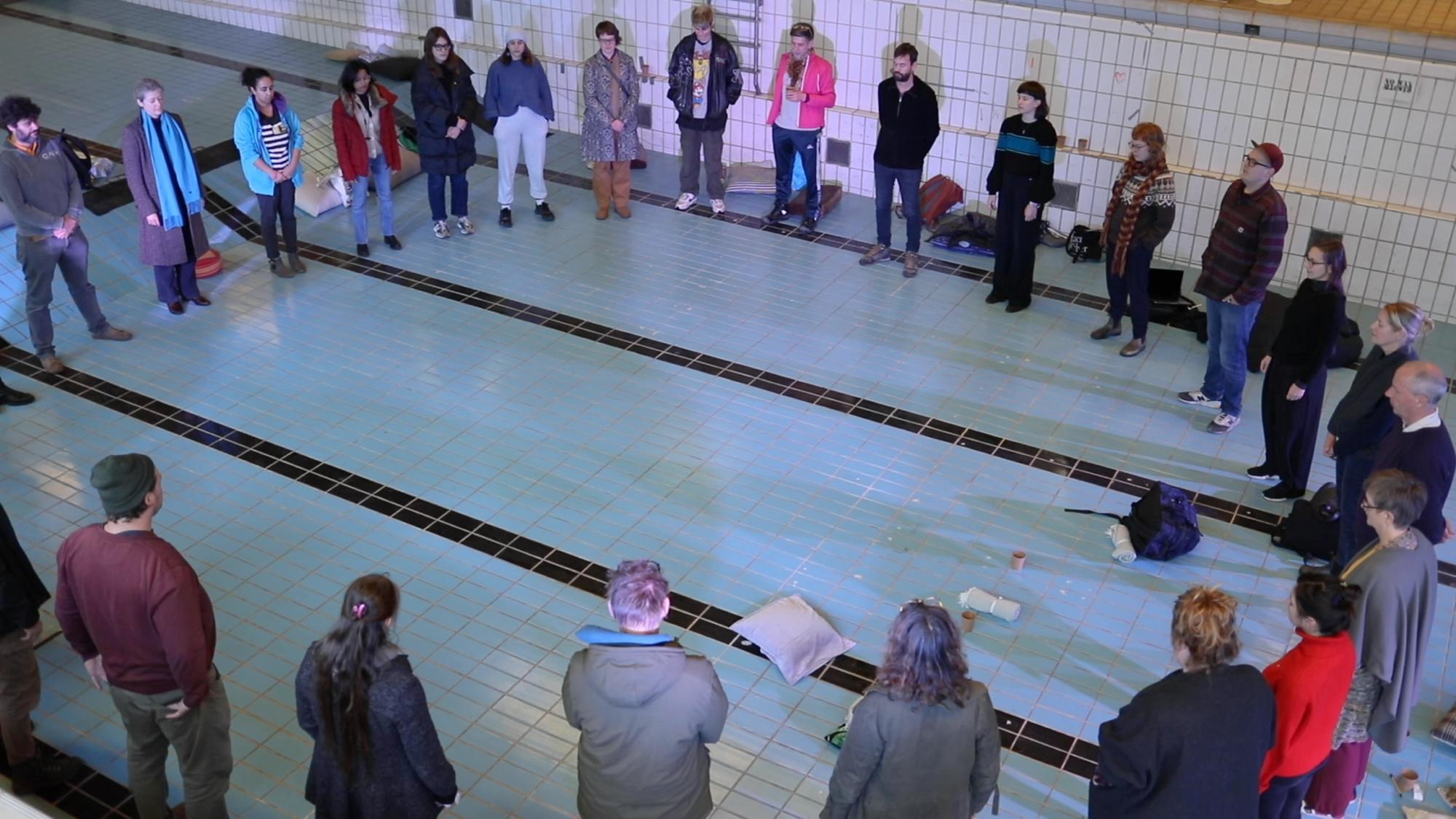
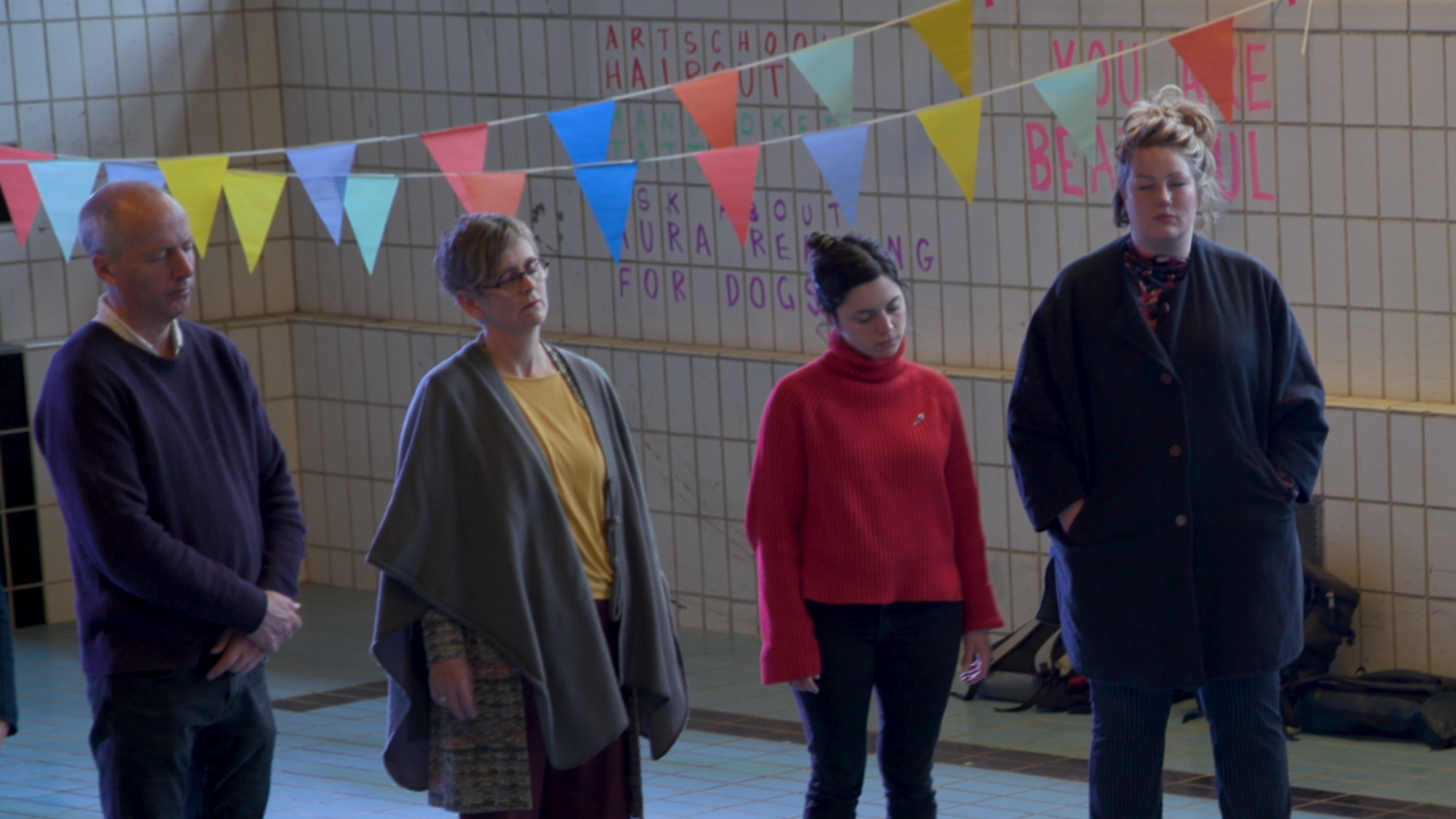
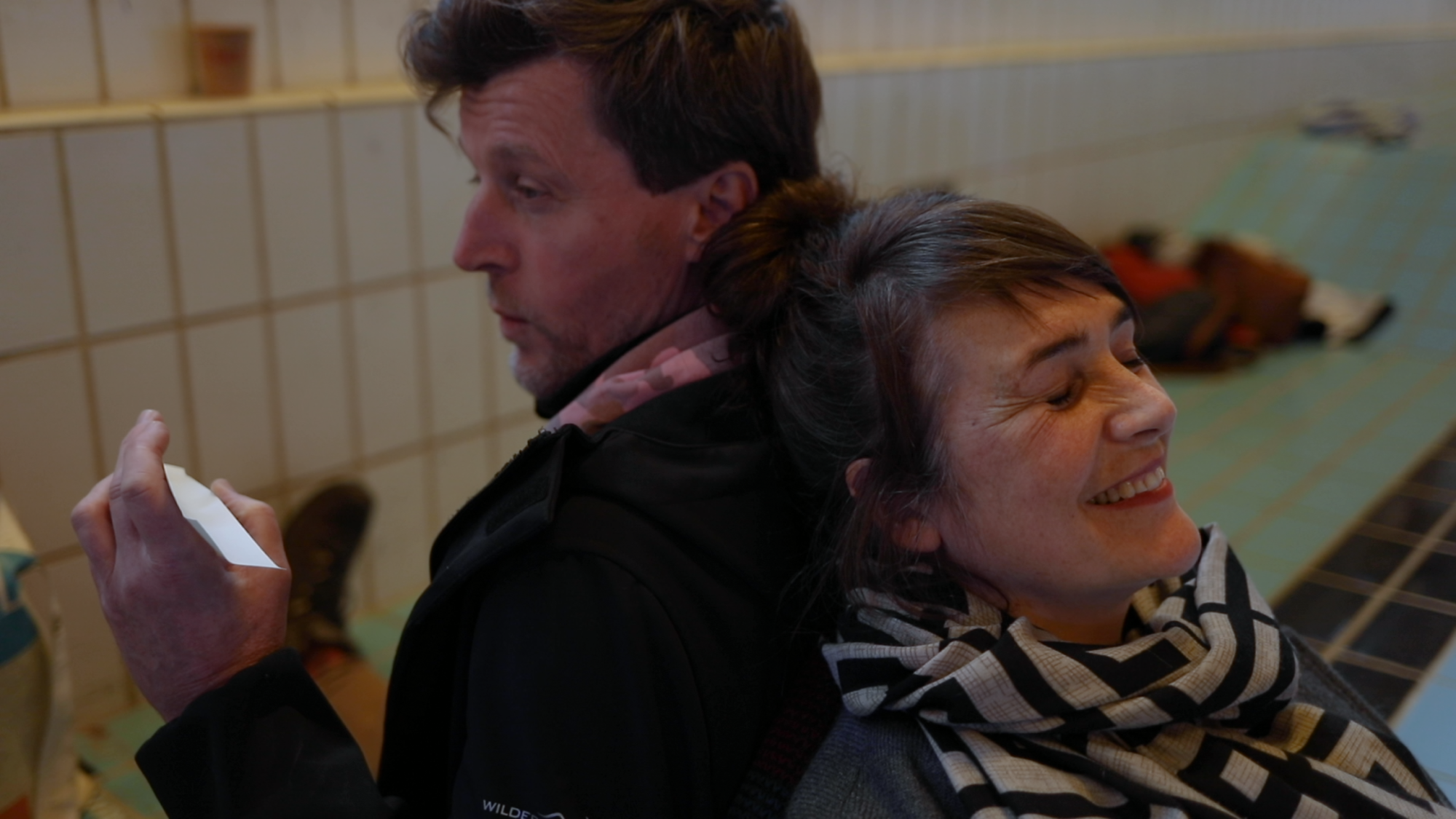
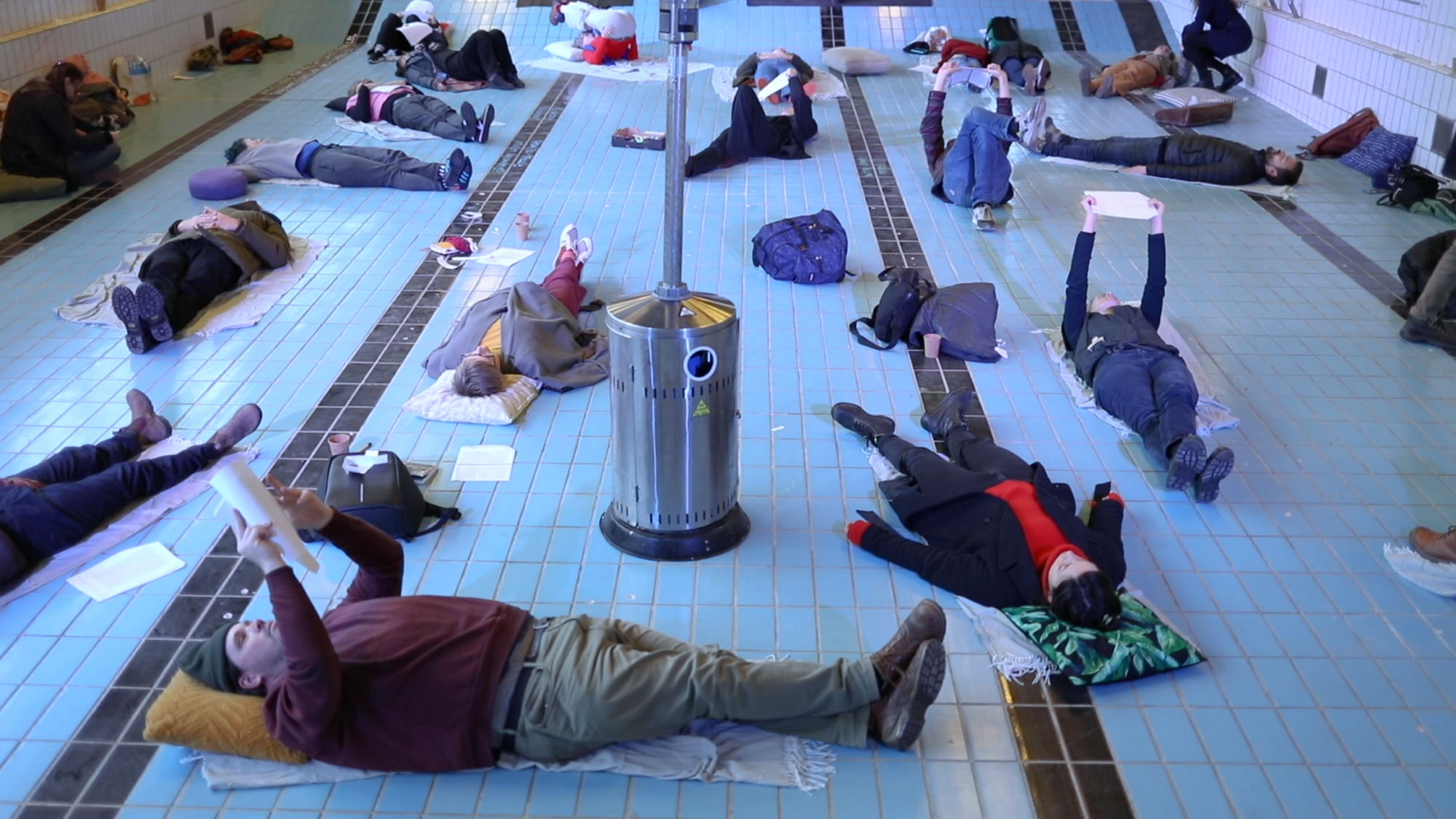
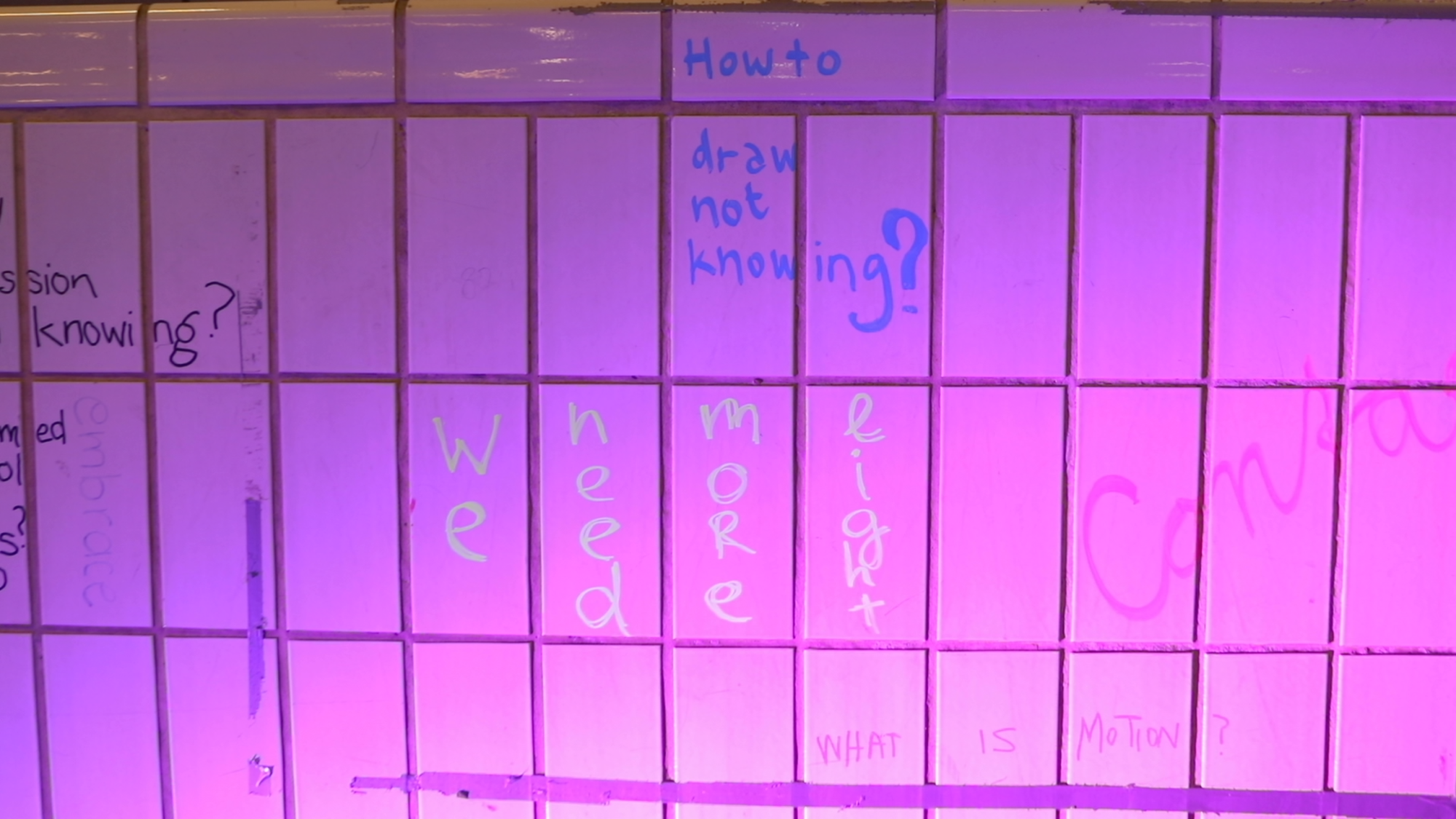
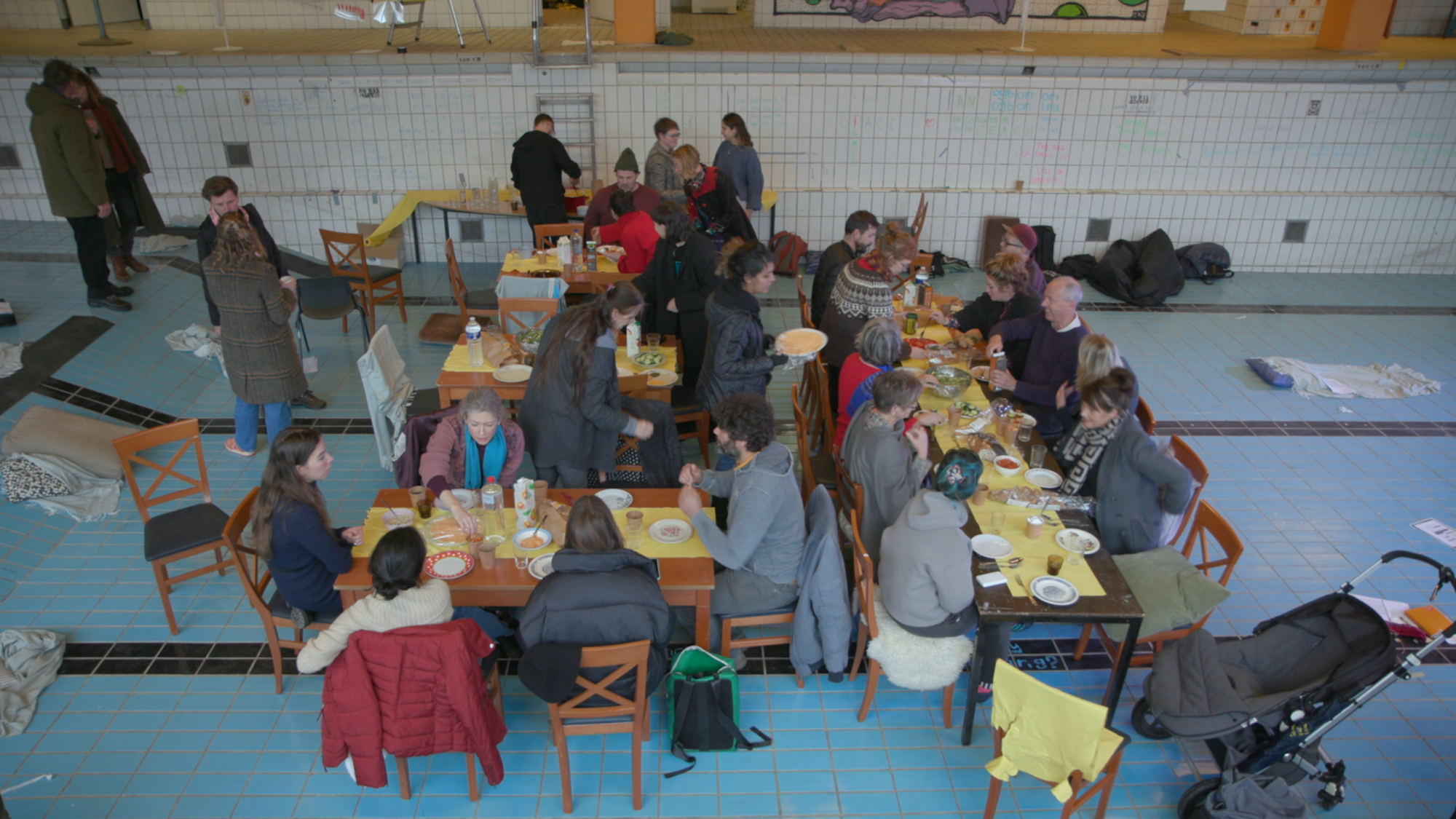
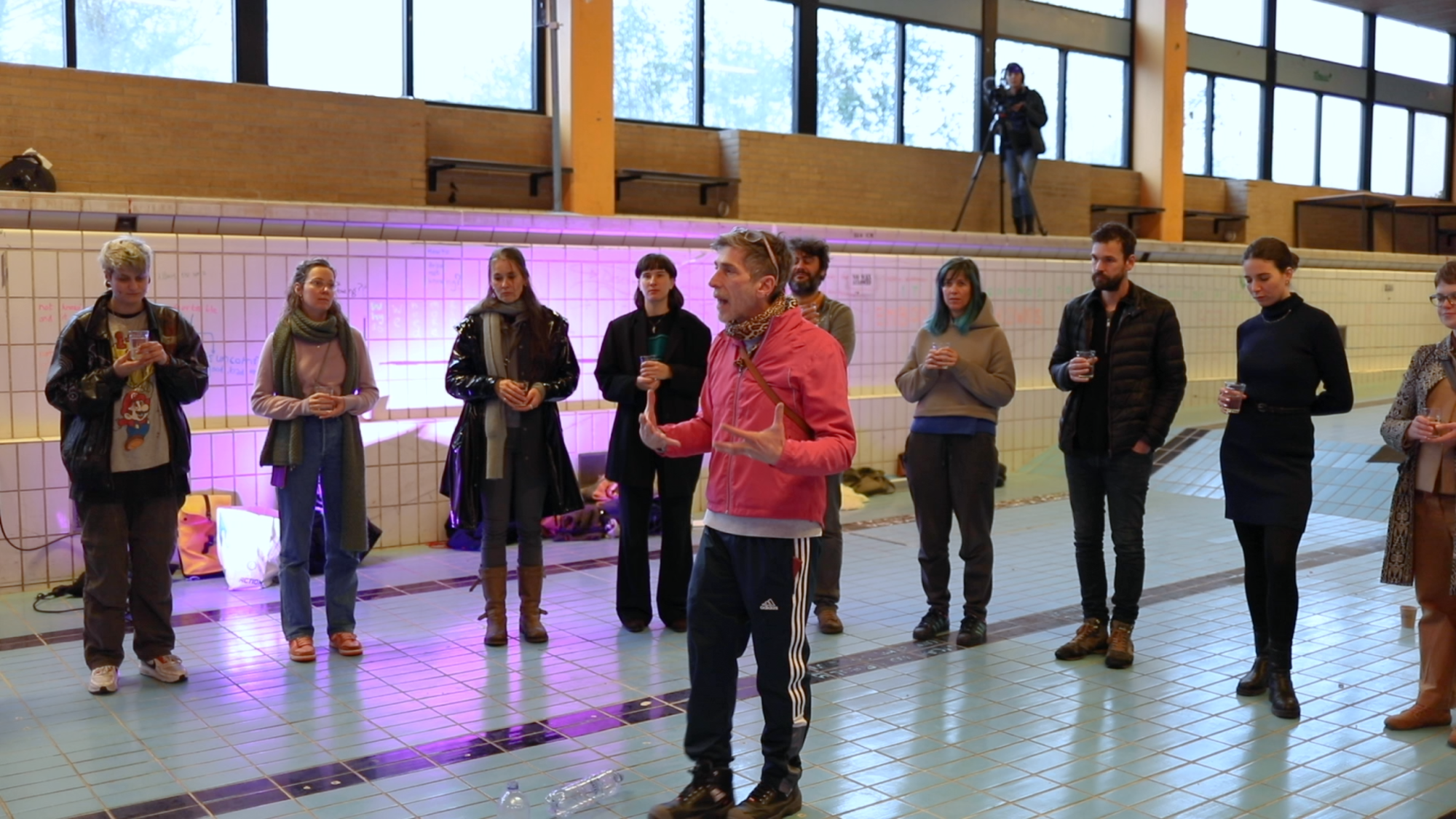
Artistic Research Community in the North, Groningen, “There is no knowledge, only encounters”, hands-on symposium on not-knowing, November 2022. All images (film stills) by VidAmir.
Discussion
Where AI systems tend to compress iterative struggle into rapid output, the score discussed here deliberately co-produces uncertainty and collective endurance, reintroducing the very conditions under which judgment and accountability are formed. In that sense, the experiment functions as a counterpoint to the dynamics outlined in the introduction clarifying the relational and ethical conditions that become fragile when judgment and agency are compressed.
In the aftermath of Synchronized Swimming, the central question became how to articulate the ethical tensions and relational dynamics that had surfaced; particularly those moments of hesitation, shared discomfort and responsiveness that unfolded in practice. Posthuman theory provided an important lens for understanding the entanglement of human and nonhuman agencies at play. It clarified that what emerged in the situation was not reducible to individual intention, but arose through distributed relations. The score functioned as a material-discursive agent, in Barad’s terms, co-producing the conditions of trust, risk, and responsiveness. From this perspective, the scores redistributed agency, inviting participation through open-ended cues rather than control and holding the tension between structure and improvisation.
While scoring has historically been associated with performance-based practices, and can certainly be analysed through its aesthetic dimension, its relevance here lies primarily in its capacity to structure ethical relations under conditions of uncertainty. I initially turned to process-oriented thinkers such as Brian Massumi and Erin Manning, whose work on emergence, encounter and collective becoming offered a vocabulary for understanding events as relational and affectively charged. Their emphasis on movement, attunement and the unfolding of the event helped to situate the experiment within a non-representational framework. Yet as my enquiry shifted toward how participants navigated responsibility together, it became clear that an additional ethical vocabulary was needed, one attuned to not only how relations emerge, but to what they demand. This is where care ethics became a complementary framework that the practice itself called forth. While participatory and performance scholarship illuminate the relational structure of collective encounters, my concern was not the event as performance, but the event as site of generative ethics. The case therefore operates as a methodological probe into the ethical conditions of engagement under distributed agency, clarifying how trust and responsibility are cultivated when human and artificial systems increasingly intersect.
Margaret Urban Walker’s expressive-collaborative model made visible how responsibility in this setting emerged through mutual responsiveness and adjustment. Rather than locating responsibility in predefined roles or compliance with rules, it foregrounded the ongoing negotiation of accountabilities within shared situations. The open-ended cues of the score held the space loosely yet intentionally, enabling deviation, misinterpretation, and improvisation without collapsing into chaos. The score became an ethical tool by keeping reflective space open amid action, allowing for difference, responsiveness, and collective risk.
Responsibility in design shifts from correctness or compliance to maintaining relational attunement. Scores, then, offer more than structure: they give form to uncertainty, echoing Calvino’s notion that constraint-based systems must contain the possibility of their own disruption. Scores that enable deviation become ethical tools, setting artistic imagination in motion; understood here as the generative capacity that unfolds across human and nonhuman agencies. If the experiment clarifies how responsibility and trust are generated among human participants, the question that follows is how these dynamics shift once artificial agents enter the ecology. What happens when both a score and an AI operate as material-discursive agents within the same relational field? The significance of the case lies in what it reveals about the distribution of agency within sociotechnical conditions. If artistic scores can act as ethical tools – material-discursive agents that hold space for uncertainty – then introducing artificial agents into this ecology will demand new forms of moral mindfulness. The challenge ahead is not primarily technical or aesthetic, but relational: designing with and for entanglements that test the limits of trust, redistribute agency, and invite artistic imagination to operate across human and nonhuman lines.
Conclusion
In response to the redistribution of agency and trust outlined in the introduction, this article contrasts two design modes: designing for and designing with. Designing for trust implies creating systems that aim to generate trust in users (for example, through transparency features). By contrast, following Donna Haraway’s call to think and act with, designing with trust positions trust as an active companion in the design process – something enacted and sustained in relation. Trust is maintained through collaboration, negotiation, and shared practice rather than built as a structure or guaranteed through good intentions. Here ‘design’ is not limited to visual knowledge production but rather refers to the shaping of relational conditions in which agency, meaning and response-ability are enacted. In both design research and education, this perspective invites a shift: from mastering tools or solving problems toward cultivating environments where meaning emerges in relation.
To practise this shift, I adapt the artistic method of the score into co-creative design contexts. Scores provide structure without prescribing outcomes, enabling design practice to move away from instrumental logics of efficiency toward the support of co-emergence, situated responsiveness, and collective risk-taking. The score’s lineage in experimental notation and Fluxus practices becomes less an aesthetic inheritance than a methodological resource for cultivating ethical attunement under contemporary technological conditions. Scores function as scaffolds providing structure around uncertainty, allowing participants to act without pre-knowledge, and creating the conditions in which trust may unfold. Reclaiming prompting itself as a gesture of invitation using scores, helps orient design toward condition-shaping rather than outcome-making, shifting the role of designers and educators to cultivating responsiveness.
Where AI systems tend to compress iterative struggle into rapid output and simulate competence without cultivating judgement – understood here as the slow, situated, and relational capacity formed through practice – scoring may deliberately reactivate uncertainty and collective response-ability. The experiment offers a counterpoint to the dominant logic of automating processes and reintroduces the relational and ethical conditions through which agency and accountability are formed. At a time when automation increasingly performs the tasks once central to design practice, this methodological reorientation clarifies what remains: the capacity to make space for collective risk, relational trust, and generative ethics. As AI systems continue to reshape design practice and education, the question is not whether to adopt or resist them, but how to cultivate the relational capacities that make shared agency accountable.
Responsibility, as this article has argued, is not located in predefined roles or compliance with rules, but arises through the ongoing negotiation of accountabilities within shared situations. Response-ability, following Haraway, refers to the situated capacity to respond to the stakes as they emerge: the ability to notice, hesitate, adjust and remain accountable within unfolding relations; attending to what matters to whom and under what conditions. In Synchronized Swimming, responsibility was not resolved in advance but enacted through response-ability. The score created conditions in which participants got to practise this capacity. In education, this shifts the conversation away from transactional questions of trust (“Do I trust my students with what they present as their own work? Do they trust me to prepare them for an automated future?”) and toward a posthuman understanding of the classroom as an ecology of entanglements. Here, meaning and responsibility are co-constituted among humans, technologies, and materials. Grounded in care ethics, this move clarifies how conditions of shared risk can be recognized and practised rather than assumed. The classroom itself can be understood as a space of moral practice, where responsibilities emerge through ongoing acts of responsiveness and mutual adjustment. In this sense, teaching becomes a caring relation enacted through co-creative encounters, with scores serving as both aesthetic and ethical structures that scaffold environments in which relational ethics and trust can be practised.
Acknowledgements
First and foremost, I would like to express my sincere gratitude to the members of Artistic Research Community ARC in the North for their contribution in the sessions described in this article. The exchanges within this community have contributed significantly to the development of this work.
I am also deeply indebted to the artists who joined the temporary collective and co-organized the event described in this article, and I extend special thanks to the participants for their engagement and generous contributions.
Furthermore, I wish to thank HKU University of the Arts Utrecht, University of Humanistic Studies Utrecht and the professorship Image in Context affiliated with Minerva Art Academy for providing the institutional contexts in which the research took place; in particular HKU University of the Arts supports my doctoral research through allocated research time.
Writing this article would have been impossible without the thoughtful guidance and critical feedback of Dr Merel Visse, Dr Henk Slager, and Dr Veerle Spronk, whose supervision has shaped the development of this research.
Finally, I would like to extend my gratitude to the members of the editorial board of FORUM+, whose rigorous and constructive engagement rendered the peer-review process a stimulating learning experience and enabled me to deepen and refine the argumentation of this article.
+++
Simona Kicurovska
investigates how digital automation technologies (algorithms / AI) are transforming the field of graphic design as a designer and a lecturer. She questions what else designers do that cannot be programmed in digital design systems. Her research is aimed at ‘designerly ways of knowing’ that contribute to socially responsible (or “response-able”) engagement in times of automated algorithmic design. Her artistic research PhD project ‘Designing with uncertainty’ is part of MAR (Meaningful Artistic Research), a partnership between HKU University of the Arts Utrecht (HKU) and the University of Humanistic Studies.
Footnotes
- Giaccardi, Elisa, and Johan Redström. “Technology and More-Than-Human Design.” Design Issues, vol. 36, no. 4, 2020, pp. 33-44; Frauenberger, Christopher. “Entanglement HCI: The Next Wave?” ACM Transactions on Computer-Human Interaction, vol. 27, no. 1, 2020, article 2. ↩
- Nicenboim, Iohanna, Elisa Giaccardi, and Johan Redström. “Designing More-Than-Human AI: Experiments on Situated Conversations and Silences.” diid disegno industriale industrial design, no. 80, 2023, pp. 32-43; Klaus, Katja, and Philipp Sack. “Machines as Teachers.” Pedagogies of Machine Learning, edited by Regina Bittner, Katja Klaus, and Philipp Sack. Bauhaus Dessau, 2024; Bittner, Regina. “Beyond the Teaching Apparatus? Technologies, Institutions, Design Pedagogies.” Pedagogies of Machine Learning edited by Bittner, Klaus, and Sack. ↩
-
The term prompt carries a pre-AI history in theatre, performance, the arts, and design practices. From the Latin prōmō – to bring forth, to bring to light – a prompt is etymologically an act of bringing something latent into presence rather than extracting a predetermined output. In theatre vocabulary, long established before the digital era, the prompter is the hidden figure who offers a cue to a performer at the precise moment the script runs out: restoring the conditions for what comes next to emerge. In design research, where participatory methods are used, open-ended instructions similarly function as devices that bring tacit knowledge and latent experience to light (Sanders, Elizabeth B.-N., and Pieter Jan Stappers. “Probes, Toolkits and Prototypes: Three Approaches to Making in Codesigning.” CoDesign: International Journal of CoCreation in Design and the Arts, vol. 10, no. 1, 2014, pp. 5-14). In process drama, Cecily O’Neill theorizes the related concept of the pretext as a source or impulse for participants in relation to potential action without prescribing its form (O’Neill, Cecily. Drama Worlds: A Framework for Process Drama. Heinemann, 1995). Across these contexts, the prompt functions as an invitation to engage in open-ended ways, allowing for unexpected developments rather than prescribing specific outcomes.
The renewed applications of AI have narrowed this understanding considerably. In that context, prompting structures human-to-machine interaction as a set of instructions optimized to elicit outputs designed for clarity, speed, and extraction. The computer sense of the word dates to 1977 (OED).
It is against this backdrop that the act of inciting response through a prompt, cue, or instruction is used here: as a carefully crafted invitation, generative in its effects, directed toward participants understood as carriers of tacit knowledge and embodied experience that cannot be prescribed in advance but can be brought forth through the right conditions. In my practice I had already been working with such cues; understood as what Manning and Massumi call “enabling constraints”, to enable novelty (Manning, Erin, and Brian Massumi. Thought in the Act: Passages in the Ecology of Experience. University of Minnesota Press, 2014). In this article, it is the score, as scaffold, that ultimately carries this logic forward. ↩ - The pink passages in this article are written as vignettes drawn from the experiment Synchronized Swimming (Groningen, 17 Nov. 2022). In these sections, I adopt a present-tense, descriptive register to invite the reader into the unfolding situation. This shift foregrounds the embodied and sensory dimensions of the encounter. ↩
- Drucker, Johanna. Graphesis: Visual Forms of Knowledge Production. Harvard University Press, 2014, introduction. ↩
- Haraway, Donna J. “Situated Knowledges: The Science Question in Feminism and the Privilege of Partial Perspective.” Feminist Studies, vol. 14, no. 3, 1988, pp. 575-99 (p. 590). ↩
- Schon, Donald A. “Designing as Reflective Conversation with the Materials of a Design Situation.” Research in Engineering Design, vol. 3, no. 3, 1992, pp. 131-47, (p. 133). ↩
- Wakkary, Ron. “Nomadic Practices: A Posthuman Theory for Knowing Design.” International Journal of Design, vol. 14, no. 3, 2020, pp. 117-28; Redström, Johan. Making Design Theory. MIT Press, 2017. ↩
- Schon, p. 132. ↩
- Braidotti, Rosi. “Affirmation versus Vulnerability: On Contemporary Ethical Debates.” Symposium: Canadian Journal of Continental Philosophy, vol. 10, no. 1, Spring 2006, pp. 235-54; Braidotti, Rosi, and Maria Hlavajova, editors. Posthuman Glossary. Bloomsbury Academic, 2018 ↩
- Barad, Karen. Meeting the Universe Halfway: Quantum Physics and the Entanglement of Matter and Meaning. Duke University Press, 2007. Barad develops the neologism “intra-action” as “the mutual constitution of entangled agencies. That is, in contrast to the usual ‘interaction’, which assumes that there are separate individual agencies that precede their interaction, the notion of intra-action recognizes that distinct agencies do not precede, but rather emerge through, their intra-action.” (p. 33). The application of this framework to trust as a relational and emergent phenomenon is my own extension of Barad’s ontology. ↩
- Braidotti, “Affirmation versus Vulnerability”; Braidotti, Rosi, The Posthuman. Polity Press, 2013. ↩
- Fahlquist, Jessica Nihlén, Neelke Doorn, and Ibo van de Poel. “Design for the Value of Responsibility.” Handbook of Ethics, Values, and Technological Design, edited by Jeroen van den Hoven, Pieter E. Vermaas, and Ibo van de Poel, Springer, 2015, pp. 473-90. ↩
- Chiou, Erin K., and John D. Lee. “Trusting Automation: Designing for Responsivity and Resilience.” Human Factors, vol. 65, no. 1, 2023, pp. 137-65. ↩
- Lindley, Joseph, and others. “Productive Oscillation as a Strategy for Doing More-than-Human Design Research.” Human-Computer Interaction, vol. 40, nos. 1-4, 2025, pp. 117-42; pp. 1-26; Lindley, Joseph, and others. “Towards a Master Narrative for Trust in Autonomous Systems: Trust as a Distributed Concern.” Journal of Responsible Technology, vol. 13, 2023, article 100057. ↩
- Barad, Meeting the Universe Halfway. ↩
- Friedman, Ken. The Fluxus Reader, 1998. researchbank.swinburne.edu.au/file/ea3479d6-558e-48bc-8fbc-3f2d84628c57/1/PDF. Accessed 7 Mar. 2025; Friedman, Ken, editor. The Fluxus Performance Workbook. 2002, figshare.swinburne.edu.au/articles/book/The_Fluxus_performance_workbook/26270992?file=47625580. Accessed 17 Aug. 2026. ↩
- Kolb, Ronald, and Dorothee Richter. “Scores – From Situated Knowledges to Shared Action.” On Curating, no. 53, 2021, pp. 118-23, www.on-curating.org/issue-53.html. Accessed 30 Jul. 2025. ↩
- Cocker, Emma. The Yes of the No. Site Gallery, 2019; Cocker, Emma. “Uncertain Knowledges.” Research Catalogue, 2021, www.researchcatalogue.net/view/1126356/1307564/0/0. Accessed 7 Mar. 2025; Cocker, Emma. Tactics for Not Knowing: Preparing for the Unexpected. Artistic Research Does #7, i2ADS – Instituto de Investigação em Arte, Design e Sociedade, U of Porto, 2023, i2ads.up.pt/wp-content/uploads/2023/10/ARD7_EmmaCocker_i2ADS.pdf. Accessed 7 Mar. 2025; Cocker, Emma, Nikolaus Gansterer, and Mariella Greil, editors. Choreo-Graphic Figures: Deviations from the Line. De Gruyter, 2017. ↩
- Calvino, Italo. “Cybernetics and Ghosts.” Oulipo: A Primer of Potential Literature, edited by Warren F. Motte, Jr., U of Nebraska P, 1986, pp. 1-13. ↩
- Walker, Margaret Urban. Moral Understandings: A Feminist Study in Ethics. 2nd ed., Oxford University Press, 2007, pp. 67-68. ↩
- Cocker, Emma. The Yes of the No. Site Gallery, 2019, p. 217. ↩
- Cocker, Tactics for Not Knowing. ↩
- Brinck, Ingar. “Joint Improvisation in the Arts Practices: Entrainment, Engagement, and Expert Skill.” Proceedings of A Body of Knowledge - Embodied Cognition and the Arts Conference, University of California, Irvine, 8-10 Dec. 2016. ↩
- Cocker, Emma. “Uncertain Knowledges.” Research Catalogue, 2021, www.researchcatalogue.net/view/1126356/1307564/0/0. Accessed 7 Mar. 2025. ↩
- Kolb and Richter, p. 122. ↩
- Friedman, The Fluxus Reader. ↩
- The event There is no knowledge, only encounters, a hands-on symposium on not-knowing held in November 2022, was created by the temporary collective comprised of: T.S. Anna, Simona Kicurovska, Kevin Perrin and Adri Schokker (Artistic Research Community in the North, Groningen), Emma Cocker, Ernest Truely and Lua Vollard. The event was organized in partnership with the professorship Image in Context affiliated with Minerva Art Academy and part of the Research Centre Art & Society. The event was made possible with the support of Kunstraad Groningen. Video documentation was by VidAmir. Images are screenshots from this footage. ↩
More from this dossier
Educational research in the arts: a practice-based and nomadic perspective
Joost Vanmaele, An De bisschop
More from this edition
Nurturing musician-educators’ reflective practice through a Blended Intensive Programme on practitioner research
Mathias Moors, Adri de Vugt, Thomas De Baets
Co-learning: Conversational, situated, and more-than-human pedagogies at Master’s level
Guus Vandeweerd, Anneleen Swillen