Dit artikel verscheen in FORUM+ vol. 33 nr. 1, pp. 4-13
Mapping smooth spaces. A co-creation methodology for interdisciplinary artistic practice
Adrián Artacho, Leonhard Horstmeyer, Hanne Pilgrim
This paper presents a co-creation methodology developed in the artistic research project Atlas of Smooth Spaces. Through stages like Null-Space, Experiments, Notation, Collision, Composition, and Performance, we explore smooth spaces – dynamic, embodied and non-hierarchical fields of possibility. Emphasizing interdisciplinary collaboration, relational dynamics, and the interplay of structure and fluidity, the methodology fosters innovative artistic practices. It offers conceptual tools for co-creation and transdisciplinary collaboration in the Performing Arts.
Dit artikel presenteert een co-creatiemethodologie die is ontwikkeld binnen het artistieke onderzoeksproject Atlas of Smooth Spaces. Via verschillende fasen, zoals Null-Space, Experiments, Notation, Collision, Composition en Performance, verkennen we smooth spaces – dynamische, belichaamde en niet-hiërarchische ruimtes vol mogelijkheden. De methodologie stimuleert innovatieve artistieke praktijken en benadrukt daarbij interdisciplinaire samenwerking, relationele dynamiek en het samenspel van structuur en fluïditeit. Ze biedt conceptuele tools voor co-creatie en transdisciplinaire samenwerking in de podiumkunsten.
In the context of the multidisciplinary artistic research project Atlas of Smooth Spaces in the Audiocorporeal Arts,1 we developed a co-creation methodology that sets disciplinary collisions at the centre of knowledge production. Rather than limiting collaboration to the overlapping edges of disciplines, our approach embraces bold, transdisciplinary processes and non-hierarchical integration of multiple perspectives. Emerging from practice, while at the same time being continuously shaped through its application, the methodology reflects the iterative and reflective nature of artistic research. This article outlines its development through exchanges between performing artists and a complexity scientist researching the spaces created, shaped, and accessed by performers. We illustrate its application through collaboratories across artistic disciplines such as Eurhythmics, Dance, Direct Sound, and Choir Conducting, and propose its potential for broader interdisciplinary use.
The seven interconnected stages of our proposed methodology should not be understood as a rigid sequence. An “Experiment” (Stage 2) might spontaneously generate a new “Null-Space” (Stage 1); a “Collision” (Stage 4) might necessitate revisiting “Notation” (Stage 3) mid-process; the “Performance” (Stage 6) might fundamentally alter the “Composition” (Stage 5). One of the ways we account for this fluidity is through the Atlas, a cartographic framework (introduced in Stage 7) that assembles the diverse outcomes of the process into a dynamic, multi-perspectival record.
We draw on the joint work of philosophers Gilles Deleuze and Félix Guattari as a conceptual toolbox. Their concepts of “smooth space” versus “striated space”,2 “line of flight”, “assemblage”, and “body without organs” offer precise ways of articulating phenomena we encountered in our practice: the tension between openness and structure, the negotiation of disciplinary boundaries, and the creation of shared spaces of indetermination. This methodology is therefore best read as a conceptual ecology that can be adapted, disrupted, and recombined in each unique collaborative encounter: a provocation to question habitual methods of artistic collaboration, to test new relational constellations, and to resist the comfort of fixed procedures.
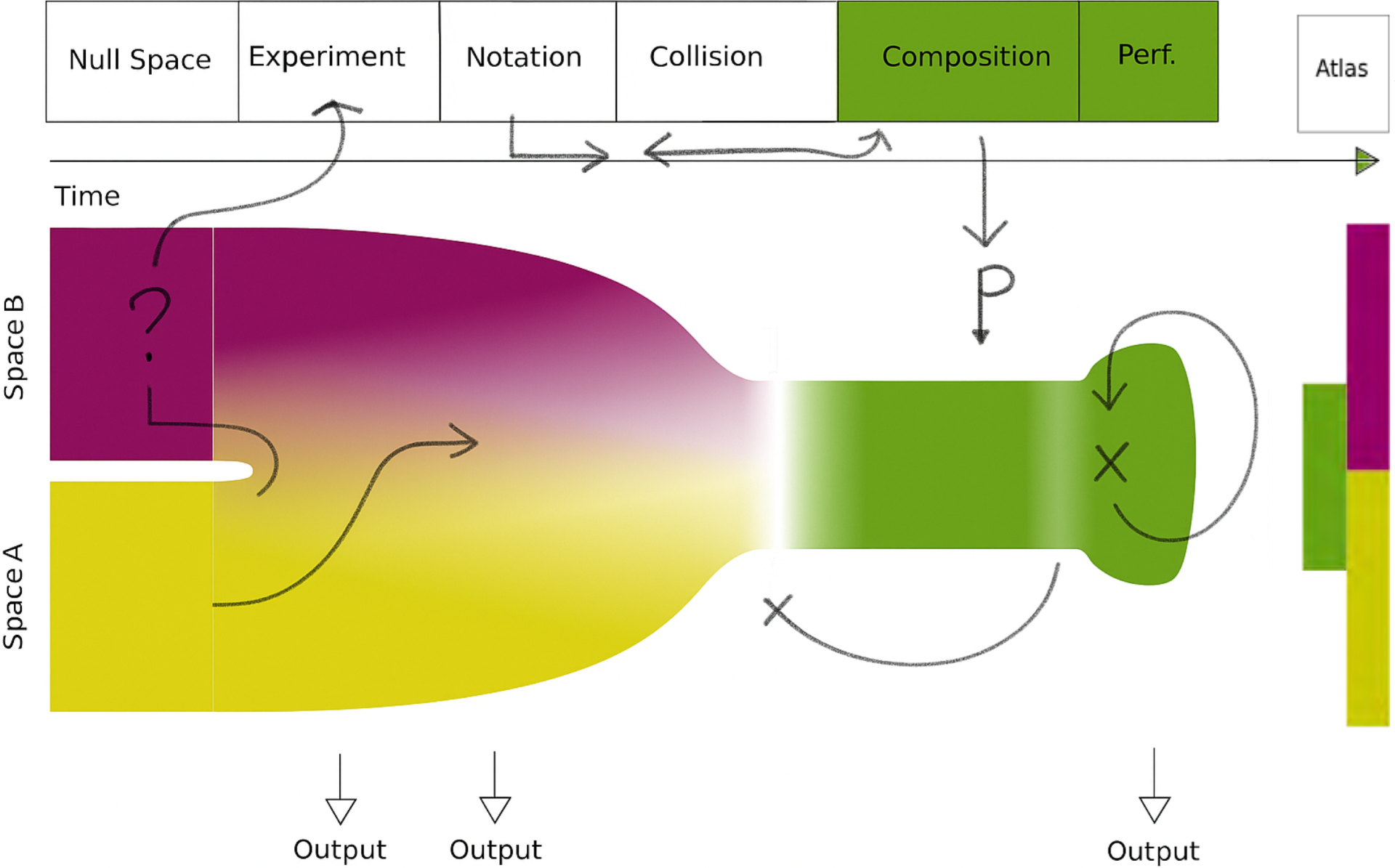
Diagrammatic representation of the methodology pipeline, annotated working document, 2025. Image by Leonhard Horstmeyer, adapted by Adrián Artacho, for the project Atlas of Smooth Spaces.
1. Null-Space: A negotiable starting point
The genesis of the null-space concept lays in a question from our transdisciplinary collaboration (dance, eurhythmics, choir conducting, and direct sound): how could we transition between different disciplinary maps without privileging a single framework? This challenge prompted us to search for a generative ground zero, leading us to the statistical notion of the null hypothesis. Unlike its statistical counterpart however, our null-space is not a testing baseline but a qualitative, context-dependent construct: a negotiable moment of shared uncertainty that practitioners are encouraged to negotiate collectively. It resonates with Deleuze and Guattari’s concept of “assemblage”,3 which links the problematics of structure with those of change and emergence, and with the Deleuzian idea of a body without organs, acting as a metaphorical field of intensity and potential, free from fixed functions. But as Deleuze and Guattari are quick to note, the body without organs is made, not found, and is always approached from a specific, stratified position. The ‘negotiable starting point’ is never free of the micropolitics and molar4 histories of the participants, and hence this statistical analogy should highlight the impossibility of a truly impartial starting point, a blank slate of sorts. This also aligns with phenomenological approaches that emphasize lived experience and the primacy of perception in shaping reality. At its core, null-space is an intersubjective construct – a space where meaning and knowledge are co-constructed through shared experiences and interactions. It is not something that exists independently of the practitioners who inhabit it, but rather something that emerges through their collective engagement.
How could we transition between different disciplinary maps without privileging a single framework?
In our practice, null-space has proven to be a powerful tool for fostering transdisciplinary collaboration. For example, in the Études d’Espace project, a eurhythmician investigated the spatial affordances of piano playing while a mathematician simultaneously described the gestures and actions in non-musical terms. This dual activity created a suspension of disciplinary authority: rather than privileging the pianist’s expertise or the mathematician’s analytic framework, both were positioned at an initial stage of not knowing. The place of indetermination was enacted through improvised tasks that neither discipline fully owned – for instance, mapping bodily movements without reference to notation, or describing them without recourse to established mathematical formalism. Of course, working within a null-space is not without its challenges, and in this project the tension between indetermination and the need for structure often became tangible: too much openness risked confusion, while too much formalization threatened to collapse the experiment back into disciplinary habits. Yet precisely this negotiation made the null-space generative – it led to a shared vocabulary of gesture and description that neither participant could have produced alone, thereby enabling the group to move beyond disciplinary constraints and to co-create a non-hierarchical compositional space.
Illustrative outcomes of the null-space practice include research on the movement affordances of a pianist, where exploratory sessions investigated how bodily gestures around the keyboard could generate new spatial possibilities for performance (this work later informed compositions such as Six Memos for a Pianist and a Self-Playing Piano). Another case was the microphone boom operators’ null-space: through collaborative workshops the group identified – and for the first time systematically documented – the fundamental movement sequences that constitute their craft. These were described as an ‘alphabet’ of boom operation, encompassing both ergonomic constraints (e.g. balancing weight, avoiding microphone shadows) and practical strategies (e.g. cueing shifts, adapting to actor movements). This shared vocabulary directly fed into the development of Tallis in Wonderland and was further formalized using video and motion-capture suits to produce a visual lexicon of boom operating techniques.
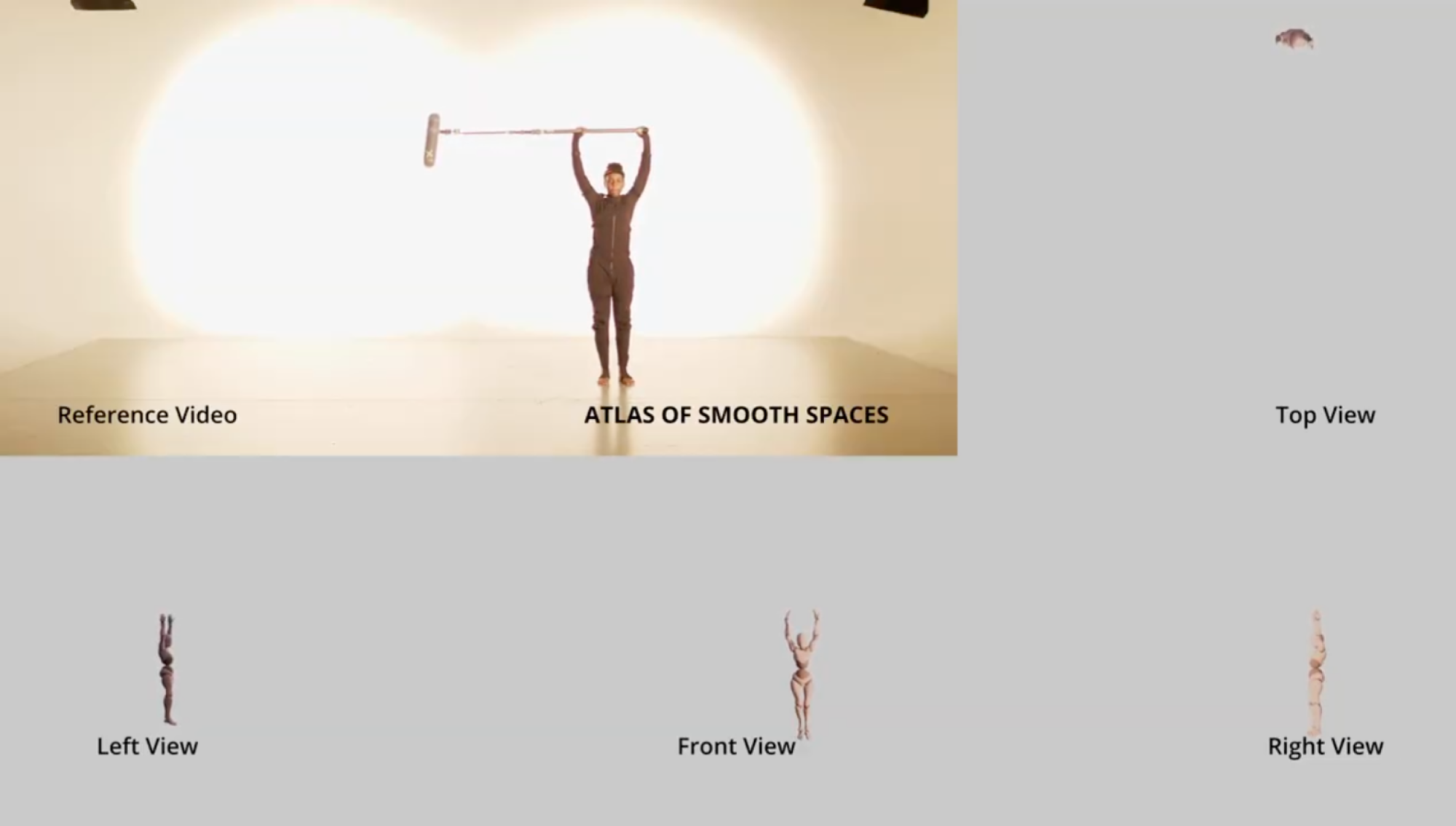
Still from the boom operator ‘alphabet’ motion capture documentation, 2025. Frame from a video by William Édouard Franck, for the project Atlas of Smooth Spaces. (Full video available on YouTube).
Ultimately, collaboration is inherently micropolitical. Whose voice is heard? Whose discipline sets the initial terms? Whose bodily habitus dominates? These questions also became tangible in our work when, for example, choreographers and musicians entered the process with different assumptions about rehearsal time, authorship, and bodily authority. The ‘Null-Space’ stage was devised with the explicit goal of enforcing a starting point of shared uncertainty, precisely to counterbalance such asymmetries. Collaboration is inevitably entered from different positions of power, knowledge, and institutional backing, and in our sessions, we saw how even well-intentioned collective agreements could mask subtle coercion, unspoken hierarchies, or the dominance of certain individuals or disciplines (for example theoretical framings overtaking practical exploration). Naming this micropolitical level was thus crucial: it helped us remain alert to dynamics that might otherwise have gone unnoticed, and to adjust the process in real time.
2. Experiments: Pursuing lines of flight
Experiments are the lifeblood of our co-creation process, involving the creation of assemblages of heterogeneous elements provisionally brought together to see what they can do. During such open-ended, transdisciplinary explorations we are pursuing what Deleuze calls “lines of flight” – movements of escape and transformation that open up new possibilities beyond established structures. The objective of these experiments is not merely to test artistic ideas in a general sense (as experimentation is always part of art-making), but to stage encounters where disciplinary habits collide, and new capacities emerge.
The tension between indetermination and the need for structure often becomes tangible.
In our experiments, a dancer, a musician, or a mathematician could step outside the conventions of their own practice and explore shared problems from unfamiliar angles and generate responses to concrete questions raised by the group. Hence, experiments are not merely exercises in trial and error, but deliberate acts of inquiry that apply a plurality of methods to address specific artistic and spatial questions. For instance, how can the addition or subtraction of elements alter the space around a performer? How do different parameters contribute to phenomenological jumps (sudden shifts in perception or experience) during performance? How can we record and analyse the dimensionality, synchronicity, continuity, fractionality, or separability of spatial phenomena? These questions guided some of our experiments, pushing us to explore the limits of what is possible within the performative space.
One telling example of this approach is the Desire Machine project, which took place at the intersection of movement, light, and sound, emphasizing the relational and dynamic nature of performative space.5 The experiment began with a minimal setup: a space and a performer. To structure the interplay of media, we drew inspiration from Hausdorff’s separability axiom in mathematics,6 which describes a space where any two distinct points can be given their own neighbourhoods without overlap. Translated into our artistic process, we set out to explore ways in which sound, light, and movement could coexist without collapsing into one another, each retaining its distinct quality while still interacting fluidly within the same performative field. Our goal was to create a network of relations that resisted homogeneity and linear order: no element could dominate or stabilize the field. For the dancer, this translated into a practice of navigating between changing zones of attraction and resistance, letting movement be guided less by pre-set choreographic intention than by the evolving interplay of light and sound.
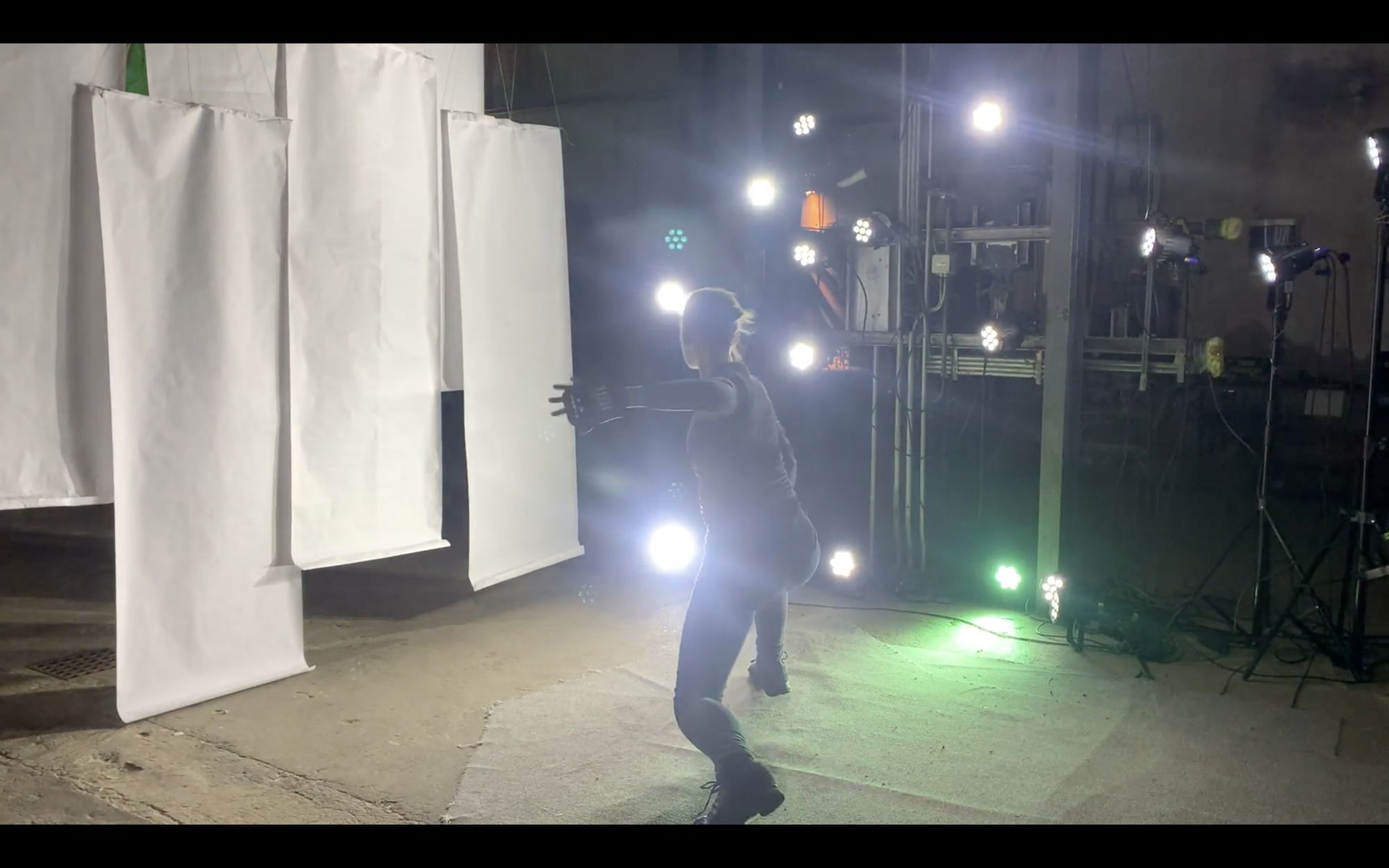
Still from the Desire Machine performance video at the Schmiede Hallein, 2023. Image by Adrián Artacho, for the project Atlas of Smooth Spaces. (Full performance video available on YouTube).
In this way, performers and environment entered a feedback loop where each action altered the conditions for the next. The result was a continual blurring of boundaries – between body and technology (as movements were instantly transduced into machinic responses), between space and performance (as lighting defined shifting architectures), and between sound and gesture (as sonic events arose from bodily motion rather than pre-composed score). The approach embraced Deleuze and Guattari’s logic of assemblage, by which hierarchies are not determined by the nature or value of substances but by the modes of organization that bring them together.
The hierarchies are not the result of substances and their nature and value but of modes of organization of separate substances. They are composed of lines, of movements, speeds, and intensities, rather than of things and their relations. Assemblages or multiplicities, then, because they are essentially in movement, in action, are always made, not found. They are consequences of a practice.7
We later extended this approach to other disciplinary collaborations. For instance, when eurhythmics practitioners and a choir worked together, specific body gestures had to be negotiated with choral timing cues, generating hybrid practices that neither discipline could have anticipated. Similarly, collaborations between boom operators and dancers led to spatial scores where microphone placement was treated as choreographic material. These concrete exchanges show that diversity is not a barrier but a resource, enabling us to explore performative space from multiple angles and to uncover connections that would remain invisible within disciplinary silos.
Nonetheless, experimentation presents inherent challenges. How do we balance spontaneity and structure in the experimental process? How do we document and analyse the often ephemeral outcomes of these explorations? And how do we ensure that the insights gained from one experiment can inform the next? These questions have led us to refine our approach by developing concrete tools such as video documentation, motion-capture recordings, and annotated scores, which later converge in the Atlas as a shared repository. The experiment stage is ultimately about more than just generating new ideas or techniques: it establishes a space where the familiar is disrupted and performers, technologies, and disciplines are compelled to interact in ways that break habitual patterns. In this sense, experiments are not simply one stage of the methodology but a mode of inquiry – a way of working that foregrounds uncertainty and cultivates curiosity as productive forces.
3. Notation: Reconstituting smooth spaces
In the journey of co-creation, notation emerges as a pivotal stage, the point at which the fluid, dynamic, and often intangible phenomena that emerge from the performative space are translated into shareable forms such as graphic scores, annotated video, verbal protocols, or motion-capture traces. Assuming a dual function, notation captures the relational and experiential dimensions of space – implying a certain degree of ‘territorialization’/‘striation’ – and creates new possibilities (deterritorialization) within that space.8 By enforcing striation upon the infinite possibilities of a ‘smooth space’, notation confines, delineates, and imposes a system among many potential ones. Yet, paradoxically, it is precisely within these confines that the playful, the intensive, and the uncountable can thrive. But how can one keep these confines ‘open’ and avoid solidifying the intensive in the process? How does one create a notation that won’t privilege a disciplinary perspective and exclude others? And ‘who’ is authorized to notate a space that is transdisciplinary in essence? Ultimately, the act of notation does not simply move from the smooth to the striated, but also reconstitutes smooth space, re-imparting fluidity and multiplicity in the wake of structure. In this sense, notation performs an ostensibly paradoxical task: it destroys the primordial smooth space of infinite possibilities and simultaneously creates and opens up new smooth spaces around itself.
Collaboration is inherently micropolitical. Whose voice is heard? Whose discipline sets the initial terms? Whose bodily habitus dominates?
In our methodology, this paradox was explored by asking ourselves how ephemeral practices could be rendered shareable without being reduced – for instance, through annotated video, motion-capture traces, or hybrid scores – and by experimenting with how such notations, once produced, could themselves generate new tasks and reframe the creative process.
Notational practices will often focus on the striated dimensions of space – its measurable, metric, and physical characteristics. While these aspects are important, we found that they only tell part of the story. We miss a way to capture the qualitative, experiential dimensions of space – the ways in which space is felt, perceived, and lived. This is where our research aims to contribute. Rather than relying solely on established systems such as staff notation for music, Laban or Benesh notation for dance, or technical schematics for stage design, we propose the development of space-notations – idiosyncratic encoded languages that translate spatial phenomena into comprehensible, shareable, and performable forms. These notations are not static or prescriptive but dynamic and open-ended, designed to evolve with the practices they describe. They are, in essence, systems of articulation that seek to enable the composition, manipulation, and performance of space itself.
For example, in some of our collaboratories, we explored the use of the ‘boom’ – a tool used in film production to capture audio from a subjective perspective – as a basis for creating notations that register the relational dynamics of performative space. In practice, this meant tracing how the boom’s movement through the room affected and was affected by performers: its shifting distance from bodies, its orientation toward sound sources, and the way these factors reconfigured both audibility and visibility. By recording these trajectories and proximities, we were able to notate the ways in which the performer’s movement shaped the sonic field and, conversely, how the boom’s presence imposed choreographic constraints and opportunities. Within the artists’ own practices, this exposed overlooked interdependencies: dancers began to treat the boom as a partner in movement rather than a neutral recording device, while boom operators recognized their gestures as part of the performative vocabulary. Our notations invited performers to engage with the space in new and unexpected ways, raising questions such as: how can we conceptualize diffuse fields as active spaces for movement and interaction? What role can dance notation systems play in the investigation of smooth spaces? And how can we communicate spatial experiences across practices, condensing them into performative and compositional forms?
The development of space-notations is necessarily a collaborative endeavour, shaped by the contributions of all participants and informed by the perspectives of various disciplines. The other – perhaps deeper – challenge that we already hinted at lies in the power inherent in ‘who’ creates the notation and ‘what’ gets captured or valued. Does the notation truly reflect the multiplicity of perspectives, or does it inevitably prioritize certain sensory modes (visual, symbolic) or disciplinary logics (mathematical diagrams versus movement scores)? The ‘idiosyncratic encoded languages’ we mentioned earlier risk becoming new, potentially exclusionary, striations if not constantly negotiated. In our collaboratories, these questions became tangible in the making of space-notations. For instance, when working with dancers and boom operators, spatial trajectories were captured both through annotated drawings and through motion-capture traces. Negotiation was required: the visual diagrams privileged geometric clarity, while the motion-capture data highlighted temporal and kinetic nuances. Rather than choosing one over the other, we developed hybrid notations that layered multiple perspectives, ensuring that neither the dancer’s embodied knowledge nor the boom operator’s technical framing dominated. These notations did not remain on paper: they fed directly back into rehearsal, where performers used them as prompts for new actions and reinterpreted them as compositional material. In this way, the notation process both documented and actively shaped the unfolding of the artistic work.
4. Collision: A collective becoming
In the landscape of our co-creation methodology, the stage we call “Collision” is where the sparks fly. It is here that disciplines, practices, and perspectives come into contact, not merely to coexist but entering a transformative relation, each altering the other (a transformed state) that resonates with the Deleuzian notion of “becoming”. A collision, in this sense, is not a passive overlap or a polite exchange of ideas; it is an active, dynamic encounter that generates friction, tension, and ultimately new possibilities. It is a moment of rupture and recombination, where the familiar is disrupted and the unknown becomes a source of creative potential.9
To understand what a collision is, we might begin with its most archetypal form: the physical collision of two objects. In Newtonian mechanics, a collision involves a clear sequence of events: before, during, and after. The ‘Before’ consists of distinct, non-intersecting entities moving through space. ‘During’ marks the moment of contact, where boundaries touch and forces interact. ‘After’ reflects a transformed state, where velocities, trajectories, and even internal structures have changed. This framework, while misleadingly simple (it might downplay the asymmetry and micropolitical friction of real-world disciplinary encounters), offers a useful metaphor: disciplinary collisions in artistic research can be thought of in terms of Newtonian collisions, in the way that distinct entities meet, interact, and are transformed in the process. Beyond the simplicity of collisions in classical mechanics, one can refine the metaphor through insights from particle physics, where the fundamental entities are not discrete particles but pervasive fields – borderless, ephemeral, and constantly interacting. A collision between fields lacks the clear temporal and spatial boundaries of classical mechanics. In our methodological context, the term points to disciplinary encounters that do not resolve into clean sequences but involve ongoing mutual shaping, where boundaries blur and outcomes emerge gradually rather than at a single point of impact. Unlike physical collisions, however, disciplinary collisions are shaped by the interplay of ideas, perspectives, and creative practices.
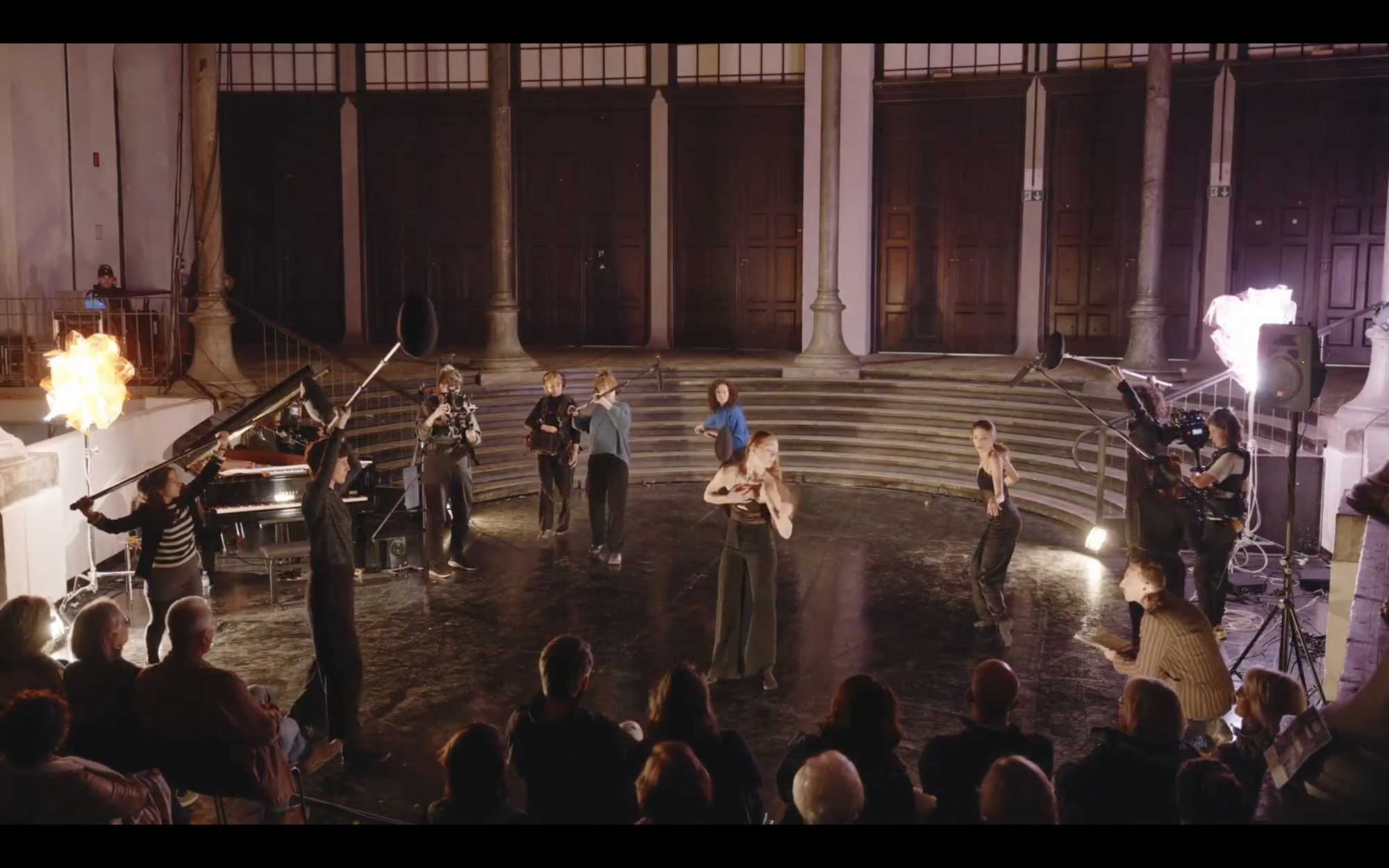
Picture from the performance Tallis in Wonderland in the Atelierhaus of the Academy of Fine Arts Vienna, 2023. Frame from a video by Amin Ebrahimi, for the project Atlas of Smooth Spaces. (Full performance video available on YouTube).
In our collaboratories, disciplinary collisions have been a source of profound insight, but have not always been easy to navigate. For example, in the Tallis in Wonderland project, the collision of a choir performing a complex musical text, spatial exploration by boom operators, and choreography was geared towards generating a non-hierarchical compositional space, but this was only possible if power imbalances were adequately addressed during the collision. In bringing together practitioners from diverse disciplines, we strived to create a space where differences were not smoothed over but actively engaged. This meant, for example, pairing a dancer and a boom operator in tasks where bodily movement had to be described in sonic rather than choreographic terms, or inviting a choir conductor and a eurhythmics practitioner to negotiate shared cues for timing and space. These frictions did not dissolve into consensus but generated emergent practices, such as hybrid gestural vocabularies that bridged bodily and sonic notation, and conceptual shifts that reframed individual expertise in relational terms. The collaborative outputs, ranging from experimental scores to site-specific performances, thus embodied perspectives that transcended the boundaries of individual disciplines.
The collision stage is not without its challenges, either. How do we navigate the friction and tension that arise when disciplines collide? How do we ensure that these encounters are productive rather than destructive? And how do we capture and communicate the insights generated through these collisions? An oversimplified framework – such as the clean-cut before/during/after analogy – can mask unexamined structural hierarchies: the kind of large-scale, rigid categories that Deleuze and Guattari describe as “molar structures”. It should therefore never stand in the way of a critical examination of the method. These questions are central to our approach, driving us to develop new tools and techniques for documenting our disciplinary encounters and fostering a critical examination that, in turn, generates insights specific to our collaborative practice.
5. Composition: Creating “blocs of sensation”
At a certain moment in the creative process, all the elements must come together into a cohesive whole. The composition stage is therefore deeply reliant on other stages. The null-space, with its emphasis on intersubjective uncertainty and qualitative beginnings, provides the conceptual foundation. The experiments, with their open-ended explorations, the spaces created by the notational practices and transdisciplinary collisions, generate the raw materials – ideas, movements, sounds, and interactions – that inform the composition. And the collisions, with their dynamic interplay of diverse perspectives, enrich the process with new insights and possibilities. Together, these stages create a rich tapestry of elements that the composition stage weaves into a unified whole.
Reflecting the tension between territorialization (forming the composition) and deterritorialization (keeping it open and fluid), we do not understand composition merely as the act of assembling parts into a finished product. Far from being a linear or prescriptive process, it involves cultivating a space of potentiality – a conceptual and performative environment where action, perception, and meaning emerge dynamically. This space is not merely physical; it is inherently relational, shaped by the interplay between the performer’s body, their environment, and the abstract frameworks established during other stages. It is a space that exists as an extension of the performer’s perception, a space that is not found but made through the act of composition. This materialization of possibility spaces, of abstract ideas and relational dynamics into a performative reality, creates “blocs of sensation” (percepts and affects that stand on their own) in the Deleuzian sense.
The dual function of notation as describing and creating spaces of possibility reflects a broader tension in the composition process – the tension between structure and fluidity, between precision and openness. On one hand, composition requires a certain degree of structure to give shape to the performative space. On the other hand, it must remain fluid enough to allow for improvisation, interpretation, and emergence. This balance is not easy to achieve, but it is essential for creating a space that is both coherent and dynamic, both grounded and open to possibility.
Using the Six Memos for a Pianist and a Self-Playing Piano project as an example, the composition stage involved translating the relational dynamics of human performance, algorithmic processes, and spatial sound into a performative space that could be inhabited and explored by the performers.10 The composition stage also raises important questions about communication and collaboration. How do we articulate the contours of an abstract space in a way that resonates with performers? How do we create such notations that are both precise and open, both descriptive and generative? And how do we ensure that the insights and perspectives gathered from all stages are effectively integrated into the composition? These questions, central to our methodology, have driven us to develop new tools and techniques.
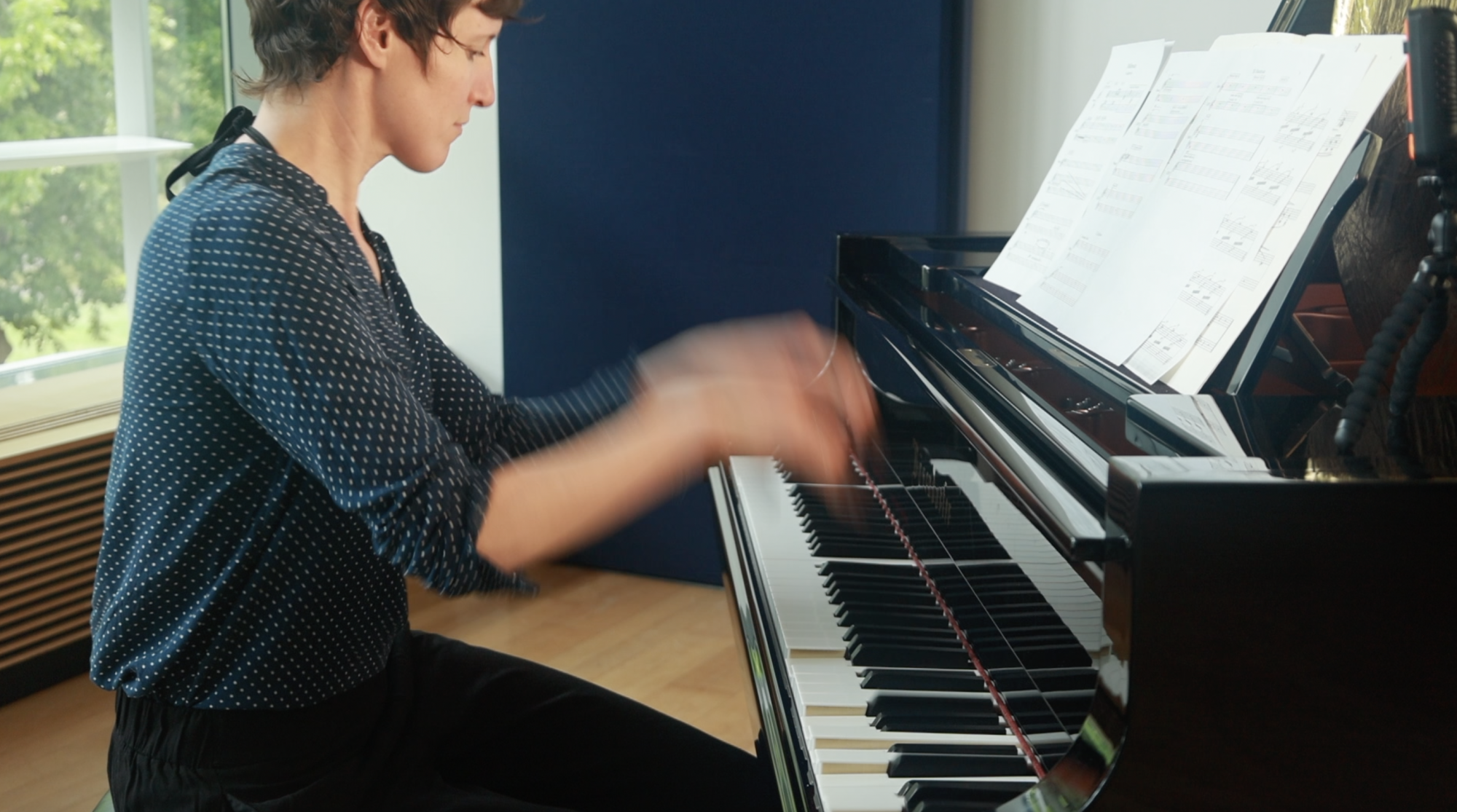
Captured frame from the first piece “leggerezza” in the video series Six Memos for a Pianist and a Self-Playing Piano, 2023. Frame from a video by Markus Kupferblum, for the project Atlas of Smooth Spaces. (Full video series available on YouTube).
6. Performance: Intensities in action
We understand performance as the actualization of the virtual (the possibility space). But performance is not merely the execution of a predefined script or the presentation of a finished product; it is an act of realization, a moment where the intangible becomes tangible, the conceptual becomes experiential, and the collective effort finds its voice. It may be just one moment – not an end point – in the continuous process of becoming we describe in this methodology, but it is a space where performers, audiences, and environments are called to interact dynamically, creating a shared experience that transcends individual contributions. At its core, performance is about presence – the presence of the performer in the space, the presence of the audience in the experience, and the presence of the space itself as an active, generative medium.11 It is a moment of convergence, where the abstract frameworks and relational dynamics established throughout the process are embodied and enacted, and the performative space is continually made and remade.
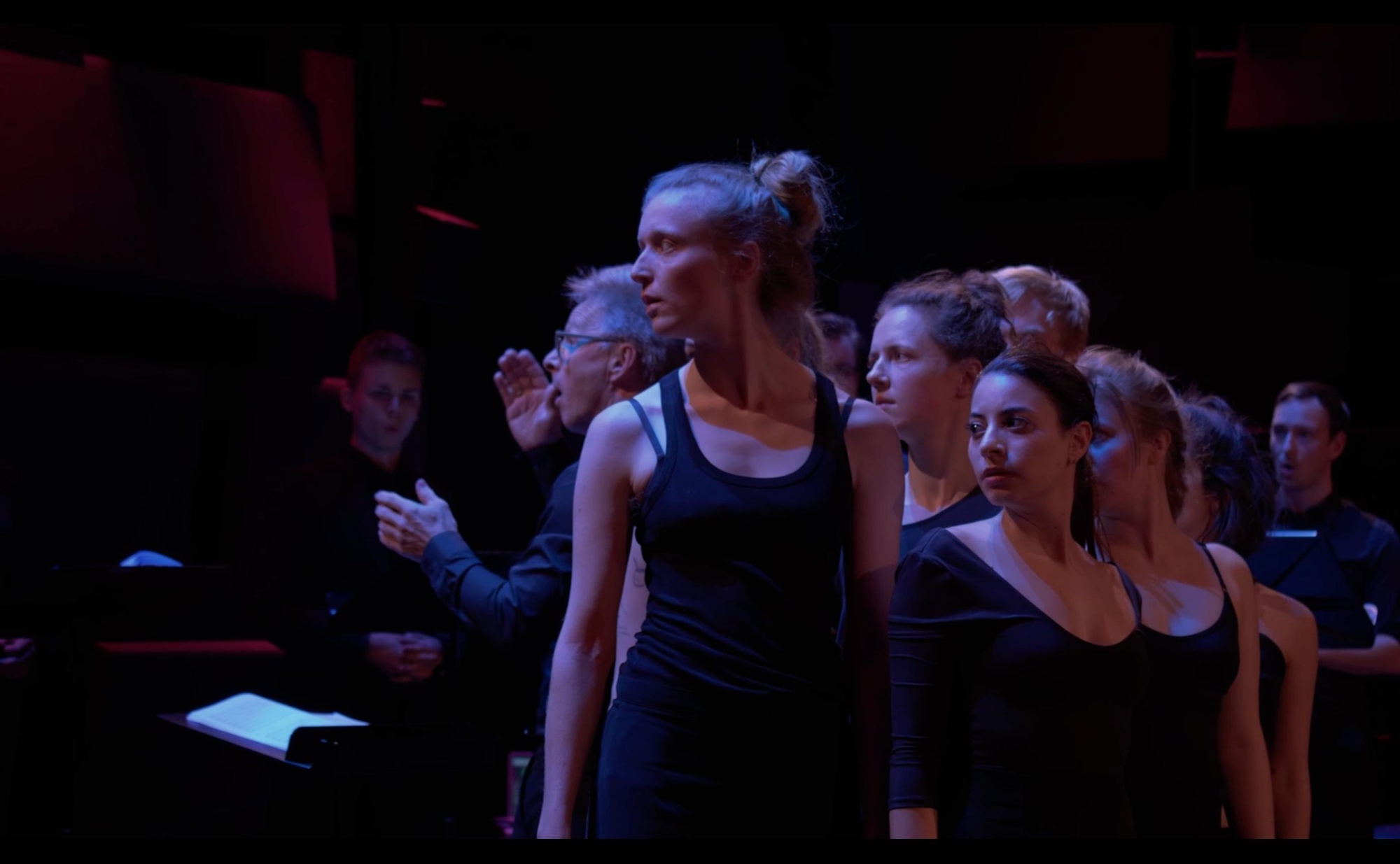
“Allemande” from Partita for 8 Voices by Caroline Shaw, performed by Company of Music Vienna and seven performers, 2025. Frame from a video by Émérentine Soulcié, for the project Atlas of Smooth Spaces. (Full performance available on YouTube).
7. Atlas: Mapping versus tracing
The final result of our co-creation methodology is the Atlas, a cartographic approach to documenting and representing the journey toward performance.12 Much like a geographic atlas, which brings together multiple charts to form a comprehensive representation of a landscape, our idea of Atlas compiles diverse perspectives, disciplinary insights, and subjective perceptions into a unified yet multifaceted whole. Opposed to the “tracing” (fixed copy), we use here the notion of the “map” (open, connectable, modifiable) as a living document that resists simplification and homogenization while capturing the richness, complexity, and relational dynamics of the creative process. At its heart, the Atlas is about multiplicity. It acknowledges that no single perspective or representation can fully capture the essence of a performative space – it aims to be a rhizomatic map of the journey. It embraces the idea that understanding emerges from the interplay of diverse viewpoints, each contributing a unique piece to the puzzle. For collaborators, the Atlas functions as a reflective tool that makes the creative process visible and negotiable; for researchers and readers, it offers a multi-layered account that resists simplification, foregrounding the relational and embodied dimensions of the work. Rather than prescribing a single interpretation, the Atlas fosters an understanding of performance as a dynamic and co-created field, inviting audiences to navigate its complexity from their own situated perspectives. But can a map (itself a form of striation) truly avoid becoming a fixed tracing of the process, especially in an academic publication context? Its compilation will inevitably privilege certain perspectives and materials over others, introducing a degree of hierarchy. This need not be a problem in itself – after all, some structuring is necessary to render the map legible. The challenge, rather, is to prevent this hierarchy from becoming totalizing, from reducing the richness of the process to a single viewpoint. Just as smooth space resists striation and fixed boundaries, our atlas practice aims to balance clarity with multiplicity, resisting the temptation to simplify and homogenize.
The process of creating the Atlas begins with the collection and curation of materials from each stage of the journey – null-space, experiments, notation, collisions, composition, and performance. These materials take many forms: notations, sketches, recordings, photographs, written reflections, and more. Each piece is a fragment of the larger picture, a snapshot of a moment in the creative process. For example, as part of our Dialogo project, the Atlas might include:13
- Diagrams of the null-space, capturing the initial moments of uncertainty and potential.
- Documentation of the experiments (e.g. showing how movement, light, and sound interacted to create new relational dynamics).
- Reflections from the collision stage, highlighting the insights generated through interdisciplinary encounters (e.g. texts, minutes).
- Notations from the composition stage, illustrating how the performative space was shaped and reshaped (e.g. scores, drafts, code).
- Recordings of the performance, capturing the lived experience of the space in action.
Each of these elements is like a chart in a geographic atlas, focusing on a specific aspect of the journey while contributing to the overall representation. Together, they form a rich, multidimensional map that invites exploration and interpretation. Rather than a static document, the Atlas is a dynamic, evolving entity. It is designed to be revisited, reinterpreted, and expanded over time. New perspectives can be added, new connections can be drawn, and new layers of meaning can emerge. Yet this openness does not imply neutrality or absence of perspective: each contribution is situated, shaped by the subjectivity and relationality of those involved. What the Atlas preserves is precisely this multiplicity of positions, held in tension rather than dissolved into uniformity. This approach also raises important questions about representation and communication. How do we ensure that the Atlas captures the full richness of the journey without overwhelming the viewer? How do we balance the need for clarity and coherence with the desire to preserve complexity and diversity? And how do we create a document that is both accessible – even by those not familiar with the project – and deeply reflective of the creative process?
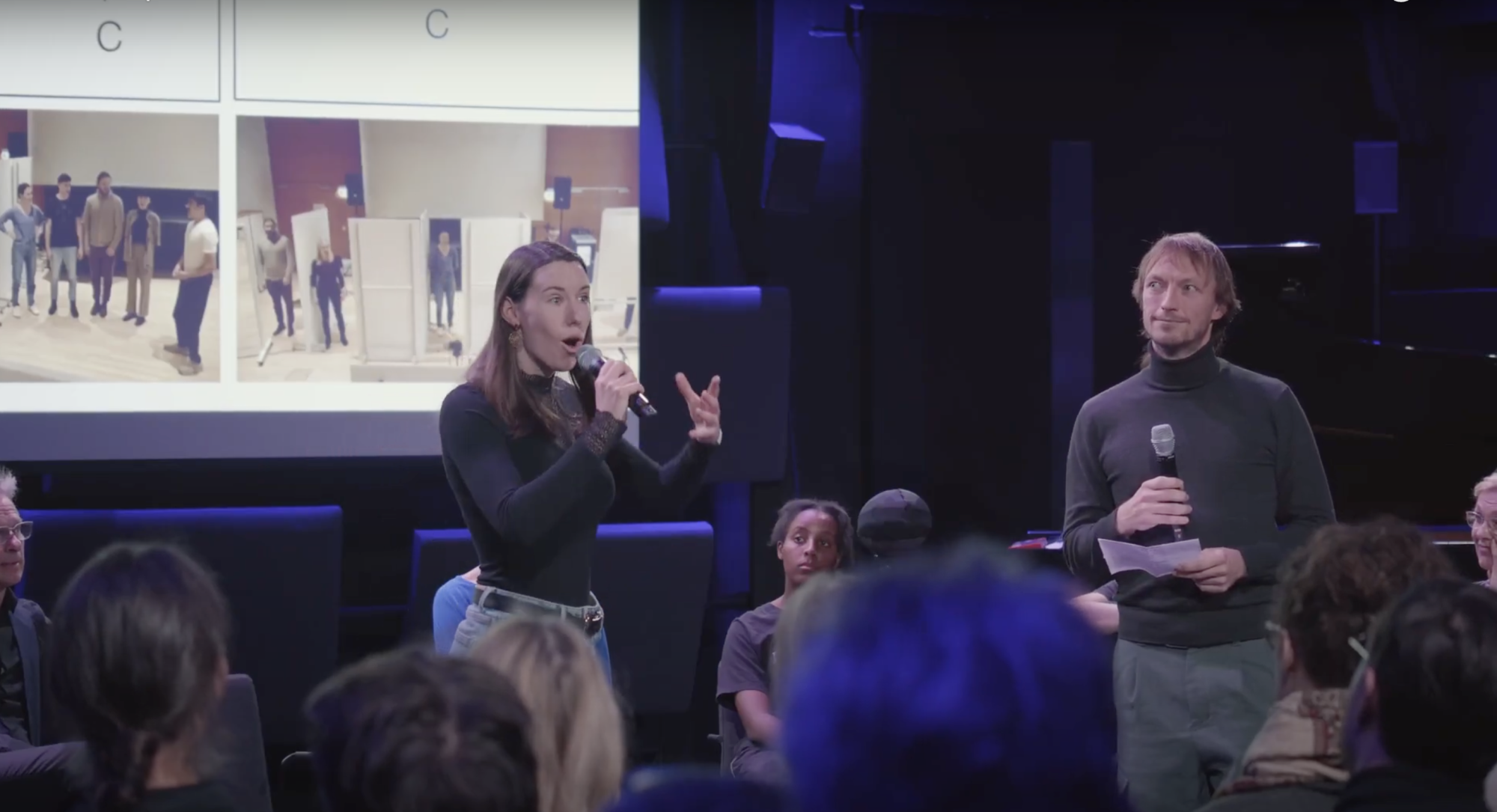
Still from the lecture performance held at the University for Music and Performing Arts Vienna, 2025. Frame from a video by Amin Ebrahimi, for the project Atlas of Smooth Spaces. (See also the lecture performance outlining the methodology on YouTube).
Dancing around molar lines
This methodology sets out to champion ‘non-hierarchical’ integration and ‘shared authorship’. However, a retrospective critical reflection on the project reveals the existence of rigid, stratified molar lines (institutions, disciplines, traditions) at odds with our intention to seek for fluid “molecular flows” of desire and connection. The unquestioned conductor’s default position on the stage, the dancers’ claim on space as their canvas, arguments from tradition or efficiency – these are powerful molar lines that persisted within the collaborative work. They profoundly shaped the ‘space of possibility’ created (for example through time constraints limiting conceptual discussion, established practices resisting challenge). The current methodology's focus on presenting a blueprint for artistic collaboration should not obscure how these molar forces striate the process from within.
Deleuze and Guattari also discuss how statements and concepts are produced within a group dynamic – not imposed from outside or by individuals – as “collective assemblages of enunciation”. From a retrospective viewpoint, it is therefore worth reflecting on how foundational concepts in this project (such as smooth space itself, null-space, assemblage) came into being: whether they were collectively negotiated and co-created through practice, or whether they were initially introduced by specific participants (for example the mathematician or the lead researchers) and only gradually taken up by the group. Importantly, the methodology described in this article did not work as a prescriptive framework but rather emerged progressively through practice and was articulated more clearly post hoc as part of the reflection process. Nevertheless we must acknowledge that the proposed framing (through regular reading sessions and open-ended discussions over many months) could, at times, have shaped how collaborators related to the conceptual discussion. We believe that such practices become most productive when conceptual tools are understood not as frameworks to be adopted wholesale, but as propositions that can be collectively explored, contested, and adapted in response to situated artistic practice.
Conclusion
This co-creation methodology challenges conventional practices by embracing disciplinary collisions, transdisciplinary experimentation, and the dynamic interplay of structure and emergence. Developed through distinct stages – null-space construction, experiment, notation, collision, composition, and performance – it provides a framework for exploring smooth spaces in the audiocorporeal arts, resulting in an Atlas of smooth spaces. Particularly valuable for mapping the amorphous nature of artistic research, this methodology adopts a pluralistic and non-centristic approach. It is designed not as a strict sequential recipe but as a provocative set of concepts and potential entry points for navigating the complex, power-laden terrain of interdisciplinary co-creation. Its true value lies in sparking reflection through a Deleuzian lens rather than offering a definitive roadmap; to fully honour its theoretical foundation, it must embrace its own potential for deterritorialization – being adapted, disrupted, and recombined rhizomatically in each unique collaborative encounter. We hope this flexible approach finds resonance beyond audiocorporeal arts within the broader field of artistic research.
Acknowledgements
This project and the central backbone of its methodology was developed during the artistic research project ‘Atlas of Smooth Spaces’, with the indispensable participation of Rose Breuss (professor for movement research), Kai-Chun Chuang (choreographer), Damián Cortés Alberti (choreographer), William Édouard Frank (production sound mixer), Sara Glanzer (choir conductor), Johannes Hiemetsberger (Professor for Choral Conducting), Marcela López Morales (choreographer), and Maria Shurkhal (choreographer).
+++
Adrián Artacho (he/him)
is a composer, artistic researcher and lecturer at the Contemporary Arts Practice Master at the University of Music and Performing Arts Vienna.
Leonhard Horstmeyer (he/him)
is a complexity scientist, mathematician and associate faculty at the Complexity Science Hub Vienna.
Hanne Pilgrim (she/her)
is a eurhythmics practitioner, pianist, and performer. She was a lecturer at Universität der Künste Berlin, Hochschule für Musik Weimar and Eurhythmics Professor at University of Music and Performing Arts Vienna. Currently, Pilgrim teaches interdisciplinary artistic practices in music and movement at the Hochschule für Musik Trossingen.
Noten
- Atlas of Smooth Spaces in the Audiocorporeal Arts was an artistic research project supported by the Austrian Science Fund (FWF), conducted between 2021 and 2025. The term “audiocorporeal” refers to the inseparable interplay of sound and body in performance, designating practices that treat musical, choreographic, and gestural phenomena not as parallel domains but as a single, entangled field where auditory and corporeal actions co-constitute meaning, structure, and perception. The project was a partnership between the University of Music and Performing Arts Vienna, the Anton Bruckner Privatuniversität in Linz and the Complexity Science Hub in Vienna. Documentation of the project is currently available on the project website the-smooth.space, and will be permanently archived in the Research Catalogue soon (for now, see the-smooth.space). ↩
- Smooth space is characterized by openness, fluidity, and continuous variation, while striated space is defined by structure, hierarchy, and fixed boundaries. These concepts are used to explore the interplay between dynamic, relational systems and rigid, organized frameworks. See Deleuze, Gilles, and Félix Guattari. A Thousand Plateaus. University of Minnesota Press, 1987, p. 482. ↩
- The concept of “assemblage” describes dynamic, non-hierarchical arrangements of heterogeneous elements that function as relational systems, emphasizing multiplicity, fluidity, and emergence over fixed structures. The concept was first introduced in Deleuze, Gilles, and Félix Guattari. Anti-Oedipus. Viking Adult, 1977; and further developed in Deleuze and Guattari, A Thousand Plateaus. ↩
- “Molar” – as opposed to “molecular” – refers here to large-scale, institutionalized structures of social formation, disciplinary categories or historical narratives that operate at the level of collective norms, shaping the way individuals approach a situation. ↩
- Desire Machine was an artistic experiment conducted during the Schmiede Hallein residency in 2022, combining dance (Maria Shurkhal), mathematics (Leonhard Horstmeyer), and live interaction (Adrián Artacho). In this experiment, the dancer’s movements controlled the behavioural regimes of an ad hoc live installation, creating a dynamic interplay between body, space, and technology. The project explored the relational dynamics of performative space, emphasizing non-hierarchical co-creation and the concept of smooth space. A detailed exposition of the project is forthcoming in the Journal for Artistic Research and will be accessible via the Research Catalogue: www.researchcatalogue.net/view/3364418/3730619. ↩
- The separability axiom, introduced by Felix Hausdorff in 1914, defines a topological space in which any two distinct points have disjoint neighbourhoods. A space satisfying this property is referred to as a Hausdorff space in mathematical literature. See Bourbaki, Nicolas. Topologie générale. Chapitres 5 à 10. Paris, Hermann, 1967. ↩
- Grosz, Elizabeth. Volatile Bodies: Toward a Corporeal Feminism. Routledge, 1995, p. 167. ↩
- The term “territorialization” refers to the process by which an open or fluid situation becomes organized, patterned, or stabilized into a recognizable structure. In this context, territorialization refers to how relational and experiential aspects of space are shaped into a more defined or “striated” configuration through practice or notation. The term was first introduced by Deleuze and Guattari. See Deleuze and Guattari, Anti-Oedipus. ↩
- This process is reminiscent of what Eugenio Barba describes as “knots”: dense points of convergence where actions, intentions, and energies intersect, creating concentrated zones of meaning and transformation within a performance. See Barba, Eugenio. Burning the House: On Directing and Dramaturgy. Routledge, 2005. ↩
- Six Memos for a Pianist and a Self-Playing Piano project (2023) explored the interplay between human performance, algorithmic composition, and spatial sound design. By combining the expressive nuances of a live pianist with the precision and unpredictability of a self-playing piano, the project created a non-hierarchical compositional space. This collaboration highlighted the relational dynamics of performative space, emphasizing co-creation and the tension between structure and improvisation. Documentation of the project is available through this YouTube playlist, which includes Lecture-Performance, Études d’Espace, Six Memos, Boom ‘alphabet’, Tallis in Wonderland, Desire Machine, Dialogo, and related works, 2025. ↩
- This understanding of presence draws on Erika Fischer-Lichte’s articulation of the concept, which emphasizes presence as an emergent, relational, and materially mediated phenomenon arising in and through performative events. See Fischer-Lichte, Erika. “Performance and Performativity – How to Discuss Presence.” Aesthetica Preprint, vol. 126, 2024, pp. 7-20. ↩
- The multimedia documentation developed within the project (including the Atlas) forms part of the online exhibition hosted on the Research Catalogue, available soon. See Artacho, Adrián. Atlas of Smooth Spaces in the audiocorporeal Arts. Research Catalogue, March 2026 or the-smooth.space/blog/. ↩
- The Dialogo project (2024) brought together a eurhythmician and a cellist to explore different segmentations of György Ligeti’s Dialogo. Through interdisciplinary collaboration, the project investigated the spatial, temporal, and expressive dimensions of the piece, emphasizing the interplay between movement and sound. The eurhythmician’s focus on spatial affordances and the cellist’s interpretation of the score created a dynamic, non-hierarchical performative space, highlighting the relational and co-creative potential of interdisciplinary artistic practice. The project documentation is currently available at the-smooth.space/blog/dialogo and will be permanently archived in the Research Catalogue (self-published exposition: doi.org/10.22501/rc.3868150). ↩
Meer in dit thema
Conversatie, participatie en cocreatie in de kunsten
Nele Wynants