Dit artikel verscheen in FORUM+ vol. 33 nr. 1, pp. 28-41
Double or nothing. A duet on mothering and artistic research
Mariske Broeckmeyer, Eva Moulaert
This essay presents itself as a doubling, a polyphonous autotheoretical reflection on the interaction between motherhood and research in the arts. A singer and a graphic designer meet at a doctoral defence and find themselves simultaneously heavily pregnant during the finalization of their own doctoral research. After giving birth, Eva (the graphic designer) encounters obstacles in her return to reading and writing – practices through which she had previously oriented her research-oriented design practice. The need to reach out brings her to write Mariske (the singer) a letter.
In this written duet, consisting of two letters, they bend themselves over the shattered efforts to rhyme with a new-born baby. How to compose and recompose oneself postpartum when writing has halted due to the fragmentation of thoughts and time? In the first letter, Eva Moulaert reflects on how motherhood halted her reading practice and deferred her design-oriented research into the sensory aspects of reading and the ways these shape aesthetic experience. In response Mariske Broeckmeyer, a singer researching the subversive potential of a failing voice, lends an ear to the impact of motherhood on vocality. For both, these writings enable a return to their practice, although in an altered shape and shade.
Dit artikel presenteert zich als een verdubbeling; een polyfone autotheoretische reflectie op de interactie tussen moederschap en onderzoek in de kunsten. Een zangeres en een grafisch ontwerper ontmoeten elkaar tijdens een doctoraatsverdediging en merken dat ze allebei hoogzwanger zijn tijdens de afronding van hun eigen doctoraatsonderzoek. Na de geboorte van haar kind ondervindt Eva (de grafisch ontwerper) moeilijkheden om weer te beginnen met lezen en schrijven – praktijken waarmee ze voorheen haar onderzoeksgerichte ontwerppraktijk had gestuurd. De behoefte om contact te zoeken brengt haar ertoe Mariske (de zangeres) een brief te schrijven.
In dit geschreven duet, bestaande uit twee brieven, buigen ze zich over de stukgelopen pogingen om zich te rijmen met een pasgeboren baby. Hoe kun je jezelf na een bevalling weer samenstellen en herstellen als het schrijven is gestopt door de versnippering van gedachten en tijd? In de eerste brief reflecteert Eva Moulaert op hoe het moederschap haar leespraktijk heeft stilgelegd. Ook haar ontwerpgericht onderzoek naar de zintuiglijke aspecten van lezen en de manier waarop deze de esthetische ervaring vormgeven heeft ze uitgesteld. In haar antwoord luistert Mariske Broeckmeyer, een zangeres die onderzoek doet naar het subversieve potentieel van een falende stem, naar de impact van het moederschap op de vocaliteit. Voor beiden maken deze geschriften een terugkeer naar hun praktijk mogelijk, zij het in een gewijzigde vorm en nuance.
Dear Mariske,
Since I became a mother for the second time last July, I have repeatedly wondered how you are doing. I heard you started a postdoc position in Cultural Studies at the University of Leuven. Congratulations! I can imagine it’s not an easy combination with a baby. How has the return been for you?
+++
We named our daughter Jackie. She is doing very well and has been attending daycare for the past few months. I absolutely adore her, but the postpartum ‘back to work’ period is intense. I now have more time for myself again and I don’t quite know where to begin. Who was I again? And what was it again that I do, exactly? How will I manage to juggle everything?
Inspired by a fragment from the chapter “The Problem of Reading” from Moyra Davey’s Index Cards,1 I’ve been trying the “blue hour” method for the past couple of weeks. “Those are the stolen hours before the routines of daily life set in – the clock hasn’t started to tick on them yet. Anything is possible at that hour, the time of day which Sylvia Plath, getting up at 4 AM to write her final, Ariel poems before her children awoke, called the blue hour.”2
In the same chapter, Moyra Davey writes: “The reading of childhood is always posited as pure and disinterested, voracious and undiscriminating, an existential moment of bliss. I had this experience as a teenager, but lost it and didn’t encounter it again until I was thirty-eight and very pregnant. I felt that only this, the weight of my gestating body, gave me permission to sit in one place and read exactly as I pleased.” 3
During the time I was trying to get pregnant, I had formed a similar image of myself, and by the time I eventually did, a big stack of books had been piling up and was waiting to be read. At the very top of that pile was The Desire of Mothers to Please Others in Letters by Bernadette Mayer.4 I had come across this title in one of my books and loved it so much that I bought the book. But I’m also drawn to its “time-based experiment”: the letters were written during the nine months that she was pregnant with her third child, Max (from the summer of 1979 until February 1980). Laynie Brown writes about the book in its preface: “The text is literally pregnant.”5
But as soon as I was finally pregnant, I was forced to let go of the image I had built up of myself. I won’t go into detail, but it was a difficult journey, getting pregnant, being pregnant and giving birth. I did not manage to read.
+++
My first public appearance with my baby bump wasn’t until I was four months pregnant. There was a “meet the author” with Rachel Cusk at the Kaaitheater, on the occasion of the French translation of her book on motherhood A Life’s Work.6 I felt tense and couldn’t remember much of the interview, but, afterwards, I still pushed myself to get in line to have my copy signed. Rachel Cusk’s gaze ostentatiously drifted from my face to my belly, where it halted. She signed the title page, flipped a few pages over to the one on which the dedication “For Adrian” is printed, and proceeded to draw a line through it with a dramatic gesture. It only dawned on me later that Adrian must be her ex-husband, the one she writes about in Aftermath: On Marriage and Separation.7
A few moments later at the bar, a woman I didn’t know started telling me about her two preterm births and how she put an end to her doctorate after the second. Whenever I am overcome with anxiety, I take comfort in a remark from a conversation between my favourite politician, Petra De Sutter, and Marleen Temmerman, Belgium’s first female professor of gynaecology: that a pregnancy during a PhD should be equated with publishing an A1 peer reviewed journal article.8
When I got back home, I put A Life’s Work at the bottom of my pile of books.
+++
When Jackie was about two months old, I saw an invitation on Facebook to the conference Experimental Writing in English (1945-2000): The Anti-Canon, organized by Hannah Van Hove and Tessel Veneboer.9 Bernadette Mayer’s name popped up several times on the event programme (there was also a presentation on the work of B.S. Johnson, whose biography Like a Fiery Elephant by Jonathan Coe has also been on my book pile for some time).10 So, going to the conference not only seemed like a good exercise in going back out into the world, but also the perfect preparation to reading The Desire of Mothers to Please Others in Letters.
I convinced my friend Rosetta, a writer who also just had a baby at the time, to come along as my perfect partner in crime. We joined “Panel 11. Procedure and Form” and followed a group to go to the Stevin Room, a relatively small space on the first floor of the Palais des Académies. You should have seen it: about twenty researchers diligently taking notes and, at the far end of these tables arranged in a U-formation, two women standing upright with their baby carriers, bobbing their little ones, trying to soothe them. The sound of our feet on the hardwood floor produced a monotonous, drowsy creak. It looked like a performance. I was bouncing all along the lecture on John Cage’s Mesostic Poetry. During the second presentation, Jackie pooed. When I politely asked the concierge where I could change her, he led me all the way to the other side of the palace to the first aid room, which looked like it hadn’t been used in twenty years. By the time I finally got back, I had missed the next two presentations. After another fifteen minutes of bobbing along to “What an associative way to live this is: Materials of Distraction in Bernadette Mayer’s Midwinter Day” by Paisley Conrad, Jackie was hungry and started to cry. Out of frustration, I abandoned the Stevin Room and planted myself on the carpet in the middle of the Throne Room to breastfeed, while being stared at by male torsos made of stone. A statue of Jackie and I on a large pedestal would not have looked out of place here. Once Jackie was full, I didn’t dare to go back into the Stevin Room, and so I decided to go look at the books that the Rile⋆ bookshop had on offer for the occasion. I bought the book Piece of Cake, which Bernadette Mayer and Lewis Warsh co-wrote when their first daughter was born.11 It’s a kind of diary from August 1976 in which they write on alternating days; “collaborative prose poetry”, they call it.
I didn’t really take anything in that day. And my attempts to read The Desire of Mothers to Please Others in Letters afterwards were unsuccessful. Even though I had committed to the constraint of reading one letter a day, I did not succeed. I suppose my dislike for the book’s graphic design didn’t help. What is it with these matt-laminated covers that pervade bookshops? Sure, they’re easy to clean in case of snot and drool stains ….
I’m letting go of Bernadette Mayer’s books for the time being, and I leave them lying around as encouraging ‘reparative objects’ with nice titles.
+++
Index Cards got me back into reading. These past months, this book has made for such a good compagnon de route. Between baby monitor sounds, milk ejection reflexes, dopamine drops, breast pumps, and a completely disrupted sleep pattern, it’s so liberating being able to read a book with fragments on extracting breast milk, postpartum feelings, and Moyra Davey’s Mother Reader.12
But this isn’t the main reason why I love the book so much. Apart from the many moments of resonance (Moyra Davey’s interest in psychoanalysis, her struggle with productivity and the accompanying blocks she experiences in her work, the search for strategies to be creative regardless, Mary Shelley …) this book paints such a nice picture of how reading and writing are a part of her practice as a visual artist. It illustrates so beautifully how professional and private life cannot be uncoupled (who came up with this idea to keep them separated anyway?).
However, I am most grateful for the insight of Index Cards about a ‘working-reading’, which helps me realise that this is the kind of reading I enjoy the most. “Reading tied to productivity, to making something.” 13 It is a way of reading that evokes ‘butterflies’, causes all kinds of associations, makes me take notes like mad and run over to my bookshelves, a reading that gives me design ideas. And I love how this insight gently encourages me to start seeing reading and writing as part of my practice as a graphic designer as well.
+++
My biggest worry towards the end of my pregnancy was designing the card to announce the birth of our daughter. (Now I feel really exposed.) For most people this is just an afterthought, but for me, a graphic designer who sets the bar high and considers this card a welcoming gift to her child, it was no small feat. It made me break down in tears and gave me false labour pains. Our midwife, Elke, intervened: “Eva, you can worry about the card later. You’re such a typical Flemish try-hard for wanting to mail out the card on the same day of the birth.” She told me how, in many cultures, people only choose a name for their child after it is born. Which makes sense to me. What if the name you chose doesn’t suit your child? Luckily, Jackie looked like a real Jackie.
I wanted to make the birth card together with Robin, my seven-year-old daughter. She was just learning how to write and would draw the most beautiful letters. Our collaboration didn’t exactly go smoothly. My suggestion to make the card out of clay (I showed her the sculpted letters of Marcel Broodthaers and his poèmes industriels made between 1968 and 1972) seemed childish to her. Luckily, at a certain point, the little girl from next door stopped by and gave us her old light box as a present. Once I’d shown Robin Dorothy Iannone’s work A Cookbook, we eventually came to an understanding.14
When our cards finally arrived (Jackie was about five months old at that point), many people were thinking we must have forgotten about them. Bas Jacobs, a friend who’s a letter designer in Amsterdam, emailed me: “I’m happy I’m not the only one who sends out a card months after the baby’s birth :-).” He sent us a stencil set of his typeface Plakato as a gift.15
I discovered online that Julia Born, one of my favourite graphic designers, did a book for Moyra Davey: Speaker Receiver.16 Unfortunately, the book is completely sold out. I own several books designed by Born, among them two gorgeous photography books she made with the photographer Uta Eisenreich. The first, titled A not B, was published in 2010.17 Its sequel As If came out only recently, not long after I found out I was pregnant.18 This is odd, because, around the same time, a kind of look-alike of one of my other favourite books was released: On the Self-Reflexive Page II by Louis Luthi.19
As If shares its physical features with A not B: same dimensions, bound with the Otabind technique, a dust jacket, structured identically (each chapter has a series of pictures divided over x-number of spreads, followed by a typographical spread that carries the captions), same page layout, and a similar sans serif font. This book, too, begins with a dedication printed in the upper left corner, on page four; “For Mia”. Just as in the previous book, this one has bright still-life photographs and compositions with abécédaire-like objects (apple, egg, sponge, milk, ball, umbrella, potato, mirror, pencil, pin, …) which engage in formal play with logic, language, and signification. They’re often funny; absurd. The black cat and the little cigarettes of the Hope brand are once again present. (I really hope that, this time around, I won’t pick up smoking again).
Uta Eisenreich describes the pictures from her first book as follows: “Explaining the world to your four-year-old son with everyday items in the safe environment of the kitchen table. The table is the theatre, the objects are the extras, the cast.” 20 “Writing with images”, she calls it.21
But the sequel As If is more complex: the composition-photographs (often inspired by rebus word games, optical illusions, IQ-tests, magic tricks, multiple choice questions) are interleaved with seductive interpretations of advertisements on glossy paper. She tells us: “This book has arrived eleven years later. My daughter Mia is ten years old. I now have to explain more sinister stuff. The game has become more complicated: an object is no longer just a stage prop, the object is also part of branding. The physical, the seductive comes into play.”22
I love these books. They are definitely no “low-hanging fruit” (the wonderful concept Moyra Davey reserves for video footage or photographs that are readily available).23 The photographs put you to work: I’m constantly navigating between image-pages and the text-pages, constructing a storyline. Its development remains exciting. And the list of cited works keeps you weaving an expanding web of books. I love how Uta Eisenreich’s creative process is accompanied by the perspective of her fifteen-year-old son and her eleven-year-old daughter. “To let oneself get infected”, Ephameron called this working method during her doctoral defence Never Alone Again: Searching for a Visual/Language to Give Voice to Early Motherhood.24
I would like to end by writing about the journal De Witte Raaf and its issue on Parenthood, in which I read that the graphic designer collective Åbäke is now doing work with the ten-year-old daughter of two of its members.25 I want to tell you that, in this same journal issue, I came across the name Tessel Veneboer again, in the article “The Mother as Muse: On the Oeuvre of Chantal Akerman”. That this made me grab Index Cards again, to remind myself of what Moyra Davey wrote on Akerman: “You tell the young woman not to be afraid of making things that aren’t beautiful. I too cannot get enough of your raspy smoker’s voice”. 26 That this fragment makes me recall a film I made a long time ago, The Last Book: Interview as Fictitious Film Makers, in which I interviewed literature sociologist Sabine Hillen while I was still a chain smoker.27 That my GP Puti (herself a heavy smoker who unfortunately died of uterine cancer) recommended I quit by writing myself a letter which I could only open one year later. That I never did open that letter, but I remember it was a kind of book report on Italo Svevo’s Confessions of Zeno.28 That I then pulled a book off my shelf: Chantal Akerman’s A Family in Brussels.29 That, out of all the streets in Brussels named after a person, only 6.1 percent are named after a woman. That the city decided three years ago to inaugurate a Chantal Akermanstraat, yet nothing has come of it yet. That with this letter, I’m sending you a fitting gift: Kate Briggs’s domestic novel The Long Form, which tells the story of a mother and baby composing a day together, and in which ‘the power of names’ takes centre stage.30
I’ll stop writing now. Perhaps, to conclude, just this nice fragment from Index Cards:
Just as a bookcase full of read and unread books conjures up a portrait of the owner over time (joggers of the memory Perec calls them), so the books that arrest us in the present constitute a reflection of what we are, or what we are becoming or desire (Schwartz). There is nothing random about that, or about any of these other seemingly random ways of coming to books, and it is from this notion that the oddly apt idea of books choosing us, rather than the other way around, seems to make sense. The idea of a book choosing the reader has to do with a permission granted. A book gives permission when it uncovers a want or a need, and in doing so asserts itself above all the hundreds of others jockeying to be read. In this way a book can become a sort of uncanny mirror held up to the reader, one that concretises a desire in the process of becoming. 31
With love,
Eva
PS This letter is set in Greta,32 a typeface by Peter Bil’ak designed for his daughter. I could have put it in Eric Gill’s Joanna,33 but that’s a less beautiful story.
PS 2 On the next page: an image of a performance of the great artist Ketty La Rocca lying in bed with a giant sculpture of the letter ‘J’.
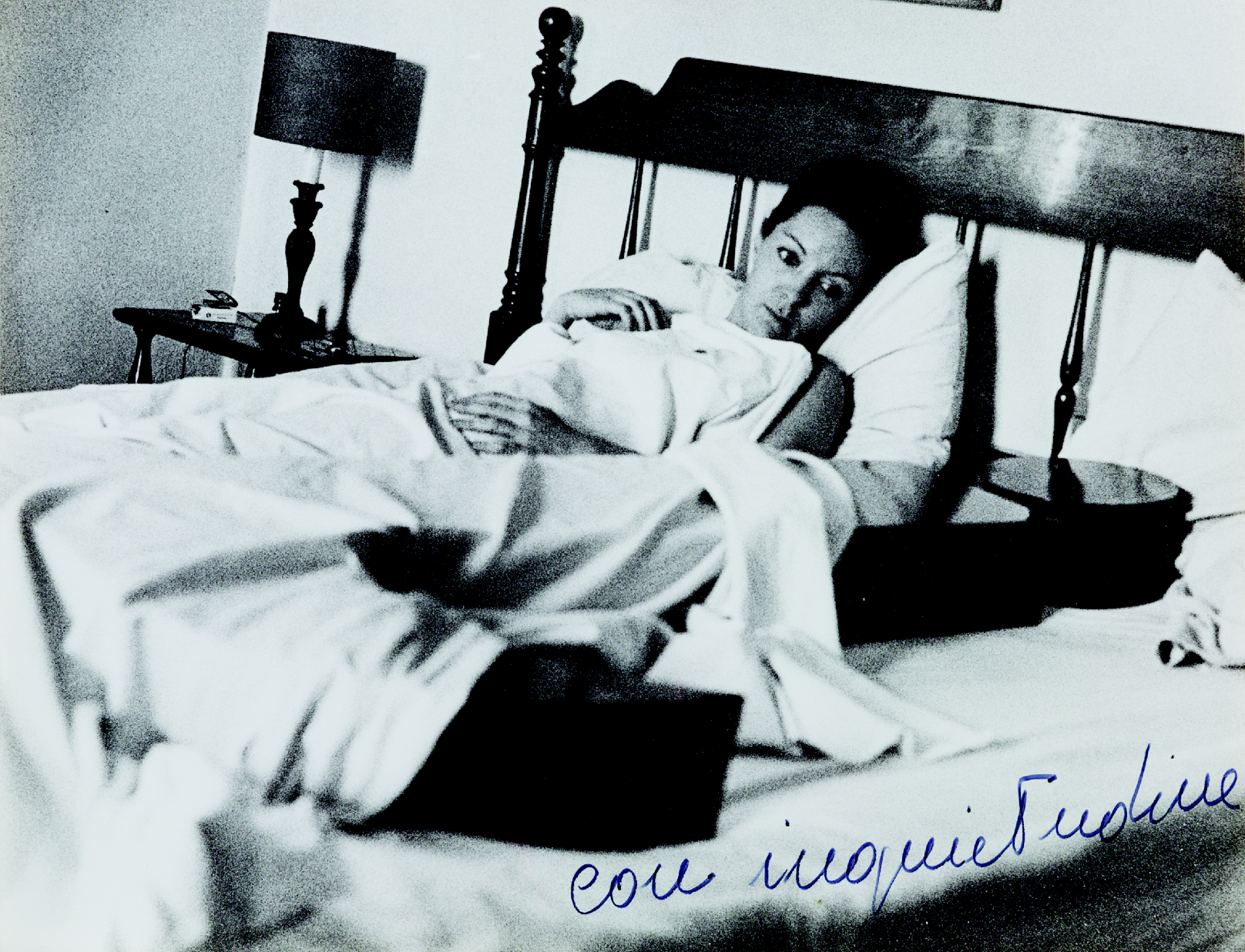
Ketty La Rocca, Con inquietudine (1971). Photograph and handwritten text, 12.6 × 17.4 cm. Courtesy Archivio Ketty La Rocca | Michelangelo Vasta.
+++
Dearest Eva,
I received your letter with great joy. And thanks for the gift. Briggs’s novel sits resplendent atop the to-read pile next to my bed – I look forward to picking it up soon. The concepts your letter proposed and the thoughts it provoked punctured the hecticity of my days. I resonate deeply with the doubleness you experience in this postpartum “back to work” period. To me it has equally been a time in which love took centre stage, beholding this new little creature in awe, while at the same time frequently finding myself behind the scenes of daily life, staring into the backstage mirror as I was overdoing my make-up not only to hide the fatigue but in search of a self, shaping it anew. I too have wondered: who am I again? How do I proceed from here? I love how in your letter you carefully construct a framework of authors and thinkers, books and artworks to make meaning of the doubts and doubleness that mark these days. You turn to the material reality of your artistic practice as a graphic designer in search for answers to these questions. It inspired me, sparked an urge to do the same. I was grateful for your mentioning Moyra Davey’s collected issue. It has moulded my thinking and guided me towards other reflections on the theme of motherhood in relation to voice.
+++
Like Lauren Elkin who wrote: “My body spoke my baby” when she experienced the assembling of bodily cells, differentiating, splitting, multiplying as an ‘articulation’ of “embryonic becoming”.34 Imagining the conception of new life as a vocal act fascinates me. To articulate a baby. As if the voice sinks into the womb to become all materiality, a blood chant,35 and by its own fleshy logic, uttering indistinctly, engenders a new body and a second voice; the ultimate echo destined to one day abandon its source. “Articulation is not a simple matter,” Elkin continued. “Language is the effect of articulation, and so are bodies.”36 This, together with your letter, dear Eva, led me to consider the tremulous relation between vocality and early motherhood.
Motherhood modifies the voice, at times even mutes it. Or as Sara Ruddick puts it: “Maternal voices have been drowned by professional theory, ideologies of motherhood, and childhood fantasy.”37 And indeed, since becoming a mother I too have often found myself wondering where the voice went and what that absence implied. As a singer, trying to make sense of the silence, I wish to add a vocal-technical perspective to Ruddick’s lineup; to propose a musical account of the impact of motherhood on voice. Without aiming for an essentialist bond between mother and child, or between motherhood and femininity, I witnessed my own vocal alterations during the first months of motherhood. Triggering sentiments of melancholy and curiosity alike, these changes made me wonder what could be revealed when lending an ear to the vocalic imagination of the maternal singer. At the same time, these writings, a letter, are an attempt to negotiate an academic silence. I gave birth twenty months ago and have not been able to write ever since. In these pages I hope to somehow retrieve that voice by attuning the mother, the singer and the writer; to compose them in a common call.
+++
Delivery room. When our daughter announced herself to the world, no urge had ever come to me with such importunateness. For years I had been theorizing pain and somehow my curiosity had managed to get me through contractions. As I declared the time to push had come, a deep loud roar escaped my oral cavities. With every push I bellowed out and even the singer in me was stunned by the profoundness of these hollers. Although I had spent years studying the edges of vocality, this sound was so unexpected that it threw me out of myself, rendering me an audience to my own newly gained maternal virtuosity. But when the delivery did not progress fast enough, and our daughter’s heartbeat dropped, the midwife told me that if I wanted to continue hollering I was free to do so, yet she advised me to redirect the energy away from the vocal cords and towards the muscular motions. It would be a better investment of my strength, one crucial to the baby. At once, I held my tongue and pushed on in silence.
In that moment, when the maternal voice took the scene for the very first time, a sense of guilt befell me. As a singer I am not unfamiliar with the intimacy of taking up space vocally, but the midwife’s remark confronted me with the selfishness of my sounding. This maternal voice bellowing attended to my physical needs rather than those of my baby, who longed for me to steer all forces silently towards her entering the world. She was born safely, and floods of all-encompassing love washed away the embarrassment, instantly. With her birth, the motherly voice originated. A voice, I learned, at times most powerful when mute.
Your writings also made me reflect on her birth card; her name written in maroon red ink: Hella. The back held a quote by Hélène Cixous picked out for its openness towards all a life could entail, for we did not wish to ravel in pink-clouded sentimentality: “[Your] text is written in black and white, in ‘milk and night’”.38 This sentence somehow also covered the academic interest of both her parents; her father studying the materiality of handwriting and myself in search of an ontology of voice through failure. Cixous has written amply on the relation between the voice and motherhood, and according to her, vocality is even founded in a maternal time of pleasure when milk flows through the voice. In the rhythmical sucking of the infant the voice gushes like a song, forming the musicality of language. These vocalities originating in the maternal unity are called languelait, and Cixous points out how they resemble the pleasures of poetic song.39
Precisely this inherent pleasure of vocality, as suggested by Cixous, stuck with me. For she was far from the only thinker to connect the sounding of a voice to pleasure. In psychoanalytic thinking too, the voice as being related to pleasure is a frequently returning topos. In the work of Julia Kristeva, for instance, the voice is connected to the semiotic, which originates in a preverbal stage of development and the communication between mother and child. In the vocal qualities of avant-garde poetry, the semiotic is foregrounded and can have revolutionary power, because it subverts the normative system of signification.40 Kristeva’s theory, in turn, is related to Jacques Lacan’s notion of lalangue, which indicates a form of jouissance or pleasure in language.41
At the same time, however, as Sara Ruddick suggests, psychoanalytic theory often frames the mother as “a silent other, a mirror in which children look to confirm their identity without interference from hers.”42 In a way, this image of the muted mother resonates with my own first encounter of the maternal voice, and indeed much ink has been devoted to the “cultural silencing of mother’s voices.”43 Approaching and understanding the maternal voice through muteness, failure, and displeasure might therefore offer a framework at least as adequate and productive as one built on pleasure.
Especially in the context of those early postpartum weeks when all life revolves around the crib and the sleeping baby calls for quietude, compelling the mother to lower her voice. I too remember it to be a time of soft and scarce whispers, and even while cradling our baby back to sleep, the voice was muffled and all its melodic gestures in avoidance of great intervals or sudden changes. The voice of early motherhood is consequently one of soothing and often speechless monotony; unstable due to a lack of vocal technical support which was lost in childbirth and shaking in the presence of this fragile little body.
When weeks turn to months this muteness is manifested in brain-fogged inarticulacy. Susan Griffin writes about how she spent her days alone with an infant, drifting through daytime television until her brain went muddy. Sleepless and erased outside her roles as mother and wife, she grew wordless and inarticulate, yet certain there was something profound she needed to say: she learned what it meant to be unable to speak.44
+++
My experience of the postpartum secludedness differs from Griffin’s but still I resonate with her when it comes to the inarticulacy this period brings. For every time I hauled myself with great difficulty to the other end of a sentence, all too often stranding in the middle of a thought, I too was embarrassed, felt stupid, uninteresting, and therefore irrelevant. But more importantly I wish to sit with her final argument and attest to the knowledge maternal muteness might hold. Without wanting to idealize nor dramatize this vocal failure, I believe it voices a different kind of subjectivity, a presence in which words, let alone coherency, are simply not at hand. It is a time, a state of being, that offers the opportunity to learn how it feels not to be able to speak.
+++
More time passed, and after a few months I returned to my artistic practice as a singer. As contractually established, I would compose and sing music to the poems of a friend. Although childless, motherhood proved to be a returning topic in her work: “Mothers sit in the undergrowth like whisper networks. They warn us that the elk will suck out all the strength from its own bones.”45 I was drawn to her words and even though my vocal cords were tired, and my ears tuned to the fitting repetitiveness of the lullaby, I composed melodies that were ridiculously complex and stretched to the outer regions of my vocal range. I often dropped to the lowest notes I could bring about, but mostly explored heights I had never before dared to enter on stage. These melodies were simply too difficult for me to sing; especially in this tired state of being, but I deliberately composed them to be that way.
I wonder what drove me to this complexity. It might have been a need for virtuosity to prove my youthfulness through voice. Listen. I am still here, alive. Vocally unbound. Revelling in suppleness and agility. Taking up the full spectrum, highs and lows alike. Maybe.
Interestingly, a review appeared that mentioned the “girlishness” of my singing. I am not at all a soprano and in previous work I only sporadically made use of my head voice. Now it seemed I was obsessed by those upper regions and consequently forged my voice into a new, rather girly, sound. Maybe I was afraid to enter the stage as a mother; which implied I would fail the singer’s duty to take on her role as object of desire. Listen. I am still relevant, for although my body has been split apart in childbirth and nights deepen the ink-blue circles below my eyes, I still carry that youthfulness necessary to be allowed onto this stage. I cannot prove this in presence, only melodically and through the timbre of my voice. Maybe.
(Writing about the relation between singing and aging, I think of Patti Smith, one of the few female vocalists of age who are still considered relevant, and I yearn to crawl into her lap. Hold me, Patti. I am so tired. Comfort me, sing to me in a motherly voice of how everything will be alright.)
Maybe. Maybe.
Or could it be that this reaching for ridiculous heights was my way of amplifying the vocal alterations that inevitably come with early motherhood? I could have masked the tiredness and my being out of shape when merely manoeuvring the vocal range I felt comfortable with, but by composing melodies too hard to sing I would plainly put the ruins on display. It might have been my way to somehow serenade the hardship of combining an intense professional life with motherhood; permanently reaching beyond what is doable and always wondering whether ‘it’ is even good enough. Every time I dragged myself to the upper G, singing: “Your mother dies in labour. Again and again. She doesn’t know how to stop.”46 I felt an imposter to the angels and wondered: is this even good enough?
Maybe.
Or maybe the answer is to be found somewhere completely different, away from the stage and closer to home, closer to our daughter. As social beings, we constantly adjust our voice to the context of our speaking. We weigh our words, alter our intonation, and even fine-tune our timbre to what we deem fit. These alterations are often subtle and mostly occur unconsciously, but when our daughter was born this vocal malleability became utterly flagrant and somehow struck me as spectacular. I talk to her in head voice. I do it all the time. I exaggerate my intonation to such an extent that it verges on singing. I sing-speak to her. And the repetition inherent to our conversations adds to the musicality of the phrases. As pointed out by thinkers like Adriana Cavarero, in repetition meaning shifts, is pushed to the back, and the materiality of the voice, its musicality, comes to the fore.47 Repetition also somehow structures the conversation into a song. What is repeated becomes a chorus, nestling in her ear, sinking into her memory.
This is the version of my voice she knows best. In fact, to her this is my voice. And those moments when she is confronted with my ‘mature’ way of speaking captivate her greatly. Especially when I answer the phone. For then, the change between registers is most drastic and abrupt. Margaret Mead too noticed how her baby granddaughter “was so sensitive to changes in the human voice that her mother had to keep low background music playing to mask the change in tone of voice that took place when someone who had been speaking then answered the telephone.”48 Indeed, when the phone rings our domestic shelter is sonically penetrated and Hella knows that in a way I leave her, I depart into the outer world, not physically but vocally. I leave her. I leave her in language. Adrienne Rich too mentions a similar dynamic in her essay "Anger and Tenderness":
I remember a cycle. It began when I […] found myself on the telephone with someone toward whom my voice betrayed eagerness, a rush of sympathetic energy. The child (or children) might be absorbed in busyness, in his own dreamworld; but as soon as he felt me gliding into a world which did not include him, he would come to pull at my hand.49
By taking the hand of his mother he literally pulled her back in. Hella, however, had a different response to the issue. She started imitating these phone conversations and every so often pretended to call the outer world. Any random object could pass as a telephone into which she would narrate endless stories, with great seriousness, adding weight to the words although they made sense to no one but her. These were the first moments in which she turned away from us; walking to the other room, phone in hand, to speak of us, not to us. We knew these instants were important, we heard it in her tone of voice.
Now, when these phone calls end, we return to our domestic inner circle of cycle songs; high pitched, repetitive, and with excessive intonation. In unison with Kristeva and Cixous, I acknowledge the value of this warbling way of communicating, for most often Hella and I indeed revel in the pleasures of the singing sounding voice. However, this is not the full reality of the maternal melody. As a mother, I also often take flight in this musicality. In extended intonation and the sounding of the head voice, frustration and fatigue go to hide. A high-pitched voice more easily conveys a sense of enthusiasm and carefreeness even when exhaustion has drowned out all the zeal. The singing voice somehow offers a place to reside, a stage to enter where the body appears, and the voice reverberates while at the same time the self can be completely let go. Indeed, as Adriana Cavarero points out, singing is “an alienation of the self, in a dispossessing of the individual.”50 In song the subject of the singer somehow disappears, a dynamic Roland Barthes also explains – how the singer’s voice is impersonal and unoriginal, expressing nothing of the cantor’s self, yet it remains singular in that it lets us hear a distinct body detached from civil identity or personality.51
In this sense, adjusting the intonation of the voice until it mimics musicality is also a way to dissociate herself from her own needs and worries in melody, an act simply inherent to the parenting of a young child. The singer can do so while still being there, fully present physically and vocally, but residing from herself by virtue of the song. When I mounted Hella into the back of the ambulance after taking a bad fall, briefly losing consciousness, I reassured her in repetitive high notes that “All will be well. All will be well. All will be well.” This high-pitched invocation concealed my own shock and fright. And instead, thanks to the singer, a lightness resonated, announcing: I am here. My body will hold yours. Always.
It occurred to me that in psychoanalytic terms to sing is, of course, to sublimate. The mother’s needs are directed to the unconscious and in turn unconsciously gratified in a manner considered ‘mature’. I argue that in this vocalic gesture a shelter is created; one that holds both mother and child.
So maybe, the mother is inherently a singer, pushing her voice until it nearly breaks but by doing so entering a stage; a place where she can productively dissolve. For this reason, it might not be unthinkable that my overly complex compositions were simply an ode to the singer as a shelter.
+++
When I near the end of this letter it suddenly strikes me, and I fail to suppress a smile: since her birth I have been calling our daughter Hellala. This affectionate nickname unconsciously, yet undeniably references Lacan’s lalangue and reveals that her name, her presence, always reminds me of the pleasures of language and song. She is the song. Yet not mine to sing. She is singing herself into being. I can only show her the full spectrum of vocality and womanhood, highs and lows alike.
+++
Thanks again for your letter, Eva. I have read it as a whisper network of feminist thinkers, artists and authors and can only wish my words in some way contribute to its conception. I hope to see you soon.
Love,
Mariske
+++
Mariske Broeckmeyer (1991 BE, she/her)
is a singer and works as a postdoctoral assistant at the Department of Cultural Studies at KU Leuven. In 2022 she obtained a PhD in the Arts from LUCA School of Arts: Unvoicing Migraine: A Study of The Failing Voice. As a singer and sound artist Mariske has released multiple albums (WERF Records) and created many sound exhibitions.
www.marismusic.net
mariske.broeckmeyer@kuleuven.be
Eva Moulaert (1983 BE, she/her)
is a graphic designer and works as a post-doctoral assistant at the graphic design department of LUCA School of Arts, Ghent. In 2025 she obtained a PhD in the Arts from LUCA School of Arts: Dear Reader, Addressing Authorship Through Graphic Design. Eva runs her own design studio Dear Reader in Brussels.
Noten
- Davey, Moyra. Index Cards. London, Fitzcarraldo Editions, 2020. ↩
- Davey, p. 235. ↩
- Davey, p. 235. ↩
- Mayer, Bernadette. The Desire of Mothers to Please Others in Letters. Washington DC, SplitLevel Texts, 2017. ↩
- Brown, Laynie. Introduction to The Desire of Mothers to Please Others in Letters, by Bernadette Mayer. Washington DC, SplitLevel Texts, 2017, p. 10. ↩
- Cusk, Rachel. A Life’s Work. London, Faber & Faber, 2019. ↩
- Cusk, Rachel. Aftermath: On Marriage and Separation. London, Faber & Faber, 2012. ↩
- Berghmans, Eva, and Griet Plets. “Interview Petra De Sutter en Marleen Temmerman: ‘Mochten mannen zwanger kunnen worden, dan was abortus allang een verworven recht’”. De Standaard, 4 Dec. 2021, www.standaard.be/economie/beurs/mochten-mannen-zwanger-kunnen-worden-dan-was-abortus-allang-een-verworven-recht/47635592.html. Accessed 9 Jan. 2026. ↩
- Van Hove, Hannah, and Tessel Veneboer. Experimental Writing in English (1945-2000): The Anti-Canon. Paleis der Academiën, Brussel, 15-16 Sept. 2022, conference. ↩
- Coe, Jonathan. Like a Fiery Elephant: The Story of B.S. Johnson. London, Pan Macmillan, 2004. ↩
- Mayer, Bernadette, and Lewis Warsh. Piece of Cake. New York, Station Hill Press, 2019. ↩
- Davey, Moyra, ed. Mother Reader. New York, Seven Stories Press, 2001. ↩
- Davey, Index Cards, p. 222. ↩
- Iannone, Dorothy. A Cookbook (1969). Edited by Clément Dirié. Geneva, JRP|Editions, 2019. ↩
- Underware. Plakato Stencil. The Hague, 2021. Typeface. ↩
- Davey, Moyra. Speaker Receiver. Basel/Berlin, Sternberg Press and Kunsthalle Basel, 2010. ↩
- Eisenreich, Uta. A not B. Amsterdam, Roma Publications, 2010. ↩
- Eisenreich, Uta. As If. Amsterdam, Roma Publications, 2021. ↩
- Luthi, Louis. On the Self-Reflexive Page II. Amsterdam, Roma Publications, 2021. ↩
- “Springvossen 419 Uta Eisenreich” radio broadcast Amsterdam FM, 11 Oct. 2021, 9 minutes. www.salto.nl/programma/amsterdamfm-springvossen/2bx2rnQBysQ4kicEmWgISS/. Accessed 9 Jan. 2026. ↩
- “Springvossen 419 Uta Eisenreich”, 20 minutes. ↩
- “Springvossen 419 Uta Eisenreich”, 10 minutes. ↩
- Davey, Index Cards, p. 201. ↩
- Cardon, Eva (‘Ephameron’). Nooit meer alleen: zoektocht naar een beeld/taal voor het prille moederschap. De Studio, Antwerpen, 19 Oct. 2021. Doctoral defence. ↩
- Dederen, Sofie. “De kinderarbeid van Åbäke”. De Witte Raaf 221, Jan. 2023, www.dewitteraaf.be/artikel/de-kinderarbeid-van-abake/. ↩
- Davey, Index Cards, p. 185. ↩
- Moulaert, Eva, and Sabine Hillen. The Last Book: Interview as Fictitious Film Makers. Jan van Eyck Academie, Maastricht, 2008. Short film. ↩
- Svevo, Italo. Confessions of Zeno. Harmondsworth, Penguin, 1964. ↩
- Akerman, Chantal. A Family in Brussels. New York, Dia Art Foundation, 2002. ↩
- Briggs, Kate. The Long Form. London, Fitzcarraldo Editions, 2023. ↩
- Davey, Index Cards, p. 239. ↩
- Biľak, Peter. Greta Text. The Hague, Typotheque, 2007. Typeface. ↩
- Gill, Eric. Joanna. London, Caslon Foundry, 1930. Typeface. ↩
- Elkin, Lauren. Art Monsters: Unruly Bodies in Feminist Art. London, Chatto & Windus, 2023, p. 64. ↩
- I borrow the image of the blood chant from Caro Van Thuyne: Van Thuyne, Caro. Bloedzang. Amsterdam, Koppernick, 2023, p. 149. ↩
- Elkin, p. 69. ↩
- Ruddick, Sara. Maternal Thinking: Towards a Politics of Peace. Boston, Beacon Press, 1989, p. 197. ↩
- Cixous, Hélène. White Ink: Interviews on Sex, Text, and Politics. New York, Columbia University Press, 2009, p. 58. ↩
- Cixous, Hélène, and Catherine Clément. The Newly Born Woman. Minneapolis, University of Minnesota Press, 1986. ↩
- Kristeva, Julia. Revolution in Poetic Language. New York, Columbia University Press, 1984. ↩
- Lacan, Jacques. The Seminar of Jacques Lacan, Book XX: Encore, On Feminine Sexuality, the Limits of Love and Knowledge 1972-1973. New York, W.W. Norton and Company, 1998. ↩
- Ruddick, p. 195. ↩
- Ruddick, p. 195. ↩
- Griffin, Susan. “Feminism and Motherhood.” Mother Reader: Essential papers on Motherhood, edited by Moyra Davey, New York, Seven Stories Press, 2001, p. 35. ↩
- Haerens, Astrid. Oerhert. Translated by Egan Garr, Amsterdam, Atlas Contact, 2023, p. 49. ↩
- Haerens, p. 50. ↩
- Cavarero, Adriana. For More Than One Voice: Toward a Philosophy of Vocal Expression. Stanford, Stanford University Press, 2009, p. 169. ↩
- Mead, Margaret. Blackberry Winter: My Early Years. New York, Morrow, 1972. ↩
- Rich, Adrienne. Of Woman Born: Motherhood as Experience and Institution. New York, W.W. Norton & Company, 1976, p. 23. ↩
- Cavarero, p. 75. ↩
- Barthes, Roland. Image, Music, Text. Translated by Stephen Heath, London, Fontana Press, 1977, p. 182. ↩
Meer in dit thema
Meer uit dit nummer
The state of collective creativity within the site and upon arrival. Artists’ perspectives on the Liminal Lab project
Marija Griniuk
Editorial
Falk Hübner
Meer in deze rubriek

(Dis)placed interventions. Tussen gedeelde en publieke ruimte
Elly Van Eeghem
Breuken in de praktijk
Patrícia Domingues