Dit artikel verscheen in FORUM+, pp. 18-19
AI in Motion. Embodied practices meet craft AI
Frederik De Bleser, Cèlia Tort Pujol, Myrthe Bokelmann, Lieven Menschaert
Art education faces enormous pressure to adopt large-scale AI tools into the curriculum, while students increasingly express anxiety about these same technologies displacing the professional occupations they were trained for. Our research at The Algorithmic Gaze aims to develop a methodology where artists have agency over AI tools rather than being dependent on them. This article gives an insight into how we apply this methodology in educational contexts.
Kunstonderwijs staat onder enorme druk om grootschalige AI-tools in het curriculum op te nemen, terwijl studenten steeds vaker hun bezorgdheid uiten over het feit dat juist deze technologieën de beroepen dreigen te verdringen waarvoor zij zijn opgeleid. Ons onderzoek bij The Algorithmic Gaze wil een methodologie ontwikkelen waarbij kunstenaars zelf de regie hebben over AI-tools, in plaats van ervan afhankelijk te zijn. Het artikel geeft inzicht in hoe we deze methodologie in onderwijssituaties toepassen.
Craft AI methodology
Since 2019, The Algorithmic Gaze research group has been developing a methodology based on small, bespoke models trained from scratch on artist-generated datasets.1 Imagine the difference between buying mass-produced furniture off the shelf and learning how to make it yourself. We call this “craft AI”. It returns ownership to artists through three elements: the corpus (training data) – so artists can curate what goes in and what stays out; the model architecture – so artists can understand and modify the underlying algorithms; and the checkpoints (trained models) – so artists permanently own their results rather than renting access that can be revoked. This approach enhances creative work and reframes AI from “magic” into an artisan’s tool.
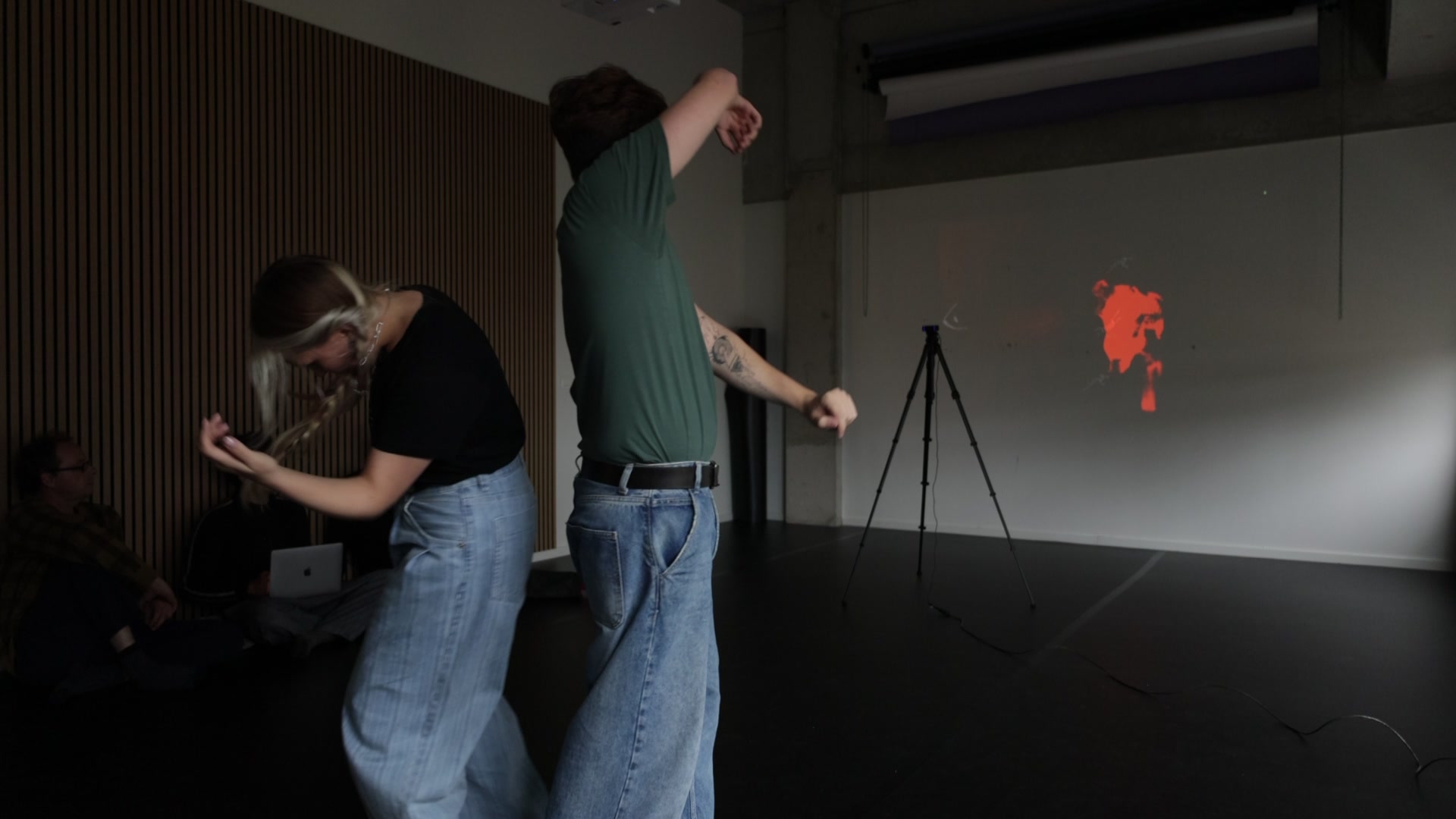
The Algorithmic Gaze, AI in Motion / Mariia Sulima and Kerem Kaysadi performing with the AI models, 2025. Photo by Frederik De Bleser.
Our open-source software Figment enables artists to process datasets, train models locally, and make results interactive.2 This approach creates a playful environment that supports the learning process and helps students build agency rather than dependency on external platforms. The challenge is whether the next generation of artists can effectively adopt these tools in their practice. Without a critical pedagogical framework, artists will default to corporate platforms regardless of available alternatives.
To support students in cultivating agency, as well as to test and refine our methodology, we developed two educational formats which we will describe in the following sections.
AI in Motion: Two-day performative workshop
In October 2025, we organized a two-day workshop at Sint Lucas Antwerpen during the Sint Lucas Antwerpen Research Group (SLARG) Research Week. Participants experienced the full craft AI loop by capturing motions, extracting skeletal pose data from the footage, training overnight, running models locally and sharing a creative output, all while reflecting on important aspects of AI such as bias, censorship, control, and longevity.
Unlike a standard educational setting, the week-long immersion allows students to focus entirely on this process without outside distractions.
The workshop started with a morning warm-up session focused on movement. Acknowledging that not all participants incorporate movement into their general practice, we used games to awaken the body in a simple and playful way. Then we used a short, guided improvisation to introduce different movement qualities, intensities, and leading points in the body from which to move. Transitioning to recording, we used “atmospheres” and “qualities” card decks to prompt improvisations, encouraging participants to expand their movement patterns. We recorded approximately 39,000 frames at 4K resolution.
The afternoon combined theory and practice, explaining AI terminology using metaphors (such as comparing model parameters to the knobs on a mixer panel), as well as teaching the use of Figment. We used the pix2pix model, a procedure that starts from a set of paired images (input + desired output), feeds them to two competing networks – one that generates fake outputs, and one that judges whether they look real – and trains them together until the generator consistently fools the judge.3
To prepare data for training, we applied pose segmentation using Google’s MediaPipe framework to extract body positions in three different formats: skeletal lines, skeletal dots, and a hands-only representation.4 Participants experimented with a pre-trained model while their own dataset trained overnight on cloud GPUs, yielding four models at 60 epochs after 6-8 hours of training.
Day two started with a sound-based warm-up showing the integration of audio and movement. We introduced exercises in deep listening and coordination. After the warm-up we explored the trained models together, discovering how the different segmentations affected the results. Skeletal representations were easier for the model to grasp, while hands-only segmentations forced the model to hallucinate the position of the rest of the body, producing more glitchy versions of the images. This glitch was not treated as an error, but as an aesthetic feature of the model, something impossible to achieve with guarded commercial systems.
Participants then formed groups and created short performances with their virtual avatars. As shown in Figure 1, these were not polished pieces but exploratory sketches that tested the results of this training and the boundaries between their own bodies and that of the AI.
A feedback session revealed two primary insights from the participants. Firstly, participants emphasized the importance of opening the body and mind to movement and sound before interacting with an avatar. Secondly, they noted the difficulty of staying fully present within their body when working with a technological set-up, since it introduces interruptions, requiring a switch in attention between performing and solving technical problems. These findings align closely with our own research challenges, validating the methodology’s relevance in educational contexts.
RAIVE: Six-day interdisciplinary immersion
Our week-long RAIVE AI Summer School adopts a broader interdisciplinary approach, mixing dance, music, and visual arts.5 Emerging artists collaborate on developing new pieces while learning to integrate AI tools into their practices.
The diverse backgrounds of participants lead to highly distinct projects that push beyond simple screen setups.
RAIVE’s pedagogical structure balances autonomy with expert coaching. Four coaches from different disciplines offer mentorship, workshops and lectures to help participants develop a piece that can cross into unfamiliar territory. Here, AI is but one new tool among many that can help in the creation of a piece.
Unlike a standard educational setting, the week-long immersion allows students to focus entirely on this process without outside distractions. To help with this immersion, each day of the summer school begins with a warm-up session, guided by a movement coach. This practice serves as a foundation for the rest of the day, ensuring that even when participants undertake technical work, they remain grounded in physical and sonic awareness.
The diverse backgrounds of participants lead to highly distinct projects that push beyond simple screen setups. For example, one group developed an audiovisual call-and-response performance called HANDS_OFF!, connecting a piano with a Max/MSP audio environment and generative visual model trained in Figment (using a similar overnight training pipeline). The piece functioned as a feedback loop: when the pianist lifted his hands from the keys, the system responded, reacting to the recorded sounds of the pianist and projecting AI-generated hands overhead. As the performance progressed, these virtual hands became increasingly unwieldy, sprouting extra fingers as the generative model drifted away from the anatomical constraints of the training data.
The public presentation at the end of the week gave participants a goal to work toward; not to present a polished piece but to show the results of a transdisciplinary process. The aim was to give audiences transparency into how things come together across disciplines and technologies.
RAIVE is becoming a platform that supports alumni to sustain their collaborations. We have witnessed how several groups continued developing their work and performed at different venues, festivals, and conferences. As this platform is still growing, we will try to support this process as much as possible in the form of coaching, networking, and offering spaces to work and perform.
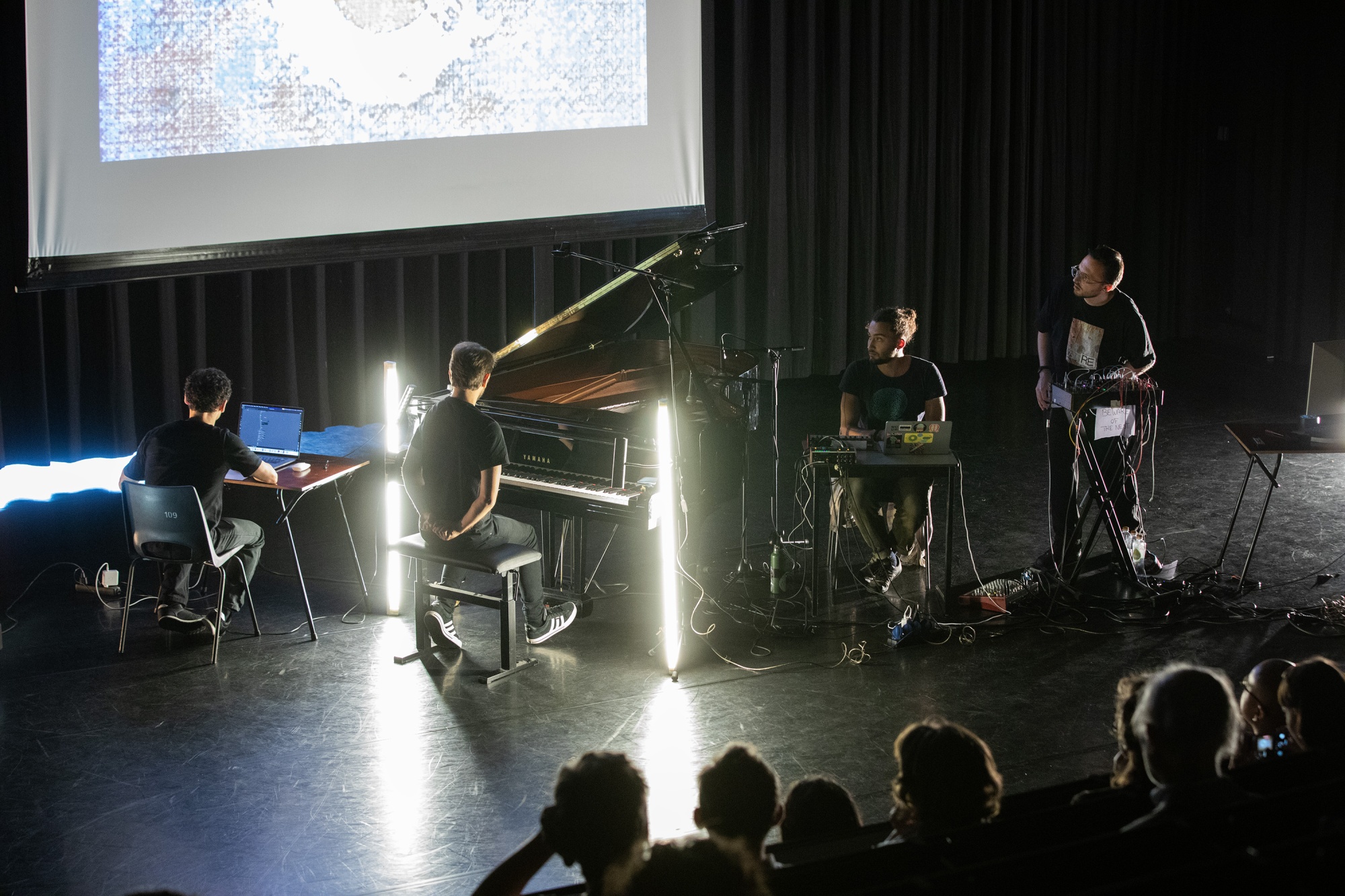
The Algorithmic Gaze and CREATIE, RAIVE AI Summer School / Daniil Hetman, Francesco Campora, Christian Johannes and Nigel Dubois performing HANDS_OFF!, 2025. Photo by Myrto Grigoriou.
Workshops as research validation
The workshop formats demonstrate how research and education reinforce each other. The formats allow us to test our craft AI methodology with diverse participants, revealing usability issues both in software and teaching. Do the metaphors land? Are participants comfortable with the warm-ups? How difficult is the pipeline for non-technical artists? Participant feedback directly informs our research.
Conversely, our research also shows that an alternative educational path around AI is viable. Locally runnable custom models can deliver quality and interactivity comparable to commercial systems, while maintaining full artistic control. When participants see that they can control every aspect of the AI, the question shifts from “will AI replace me?” to “how can I co-create with AI?” This challenges the narrative that the next generation of artists must accept dependency on commercial platforms.
Shifting the relationship with AI
Our work addresses a fundamental question in arts education: how do we prepare students for an AI-ubiquitous future without reducing them to consumers? The answer lies in shifting from consumption to creation. Participants see AI not as magic but as a technical tool they can build, train, and control. Experiencing the complete loop demystifies the 'black box' and shows they do not have to accept the corporate terms of service regarding access, pricing, or censorship. Craft AI actively resists the centralization of creative tools in corporate hands. By proving that locally trained models match commercial quality within realistic educational timeframes, we demonstrate that autonomy is achievable, not aspirational. An alternative path to AI exists, it works, and it can be taught.
+++
Frederik De Bleser (he/him, Belgium, 1978)
is a researcher and lecturer at Sint Lucas Antwerpen, where he coordinates the master’s degree in digital media. His research focuses on the connection between art and technology and the development of free software tools for artificial intelligence and data visualization. He also works as a freelance data visualization artist, creating projects for Belgian news and online democracy platforms.
Cèlia Tort Pujol (she/her, Catalunya, 1995)
is an oboist, performer and researcher. Her practice is based on how to integrate the oboe into new contexts of artistic creation. She leads workshops around collective creation and improvisation, and she is currently working on performative AI at Sint Lucas Antwerpen with the research group The Algorithmic Gaze.
Myrthe Bokelmann (they/them, Netherlands, 1998)
is a freelance dance maker, dance performer and researcher at Sint Lucas Antwerp. Aside from their artistic practice they do production work for various artists and performance festivals. Myrthe hopes to create and support art that is as honest and playful as possible.
Lieven Menschaert (he/him, Belgium, 1975)
is a researcher and lecturer at Sint Lucas Antwerp and LUCA school of arts. His main interest is in generative and computational design and therefore he sees AI and machine learning as the logical next step in a procedural generation practice.
Noten
- De Bleser, Frederik, Martina Menegon, and Lieven Menschaert. “I’m sorry I made you feel that way. Exploring empathy and well-being through virtual bodies and generative AI.” FORUM+, vol. 31, no. 2, 2024, pp. 20-25. ↩
- “The Algorithmic Gaze.” Figment, 2025, figmentapp.com. Accessed 15 Dec. 2025. ↩
- Isola, Phillip, et al. “Image-to-image translation with conditional adversarial networks.” Proceedings of the IEEE conference on computer vision and pattern recognition. 2017. ↩
- Lugaresi, Camillo, et al. “Mediapipe: A framework for building perception pipelines.” arXiv preprint, arXiv:1906.08172, 2019. ↩
- RAIVE AI Summer School is organized jointly by the research groups The Algorithmic Gaze and CREATIE, based at Sint Lucas Antwerpen and the Royal Conservatoire Antwerp respectively. RAIVE AI Summer School, 2025, raive.school. Accessed 15 Dec. 2025. ↩
Meer in dit thema
Future Shock Orchestra. Een laboratorium voor het uitvinden en bijwerken van instrumenten
Chiara Percivati
Conceptual, performative, personal: A curriculum
Yuki Okumura
Het uur van de aap. De rol van spanning, traditie en repertoire in de toneelschool
Clara van de Broek, Sara De Roo, Jan Joris Lamers
Meer uit dit dossier
Thinkering as method. Two educational laboratories at the nexus of research and artistic practice at Koninklijk Conservatorium Brussel
Jeroen Billiet
Voorbij regels, voorbij grenzen
Jaana Erkkilä-Hill
Meer uit dit nummer
Co-learning: Conversational, situated, and more-than-human pedagogies at Master’s level
Guus Vandeweerd, Anneleen Swillen
Embodied Theory
Anne-Lise Brevers
Mapping the Local. A collaborative pedagogical paradigm
Özgür Ilter, Allan Siegel