Dit artikel verscheen in FORUM+, pp. 16-17
The Winter School as a research laboratory. A pedagogical interruption in the curriculum
Ellen Gillard, Jori Galama
This article examines the Winter School as an intensive environment for artistic research and practice, where students experiment with methods and develop their position as artist-researchers under the guidance of experienced practitioners. Based on the workshop Am I Evil? we analyse how discomfort, friction, and pedagogical reciprocity strengthen learning and enable critical engagement with cultural, social, and political complexity.
Dit artikel onderzoekt de Winter School als intensieve leeromgeving voor artistiek onderzoek, waarin studenten onder begeleiding van ervaren onderzoekers experimenteren met onderzoeksmethodes en hun eigen positie verkennen onder begeleiding van ervaringsdeskundigen. Aan de hand van de workshop Am I Evil? analyseren we hoe ongemak, frictie en pedagogische wederkerigheid leerprocessen versterken en studenten kritisch leren omgaan met culturele, sociale en politieke complexiteit.
The Winter School is an intensive interdisciplinary programme that foregrounds artistic research within the curriculum of the Royal Institute for Theatre, Cinema and Sound (RITCS). As a course for third-year Bachelor’s and Master’s students in dramatic and audiovisual arts, it brings together students from different specializations for three weeks in parallel workshop tracks centred on an annually changing theme. A curator develops the conceptual framework and selects the coaches: artist-researchers who bring their own research into the workshops. In contrast to much of the curriculum, where final outcomes often take precedence, the Winter School explicitly emphasizes process. Students explore research methods, experiment collectively, and develop skills that extend beyond disciplinary competencies. It thus creates an intensive, temporary environment in which artistic research is not taught as theory, but shared in a concentrated, experience-based manner.
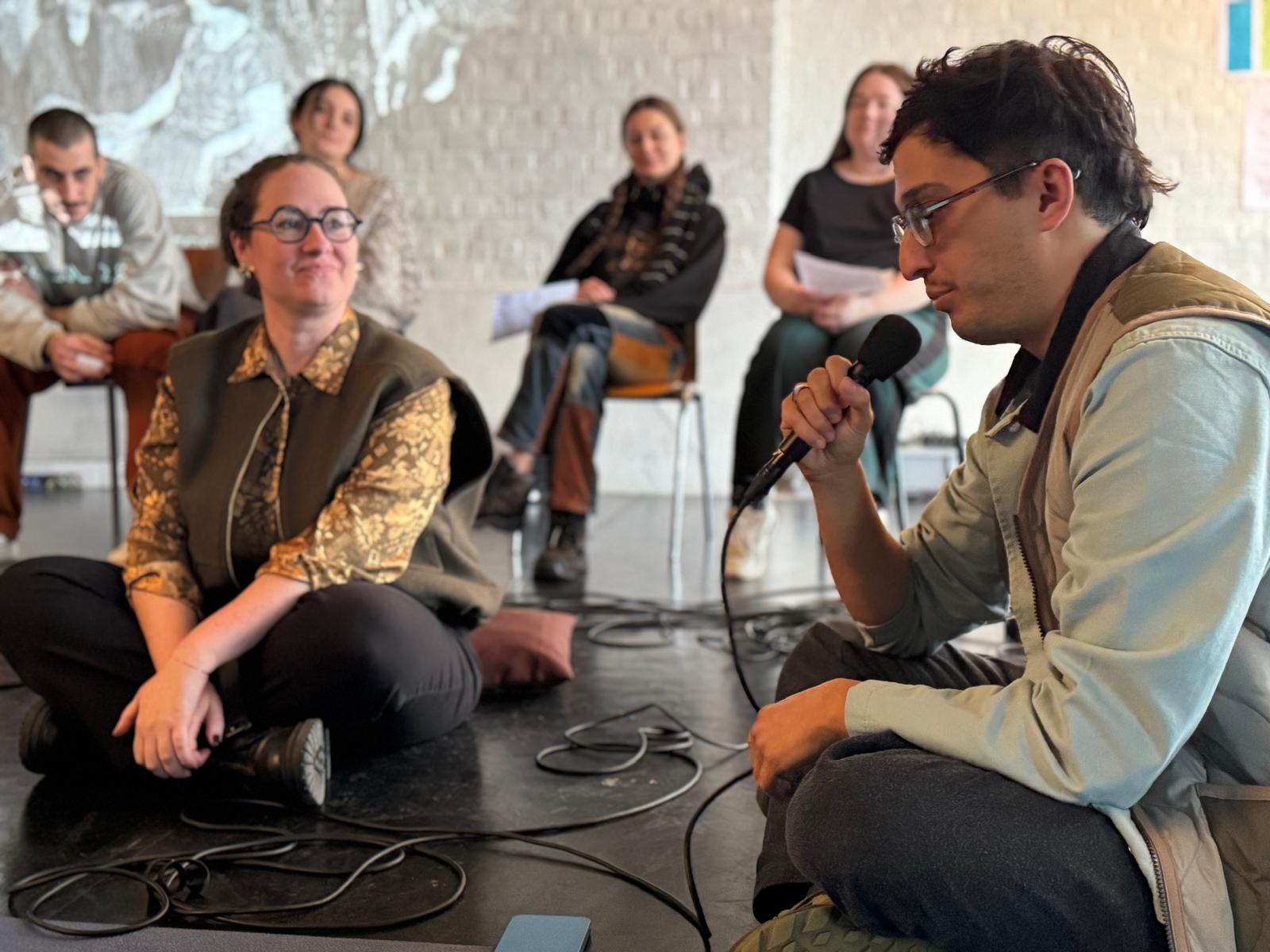
RITCS Winter School 2025: Simone Basani and Alice Ciresola address the group during the collective showcase. Photo by Tim Martens.
For us, artistic research is an essential component of students’ learning trajectories in higher arts education, as it enables them to connect their artistic practice to critical reflection and to adopt an inquisitive approach within that practice. By approaching their own work and that of others as research – formulating questions, developing methods, and examining their position – they shape an artistic voice that is both personal and socially engaged, along with capacities that support them throughout their careers. Our focus in this article, therefore, is not on whether artistic research should have a place in the curriculum – for us, this is a given – but on how it can be meaningfully embedded pedagogically in students’ trajectories and contribute to their development as artists.
To explore this question, the article focuses on the workshop Am I Evil? by researchers Simone Basani and Alice Ciresola, part of the Winter School 2025. Centred on the theme Voices and Silences, the Winter School examined different forms of speech and silence in personal, social, and institutional contexts. We present this workshop as an example that highlights several key themes and methods and offers points of departure for further development of the Winter School and the curriculum.
Case Study: Am I Evil?
The workshop Am I Evil? forms part of an ongoing artistic research project initiated in 2022. During archival research at the Royal Museum for Central Africa, Basani and Ciresola encountered the story of Jeanne Walschot, one of the first female collectors of African art in Belgium. In photographs, Walschot portrayed herself with looted objects (mostly Central-African), often caressing or cradling them. The researchers read these images as an embodiment of colonial and erotic power relations, prompting a shift in their research and leading them to develop new methods for exploring decolonial perspectives on eroticism. A key motivation was that eroticism, as Gloria Wekker argues, constitutes a repressed component of a society’s cultural archive, and, moreover, does not easily lend itself to being unlocked by conventional scholarly methods.1
Artistic research in the Winter School is not explained but lived and shared as a practice in progress.
Basani and Ciresola did not translate these insights into an academic theoretical framework, but shared them as a dynamic “research apparatus”, in which autofiction as a method plays a central role. This literary form has gained increasing recognition in recent years, offering a way of articulating complex and ambiguous cultural affects, and proved suitable within the Winter School. Students were invited to question their position within power structures by writing autofictional erotic narratives. They were introduced to the concept of the body as somatic archive (or somathèque, following philosopher Paul B. Preciado)2 and worked with targeted writing exercises that engage corporeality. Throughout, the coaches sought to balance safety and challenge: public sharing, for example, was never mandatory and could take multiple forms (like students reading each other’s work out loud), and potentially sensitive or triggering topics were mentioned in advance.
Another recurring method was peer-to-peer rewriting: students rewrote each other’s texts and returned them as what Basani and Ciresola call a “gift”: the aim was not to criticize but more to generously give rise to new ideas. These interventions activated underdeveloped narrative threads and unconscious layers, making writing both a collective and potentially transformative practice.
Drawing on the distinction between methods and methodology, as outlined by Falk Hübner and Joost Vanmaele,3 this research practice followed a methodological logic in which methods are deployed situationally and fluidly to find language for erotic experiences. The application of these methods was not fixed in advance: decisions regarding pace, public sharing, intervention, and intensity – for instance, when topics such as sexual violence and rape emerged – were continuously attuned to the group. Students thus learned not only specific research methods, but also how to engage with them critically and responsively within an evolving research practice.
Learning through friction and discomfort
In this context, tensions and discomfort also became visible, for instance during a conversation with the Belgian-Italian director Loredana Bianconi about the (sexual) relations between white Italian migrant workers and Black women from various African countries in the twentieth century. This brought to the fore strongly divergent, generationally shaped perspectives on colonial legacies. The resulting discomfort was not avoided by the coaches, but rather made explicit. A critical and personal intervention by a student the following day, for example, was encouraged and incorporated into a group discussion – a moment that, according to Basani, significantly stimulated the students’ working processes.
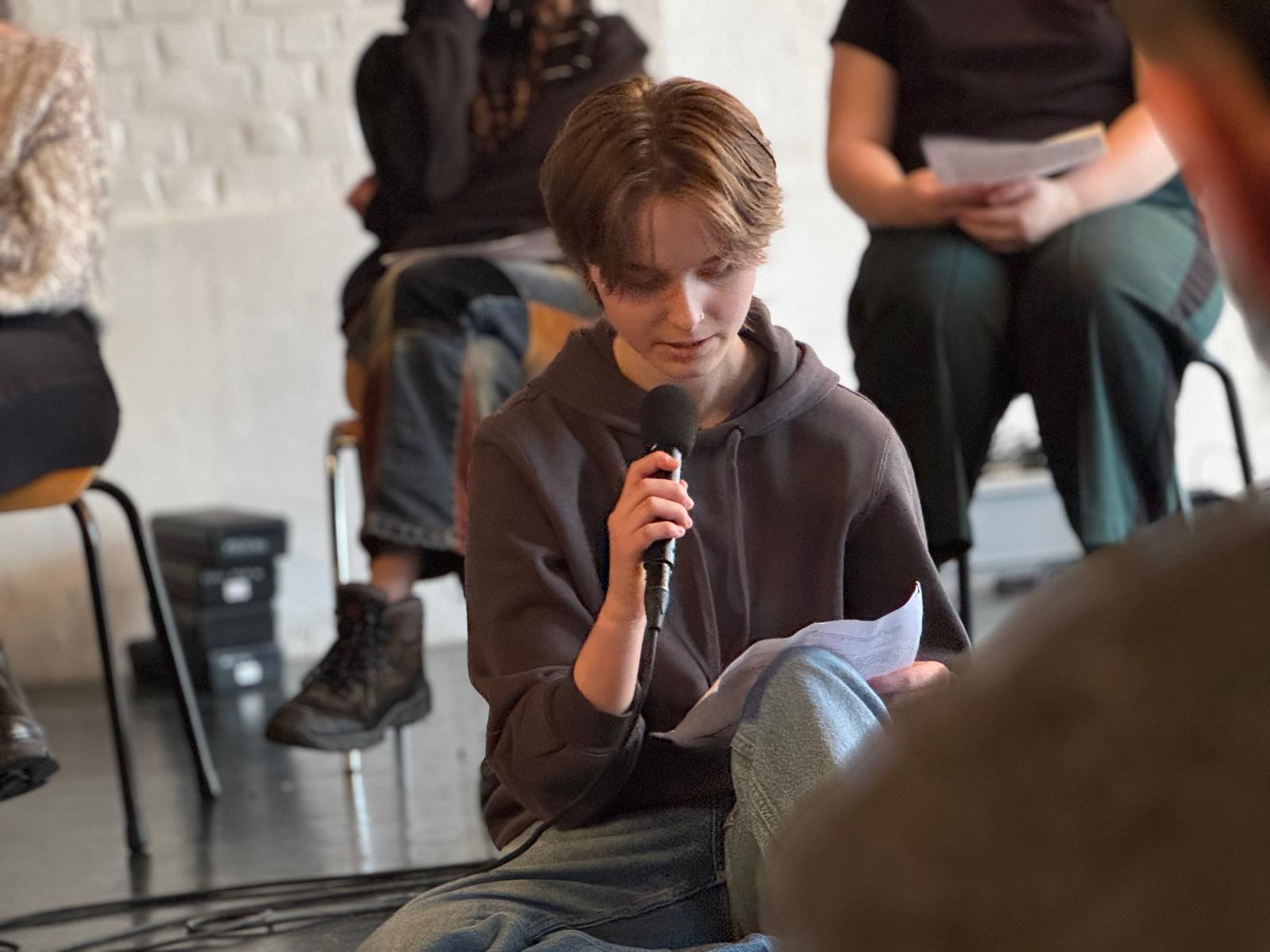
RITCS Winter School 2025: students presenting their work during the collective showcase. Photo by Tim Martens.
At the same time, it became clear from a pedagogical perspective that embedding the Am I Evil? workshop in the RITCS Winter School brought together a broader range of participants than previous editions of the workshop, which was organized through open calls. Some students were already familiar with decolonial thinking through personal experience or prior education; others indicated that their assumptions were fundamentally challenged by the workshop. This heterogeneity placed significant demands on the coaches, who, thanks to their situated research methodology, were able to work with these differences without simplifying the research process.
It is precisely this confrontation – temporarily dislodging students from their familiar educational context and bringing them together in intensive research environments – that is a core design feature of the Winter School. One significant outcome of this workshop was an increased awareness among students of their position in relation to colonial legacies; an insight that, even when it does not immediately translate into their graduation work, leaves lasting traces in their thinking and subsequent artistic choices.
By temporarily suspending the regular curriculum, space is created for friction, discomfort, and learning through artistic research.
These observations highlight that the Winter School is not only an intensive moment of learning and production, but also functions as a pedagogical interruption in which discomfort is consciously permitted. By temporarily placing students in a research environment that differs from their usual practices, frictions emerge between prior knowledge and unfamiliarity, expectations and open processes, and making and thinking. We do not regard this productive discomfort as a side effect, but as a constitutive element of the Winter School. In this way, the Winter School can function as a space where underexposed themes can be addressed and where new perspectives, methods, and forms of research enrich the curriculum.
At the same time, we emphasize that this productive discomfort should not simply arise from students encountering artistic research for the first time in their curriculum. To be most effective, it should build on prior experience with research-based methods and practices. This points to the need for a clear learning trajectory for artistic research within the curriculum. In our view, the Winter School can be most meaningful when artistic research is embedded in a trajectory throughout the curriculum – an aspect that remains to be further developed.
Pedagogical reciprocity
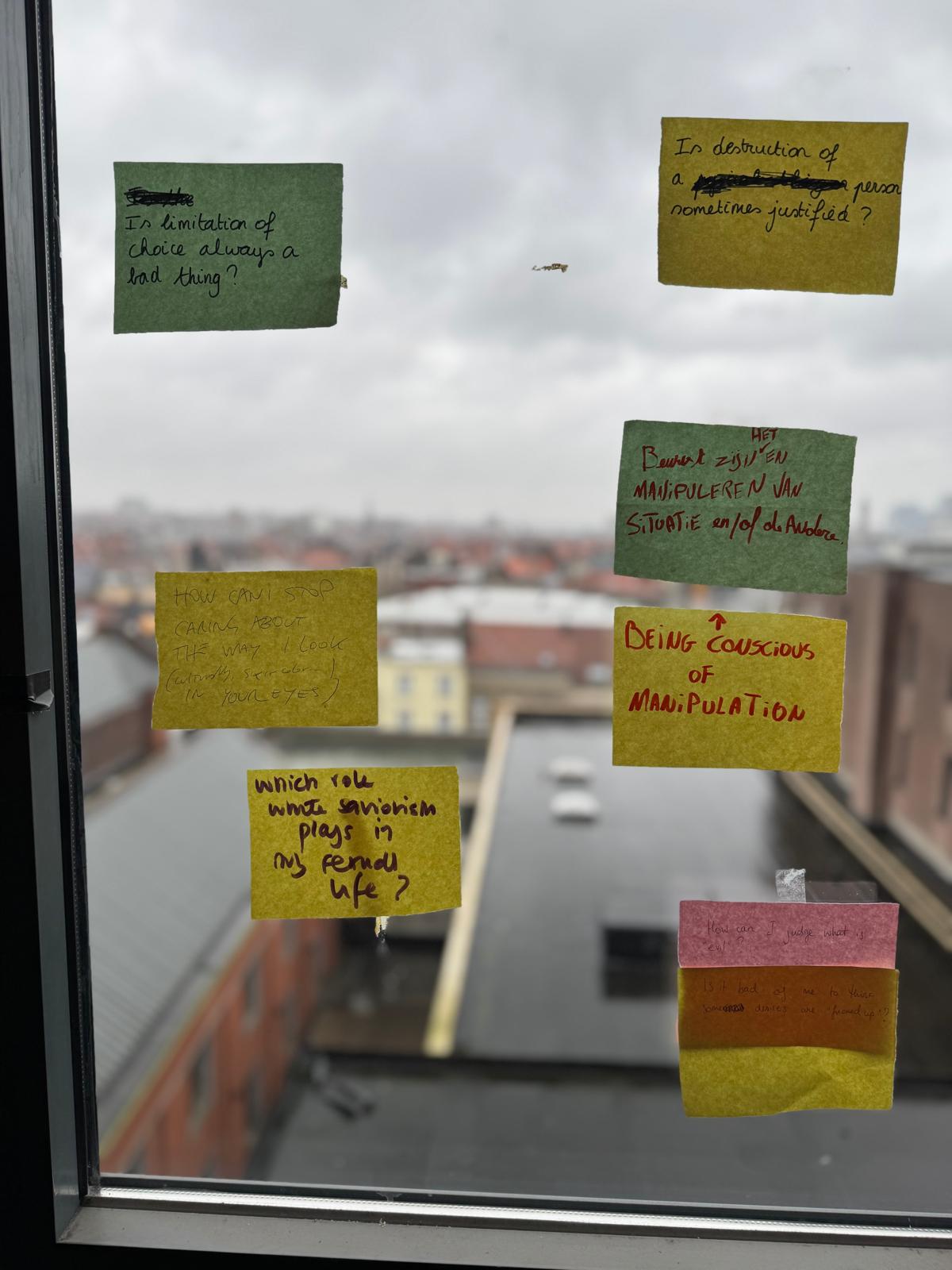
RITCS Winter School 2025: collective working session Am I Evil? Photo by Tim Martens.
The case study also shows that artistic research within the Winter School is not used to tick off predefined objectives, but develops in dialogue with students. We therefore seek coaches who are not only strong artist-researchers, but can also work pedagogically with openness and uncertainty. A key aim for future editions is to create a learning environment in which students are approached not only as learners, but also as co-thinkers and “resonance fields” within the coaches’ research. Their questions and perspectives can challenge and sharpen the research, requiring coaches to embrace a certain vulnerability, an attitude that aligns with Jacques Rancière’s notion of the “ignorant schoolmaster”.4 The case study demonstrates how this reciprocity enriches both student learning and the coaches’ research. For future editions, we therefore aim to explicitly foreground this dynamic as a pedagogical question in our preparatory conversations with the coaches: how can coaches create space for such interplay in their guidance? In doing so, the Winter School can foster an inquisitive disposition in students while generating new insights, questions, and methods through interaction for the coaches.
More than an intensive workshop format, the Winter School can therefore function as a catalyst within the curriculum: a place where experiment, discomfort, and reciprocity open up new perspectives and prepare students for artistic practices in which making, thinking, and social engagement are inextricably intertwined.
Acknowledgements
We thank Simone Basani, Alice Ciresola, and Els Moors for their guidance of the Am I Evil? workshop strand during the Winter School 2025, and Simone Basani for the conversation that informed this article. We also thank Tim Martens for his longstanding role in the production and organization of the Winter School, and the other coaches of this edition (Julia Clever, Tom Dupont, and Arkadi Zaides) for bringing their artistic and pedagogical expertise to the parallel workshop strands.
+++
Ellen Gillard
was curator of the Winter School 2025 and is currently researcher and head of Research at the Royal Institute for Theatre, Cinema and Sound, Brussels (RITCS).
Jori Galama
is Assistant Policy Officer for Research at RITCS. They are also active as a director and creative producer of documentaries, and as a writer of fiction and art criticism.
Noten
- Wekker, Gloria. White Innocence: Paradoxes of Colonialism and Race. Duke University Press, 2016. ↩
- Preciado, Paul B. Dysphoria Mundi. Fitzcarraldo Editions, 2022. ↩
- Hübner, Falk, and Joost Vanmaele. “Op weg naar een vruchtbare vallei: Over methoden en methodologieën in artistiek onderzoek.” FORUM+ voor onderzoek en kunsten | for research and arts, vol. 27, no. 3, 2022, pp. 4-16. ↩
- Rancière, Jacques. The Ignorant Schoolmaster: Five Lessons in Intellectual Emancipation. Stanford University Press, 1987. ↩
Meer uit dit dossier
De academische carrière van de rupsband. Middelen voor voortbeweging – Betekenis van vooruitgang
Bert Willems
De kunstschool in transitie
Kevin Voets
Meer uit dit nummer
Embodied Theory
Anne-Lise Brevers